Physical activity and cancer
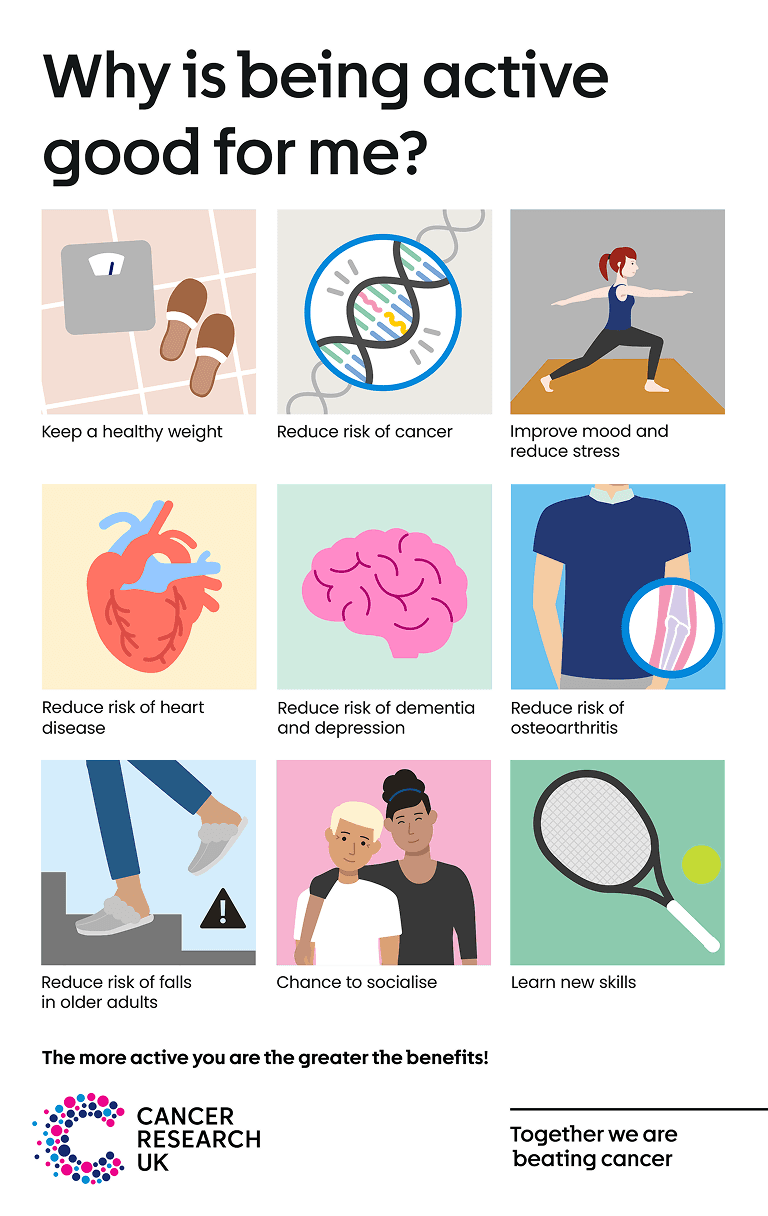
Regular exercise and physical activity can be good for your physical and mental health. The benefits of physical activity include:
Keeping a healthy weight
Reducing the risk of cancer
Improving mood and reducing stress
Reducing the risk of heart disease
Reducing the risk of osteoarthritis
Reducing the risk of dementia and depression
Reducing the risk of falls in older adults
Socialising
Learning new skills
You don’t need to become a marathon runner or join the gym to be more active – you don’t even have to leave your home. Anything that gets you a bit warmer, slightly out of breath, and your heart beating faster counts. That can include housework, gardening or a brisk walk. Any amount of activity is good for you, but it’s good to build up your activity levels over time. Find out about how to be more active and how much activity you should aim for.
Being active can help you keep a healthy weight and reduce your risk of cancer. Even adding small amounts of activity and exercise into your daily routine can help you lose weight or keep a healthy weight.
Keeping a healthy weight lowers your risk of 13 different cancer types. This includes two of the most common types of cancer (breast and bowel) and three of the hardest to treat cancers (pancreatic, oesophageal and gallbladder).
Check out our 5 ways forward for a healthy weight.
Learn more about weight and cancer risk.
As well as helping you to keep a healthy weight, being physically active may also lower your risk of breast cancer and bowel cancer in ways that aren’t directly related to weight. But it isn’t clear yet how much your risk is reduced.
Scientists have some theories on how doing a lot of physical activity may prevent breast cancer and bowel cancer. Many of these benefits are also linked to being a healthy weight.
Being active and being a healthy weight can reduce the levels of oestrogen and insulin in the body. These hormones can encourage breast cells to divide more often, which increases the risk of cancer.
Being active can help your immune system to work at its best. This means the body can be better at spotting, and dealing with, cells which could go on to become cancer.
Being active helps move food through our bowel faster. This means anything harmful in the food we eat and the waste we excrete (poo) spends less time in our bowel. This may help to prevent bowel cancer.
Being active and being a healthy weight reduces chronic inflammation. Too much inflammation can cause our cells to divide more often, increasing cancer risk.
Overall, the more active you can be, the more you can lower your risk of cancer – especially breast cancer and bowel cancer. So even if you start by doing small amounts of activity, you can build it up over time.
Sitting or lying down for long periods of time throughout the day (being inactive) isn’t good for our health. Even people who do lots of exercise might spend too much time being inactive during the rest of the day.
If you do spend long periods of time being inactive at home or at work, it’s a good idea to get up and move about regularly if you are able to do so. Try going for a walk on your lunch break, doing bits of housework, regularly going to get a drink of water, or moving on the spot when taking phone calls. There are also seated exercises you can do to move the body.
If you have limited mobility, or live with chronic pain or illness, look for options that could work for you. Some people find using mobility aids helps, and many areas have different groups locally that support people with different needs to exercise. If you're unsure where to start, a healthcare professional such as a pharmacist, nurse, physiotherapist or GP may be able to help you find activities that work for you.
It’s not clear yet if spending lots of time sitting or lying down increases the risk of cancer. This is an area of research that is still developing, and we need more good quality research that considers the impact of inactivity, physical activity and weight on the risk of cancer.
Find out how to build more activity into your dayLast reviewed: 14 Oct 2026
Next review due: 14 Oct 2029