Speaking after a laryngectomy
During your operation, your surgeon separates your windpipe (trachea) from your mouth and food pipe. Then, they make a hole in your neck, called a stoma that you breathe through.
With a breathing stoma, you can no longer force air from your lungs through your mouth to speak. So you have to learn new ways of communicating.
Read more about when and how you might have a laryngectomy
You see a speech and language therapist before your operation. They will discuss the different ways you can communicate after your surgery. You might also be able to meet someone who has had similar surgery. Or you can watch videos of people communicating after their laryngectomy.
The type of communication you can use will depend on:
your situation
the type and amount of surgery you have
what you prefer
There are 3 main ways to help you make sounds and learn to speak again. These are:
voice prosthesis or tracheo oesophageal puncture (TEP)
oesophageal speech or swallowing air
electrolarynx
The main aim is to keep your life as normal as possible. This means helping you to feel confident speaking with people in everyday situations, including using the telephone. Some options are likely to be better suited to your work and home situation than others.
During your surgery, your surgeon makes an opening between your windpipe and food pipe (oesophagus) and puts a small valve into it. This allows you to make sounds.
Surgeons can sometimes do this at the same time as a laryngectomy. Or you can have it at a later time. But this type of surgery isn't suitable for everyone.
You might also hear this procedure called surgical voice restoration.
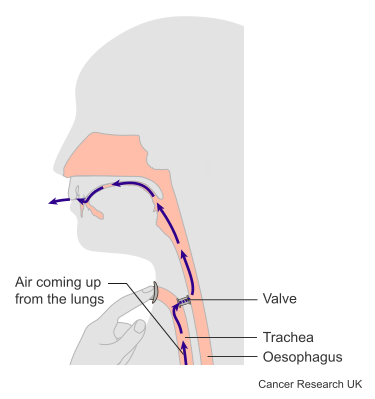
Read more about voice prosthesis
You create speech by moving air down into the food pipe (oesophagus) and then back up into your mouth. You don't need any equipment with this way of communicating.
Read more about oesophageal speech
An electrolarynx (electronic larynx) is a battery operated machine that produces sound for you. They are usually about the size of a small electric razor. You hold the machine against your neck, or fit a small tube into the corner of your mouth.
Other ways to communicate include:
using a notepad and pen that you can carry around with you
laptop computers
smartphones
tablet computers
electronic notebooks
keyboards
Several small portable machines are available. Your speech and language therapist can advise you on which might suit you best.
You might find learning a new way of speaking difficult at first. But over time this does improve. Your speech and language therapist will support you as you learn different ways to communicate.
It may also help to speak to someone who uses the same type of communication that you have chosen. The National Association of Laryngectomee Clubs (NALC) is an organisation that offers support.
Visit the National Association of Laryngectomee Clubs (NALC) website
Last reviewed: 20 Sept 2024
Next review due: 20 Sept 2027
A breathing stoma is a hole in your neck that you breathe through after surgery to your larynx. You might have a temporary stoma or a permanent stoma.
There are several organisations, support groups, books, videos and other resources to help you cope with laryngeal cancer and treatment.
Laryngeal cancer is cancer that starts in the voice box (larynx). It is a type of head and neck cancer.
Laryngeal cancer is cancer that starts in the voice box (larynx). It is a rare type of head and neck cancer



