
About Cancer
Chronic lymphocytic leukaemia (CLL) is a type of cancer that affects the blood, bone marrow and white blood cells called lymphocytes. It tends to develop very slowly and not everyone needs treatment for it straight away.
There are different types of leukaemia and the treatment you need depends on which type you have.
Leukaemia is a blood cancer. Your bone marrow makes . The bone marrow is the soft, spongy tissue of the inner part of some of your bones.
In most types of leukaemia, abnormal are made in the bone marrow. These cells can get into the bloodstream and circulate around the body. They do not develop properly and so do not work normally. For example, they don't give you the protection from infection that they should. There are too many of these abnormal white blood cells. They might stop the bone marrow producing enough healthy blood cells.
They can also build up in the and and cause swelling.
There are different types of leukaemia. They are divided into two main groups:
acute leukaemia
chronic leukaemia
Acute leukaemias tend to develop quickly and get rapidly worse if they are not treated. Chronic leukaemias develop slowly and tend to get worse slowly, over a long time.
In chronic leukaemia the white blood cells are almost fully developed, but are not completely normal. They still work, but not as well as they should do at fighting infection. Your body makes too many of these abnormal white blood cells.
Get information about the other main types of leukaemia
To understand how and why leukaemia affects you as it does, it helps to know more about blood cells.
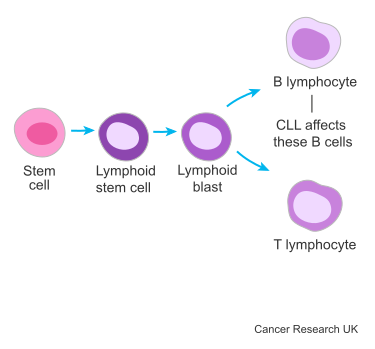
All blood cells start as the same type of cell, called a stem cell.
This stem cell then develops into:
myeloid stem cells, which become white blood cells called monocytes and neutrophils (granulocyte), red blood cells and platelets
lymphoid stem cells, which become white blood cells called lymphocytes
The diagram below helps to explain this.

The type of chronic leukaemia you have tells you which type of white blood cell has become cancerous. In chronic lymphocytic leukaemia (CLL), it is the lymphocyte white blood cells that are cancerous. CLL affects the B lymphocytes.
White blood cells help to fight infection. If you have abnormal white blood cells they cannot fight infection so well. You may get a lot of infections, which may be difficult to get rid of.
When too many white blood cells are made, they take up much more room in the bone marrow than they would normally. This means that there is not enough space for making normal red blood cells and platelets. Red blood cells carry oxygen round the body. If you don't have enough of these, you have anaemia. This can make you tired and breathless.
Platelets are vital for normal blood clotting. If you do not have enough platelets, you will have bleeding problems such as nosebleeds, very heavy periods or a fine rash of red spots caused by bleeding into the skin (petechiae).
Blood cells normally die when they are worn out. In some types of chronic leukaemia the blood cells are not over produced but they don't die when they are worn out. So, there are too many white blood cells than is normal.
Find out more about blood cells and what they do
The two most common types of chronic leukaemia are:
chronic myeloid leukaemia (CML)
chronic lymphocytic leukaemia (CLL)
The difference is the type of white blood cell that has become cancerous.
In CLL the abnormal cells develop from the lymphoid blood stem cells. The cancerous white blood cells are B lymphocytes, also called B cells. Lymphocytic in CLL is pronounced lim-fo-sit-ik.
In CML, the abnormal cells develop from the myeloid blood stem cells. So the cancerous white blood cells are myelocytes. These cells are sometimes called granulocytes.
You may hear this type of leukaemia called chronic granulocytic leukaemia (CGL). Myeloid is pronounced my-el-oyd and granulocytic is pronounced gran-you-low-sit-ik.
If you are looking for information about chronic myeloid leukaemia, this is not the right section for you.
Get more information about chronic myeloid leukaemia
Rarely, CLL can change over time into another type of leukaemia called prolymphocytic leukaemia. Doctors call this transformation. Sometimes prolymphocytic leukaemia is diagnosed in people who have not had CLL.
Advanced CLL can sometimes develop into a cancer of the lymphatic system (a lymphoma). This is called Richter's syndrome. Between 2 and 10 out of every 100 people (2-10%) with CLL develop Richter's syndrome.
Read more about Richter's syndrome
Hairy cell leukaemia is a type of chronic leukaemia that is rarer than CLL or CML. The leukaemia cells have outgrowths that look like tiny hairs on their surfaces. These can be seen under a microscope and give this type of leukaemia its name.
Read more about hairy cell leukaemia
Small lymphocytic lymphoma (SLL) is very similar to chronic lymphocytic leukaemia.
SLL and CLL develop when B cells grow out of control. The abnormal B cells don’t work properly. They build up in different parts of your body.
In CLL, many of the abnormal B cells are in the blood and bone marrow. So doctors call it leukaemia. In SLL the abnormal lymphocytes are mainly in your . So doctors call it lymphoma.
Treatment for CLL and SLL is the same.
Around 3,800 people are diagnosed with chronic lymphocytic leukaemia in the UK each year. CLL is by far the most common type of chronic (slowly developing) leukaemia. Not everyone with CLL needs treatment straightaway. Some people don’t ever need treatment.
CLL is more common in older people and is rare in people under 40. Men are more likely to develop CLL than women. We don't know why that is.
Although leukaemia is the most common type of children's cancer, leukaemia in children is nearly always acute leukaemia – either acute myeloid leukaemia or acute lymphoblastic leukaemia. Chronic leukaemia is very rare in children.
Read more about acute lymphoblastic leukaemia in children
Symptoms of CLL can include swollen glands, weight loss and infections that don't get better. Many people with CLL don't have any symptoms.
We don’t know what causes most cases of CLL. But there are some factors that may increase your risk of developing it.
You usually start by seeing your GP and they might refer you to a specialist and organise tests. Find out more about tests and screening for CLL.
Your doctor can usually diagnose CLL by doing a number of checks on your blood sample cells. These are called immunophenotyping tests. You then may have other tests to find out more information about your CLL.
Last reviewed: 25 Sept 2024
Next review due: 25 Sept 2027



