Non melanoma skin cancer
Basal cell carcinoma (BCC) is also called basal cell skin cancer. It develops from basal cells found in the deepest part of the outer layer of the skin (the epidermis).
Basal cells are a type of keratinocyte. Keratinocytes are the main skin cells in the epidermis. So basal cell carcinoma (BCC) is a type of keratinocyte carcinoma.
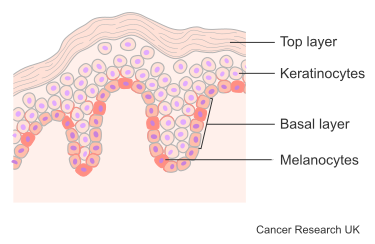
The two main groups of skin cancer are non melanoma skin cancer and melanoma skin cancer. BCC is a type of non melanoma skin cancer. They are different from skin cancers which start in skin cells called melanocytes.
Find out more about melanoma skin cancer
Basal cell carcinoma (BCC) is the most common type of non melanoma skin cancer. Around 75 out of every 100 non melanoma skin cancers (around 75%) are BCCs.
BCC’s can look different. They might be:
a smooth firm lump
a patch of scaly skin
an area of shiny skin that looks like a scar
They can appear differently on black or brown skin and may look like a dark coloured growth. This can be mistaken for a mole.
Find out more about what a BCC may look like
BCCs are most likely to develop on areas of the skin which are most exposed to the sun. But they can develop all over the body.
It's very rare for BCC to spread to another part of the body to form a . But it's possible to have more than one basal cell cancer at any one time. And having had BCC in the past increases your risk of getting another.
There are different types of BCC. Each type can look and behave differently. They include:
nodular basal cell carcinoma – this is the most common type
superficial basal cell carcinoma
infilitrative basal cell carcinoma - also known as sclerosing or morphoeic basal cell carcinoma
pigmented basal cell carcinoma
Basosquamous carcinoma is a rare type of non melanoma skin cancer. This is a mixture of basal cell carcinoma and .
Doctors can describe BCCs as high risk or low risk:
High risk means that the cancer is more likely to come back after you have treatment. And very rarely, may spread to other parts of the body.
Low risk means that the BCC is less likely to come back.
Doctors decide on whether a BCC is a high risk or low depending on:
where it is on the body
how big it is
how clear and even the edges (borders) are
how many times you have had treatment before
how it is growing - for example, is it a lump or is it growing downwards into the skin
how deep it is in the skin
Your doctor considers other factors to diagnose a BCC as low or high risk. For example:
how well your works
if you have had previous to the area
if you have a condition called
Some GPs have had special training and are able to diagnose and treat BCC. So you might not need to see a skin specialist at the hospital.
Tests to diagnose include:
a physical examination of your skin
looking closely at your skin with a special instrument (dermatoscope)
taking photographs of abnormal area of skin
taking a sample () of the abnormal area
Find out more about getting diagnosed with non melanoma skin cancer
For low risk BCC, your GP might be able to treat you rather than referring you to a specialist. They will discuss the different treatment options with you. Or they might refer you to a skin specialist at the hospital.
For high risk BCC, your GP will refer you to a . This is a team of doctors and other professionals who discuss the best treatment and care for you.
There are two levels of MDTs for non melanoma skin cancer:
The Local Hospital Skin Cancer MDT is usually in cancer units in district general hospitals. This team discusses your treatment if you have a high risk BCC.
A Specialist Skin Cancer MDT is usually in larger hospitals that have cancer centres or plastic surgery centres. This team might discuss your treatment if you need specialist treatment for your BCC.
Read more about referral to see a specialist
The treatment you have for BCC depends on:
the size of the BCC
where it is on your body
the type of BCC
whether you have had any treatment in the past
your general health and level of fitness
your personal wishes
Your doctor will discuss your treatment options with you. And tell you about the benefits and the possible side effects.
Surgery is the main treatment. There are different types of surgery.
If your GP has specialised training, then they can do an excisional biopsy. This is when the doctor removes the skin cancer and some of the surrounding healthy . This helps them diagnose the cancer at the same time as treating it.
This surgery is also called curettage and cautery (C and C). Your doctor cuts away the cancer and uses an electric needle to kill any cancer in the surrounding tissue. This is mainly a treatment for low risk BCCs.
Your GP may also do cryosurgery to remove the BCC. Your doctor puts liquid nitrogen on to your skin. The liquid freezes the area. It turns white as it freezes. After a few minutes the liquid nitrogen dissolves and the area thaws.
If you have a high risk BCC, then you may need a wide local excision. You have this operation in hospital.
Your doctor removes a large area of tissue. You may then need a or flap to replace the skin that the doctor removes.
A surgeon might need to replace the area of skin if they remove a large area. This is called a skin graft or skin flap. A or specialist does this operation.
Find out more about these surgeries
Your doctor might offer Mohs surgery if you have a high risk BCC.
It is a treatment option if your BCC is in a high risk part of your body such as your face or hands. And if it is difficult to clearly see the edges of the cancer.
Mohs surgery is also an option if your BCC has come back after previous treatment.
Find out more about Mohs surgery
Radiotherapy uses high energy rays similar to to destroy cancer cells.
You may have radiotherapy to treat a BCC if surgery is not possible. It is also a treatment for deeper cancers, large BCCs or alongside other treatments.
You usually have a type of radiotherapy called electron beam radiotherapy to treat skin cancers. Your radiographers attach special parts, called applicators, to the radiotherapy machine. These help direct a beam of particles called electrons close to the surface of the skin.
You may have a one off treatment. Or treatment every day from Monday to Friday, for up to 6 weeks.
Find out more about having radiotherapy
Your doctor might offer you a cream to put on the skin cancer. This might be an option if you have low risk BCC and you can’t or don’t want to have surgery.
There are different types of creams.
Imiquimod cream is a type of . It helps your immune system produce natural substances which help fight BCC.
You put on this cream before going to bed. You usually put it on 5 days a week for 6 weeks.
Find out more about imiquimod cream
A chemotherapy drug called fluororacil (5FU) comes as a cream called Efudix.
Usually, you put on the cream once or twice a day for 3 to 4 weeks. Depending on where the skin cancer is, you might have waterproof dressings to put over the cream to keep it in place.
Find out more about chemotherapy cream
Photodynamic therapy (PDT) is a cancer treatment. You have a drug that makes cells sensitive to light. Then the doctor shines a particular type of light on the treatment area. This destroys the cancer cells.
Your doctor might suggest PDT if you have a low risk BCC on the top surface of your skin. Doctors call this superficial BCC. It might be an option if your BCC is in:
an area where the skin doesn’t heal very well
an area of your body where a surgical scar might be more noticeable
several places or covers a large area
You might also have PDT for a type of BCC called nodular BCC. This is an option if the BCC is thin, and other treatments are not possible.
Find out more about having PDT
Targeted cancer drugs work by targeting the differences in cancer cells that help them to grow and survive.
Vismodegib (Erivedge) is a type of targeted drug called a . It targets a group of proteins known as the hedgehog pathway. So, it is also called a hedgehog pathway blocker. Vismodegib as a tablet that you swallow.
Find out more about cancer growth blockers
Vismodegib has a drug license for BCC. But the National Institute for Care Excellence (NICE) and the Scottish Medicines Consortium (SMC) have not recommended it as a skin cancer treatment. So, it is not widely available in the UK.
Vismodegib might be available through the cancer drugs fund in England if you have lots of BCCs. But it can be difficult for doctors to prescribe this treatment on the NHS.
Read more about targeted and immunotherapy for skin cancer and their availability in the UK
Being diagnosed with skin cancer can be a shock. Even if treatment is likely to cure you, you may feel worried or sad. Talking about your feelings can help.
You may have a small scar after treatment. This may not affect you very much. But you might have a skin graft or a scar on a very visible part of your body. This can affect how you feel about yourself.
Read more about coping with non melanoma skin cancer
After treatment for skin cancer, you are more at risk of developing another skin cancer. So it’s important to keep an eye on your skin and protect it when out in the sun.
It may help to remember that simple treatments cure nearly everyone diagnosed with BCC. And it’s rare for low risk BCCs to come back.
Find out more about looking after your skin after having skin cancer
Last reviewed: 07 Jul 2026
Next review due: 07 Jul 2029
There are many different types of surgery for non melanoma skin cancer. The surgery you have depends on the type of skin cancer you have.
The 2 main types of non melanoma skin cancer are basal cell carcinoma (BCC) and squamous cell carcinoma (SCC). Rarer types include Merkel cell carcinoma, sebaceous gland cancer and Kaposi's sarcoma.
Non melanoma skin cancer includes basal cell skin cancer, squamous cell skin cancer and other rare types.
Non melanoma skin cancer includes basal cell carcinoma, squamous cell carcinoma and other rare types. They tend to develop most often on skin that has been exposed to the sun.

About Cancer generously supported by Dangoor Education since 2010. Learn more about Dangoor Education


Search our clinical trials database for all cancer trials and studies recruiting in the UK.

Connect with other people affected by cancer and share your experiences.

Questions about cancer? Call freephone 0808 800 40 40 from 9 to 5 - Monday to Friday. Alternatively, you can email us.
