TNM and number stages
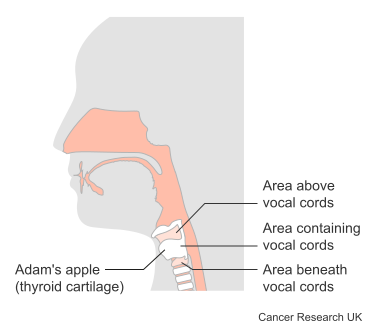
Staging of cancer of the larynx is complex. There are 3 parts of the larynx and doctors stage each part separately. Each part is surrounded by slightly different structures and tissues in the voice box.
This page is about cancer in the area above the vocal cords (supraglottis).
Read about staging for cancers in other parts of the larynx
Your doctor might use clinical or pathological staging to stage your cancer.
Your doctor stages your cancer after examining you and looking at test and scan results. Doctors use clinical staging if you don’t have surgery straight away.
Your doctor stages your cancer by using the tissue removed during the operation. We have included clinical staging on this page. Staging in general can be quite complex. Speak to your doctor or specialist nurse for more information. They can help you understand more about your individual stage.
Tumour (T) describes the size of the tumour and how far it’s grown in the nearby area.
Tis means tumour in situ. The cancer is very early. It is in the top layer of cells that line the area above the vocal cords and has not spread into deeper layers.
T1 means the cancer has grown deeper but is only in one part of the supraglottis. The vocal cords can move as normal.
T2 means the cancer is in more than one part of the supraglottis or the vocal cords (glottis) or the area outside the supraglottis such as the lining that covers the base of the tongue (mucosa). The vocal cords are still able to move normally.
T3 can mean one or all of the below. The cancer:
is still in the voice box (larynx) and has stopped a vocal cord from moving (your doctor may call this vocal cord fixation)
has grown into nearby areas such as an area behind the voice box called the post cricoid area, an area of fat in front of the epiglottis called the pre epiglottic space (the epiglottis is a flap of tissue that closes the windpipe while you're eating. It prevents food from entering your airway), a fat filled space on either side of the voice box, called the paraglottic space
has grown into the inner part of the cartilage that protects the vocal cords in the front (thyroid cartilage)
T4 is divided into 2 stages:
T4a means one or all of the below. The cancer has grown:
through the outer part of the thyroid cartilage
into tissues outside the voice box such as the windpipe, soft tissues of the neck, deep muscles of the tongue, the thyroid gland or food pipe (oesophagus)
T4a cancer of the larynx is also called moderately advanced local disease.
T4b means:
the cancer has grown further into the space before the spine (prevertebral space), around a blood vessel called the carotid artery, or into structures in the space between the lungs (the mediastinum)
T4b cancer of the larynx is also called very advanced local disease.
Node (N) describes whether your cancer has spread to the lymph nodes.
When your doctor plans your treatment, it is important for them to know:
whether any nodes contain cancer
the size of the node containing cancer
which side of the neck the node containing cancer is on
N0 means there are no cancer cells in nearby lymph nodes.
N1 means there are cancer cells in one lymph node on the same side of the neck as the tumour. The node measures 3cm across or less.
N2 is split into 3 groups based on how many lymph nodes are affected, their size and if they are on the same side or both sides of the neck:
N2a means there are cancer cells in one lymph node, on the same side of the neck as the tumour. The node is between 3cm and 6cm in size
N2b means there are cancer cells in more than one lymph node on the same side of the neck, but none are more than 6cm in size
N2c means there are cancer cells in at least one lymph node on the other side of the neck (or on both sides), but none are more than 6cm in size
N3 is split into 2 groups based on the size of the lymph node and whether it has spread outside the lymph node:
N3a means that the cancer has spread to a lymph node and it is larger than 6 cm in size
N3b means the cancer has spread to a lymph node and then has grown outside of it
Metastasis (M) describes whether the cancer has spread to a different part of the body.
M0 means the cancer has not spread to other parts of the body.
M1 means the cancer has spread to other parts of the body, such as the lungs.
The number staging system uses the TNM system to divide cancers into stages. Most types of cancer have 4 stages, numbered from 1 to 4.
Stage 1 means the cancer is only in one part of the area above the vocal cords (supraglottis). The vocal cords can move as normal. The cancer has not spread to nearby tissues, lymph nodes or other parts of the body.
Stage 2 cancer means the cancer has grown into more than one part of the supraglottis or the vocal cords (glottis) or the area outside the supraglottis. But the vocal cords are able to move normally. The cancer has not spread to lymph nodes or other parts of the body.
Stage 3 means the cancer is still in the voice box, but it has caused a vocal cord to stop moving. Or the cancer is growing into nearby areas such as the post cricoid area, paraglottic space, pre epiglottic space, or the inner part of the thyroid cartilage, or all of these areas. The cancer has not spread to nearby lymph nodes or to other parts of the body.
OR stage 3 means the same as any of the above stages (1 to 3), but it has spread to one lymph node on the same side of the neck as the tumour. It is 3cm across or less. The cancer has not spread to other parts of the body.
Stage 4 cancer is divided into stage 4A, 4B and 4C.
Stage 4A means the cancer has spread through the thyroid cartilage and might have spread into tissues outside the voice box. The cancer might have spread to one lymph node on the same side of the neck, and it is not more than 3 cm. It has not spread to other parts of the body.
OR stage 4A means the cancer is in one or more areas of the supraglottis, might have spread to the vocal cords and might have spread outside the voice box. The cancer has spread to one or more lymph nodes on one or both sides of the neck. None of the lymph nodes are more than 6 cm. The cancer has not spread to other parts of the body.
Stage 4B means the cancer has grown into the prevertebral space, around the carotid artery or the structures in the space between the lungs. The cancer might have spread to nearby lymph nodes. It has not spread to other parts of the body.
OR stage 4B means the cancer can be any size. The cancer has spread to at least one lymph node that is larger than 6 cm across. Or it has started to grow outside the lymph node. It has not spread to other parts of the body.
Stage 4C means the cancer has spread to another part of the body such as the lungs.
Read about treatment options for your number stage of laryngeal cancer
Last reviewed: 23 Jul 2024
Next review due: 23 Jul 2027
Laryngeal cancer is also called cancer of the voice box (larynx). The staging of a cancer helps your doctor to decide on what treatment you should have. The grade of a cancer tells you how much the cancer cells look like normal cells.
There are different ways of staging cancer in the area below the vocal cords (subglottis) The 2 main ways are the TNM system and the number staging system.
There are different ways of staging cancer in the vocal cords (glottis). The 2 main ways are the TNM system and the number staging system.
The type of laryngeal cancer means the type of cell the cancer started in. The most common type is squamous cell carcinoma.
You might have surgery, chemotherapy, radiotherapy or a combination of treatments to treat laryngeal cancer.

About Cancer generously supported by Dangoor Education since 2010. Learn more about Dangoor Education


Search our clinical trials database for all cancer trials and studies recruiting in the UK.

Connect with other people affected by cancer and share your experiences.

Questions about cancer? Call freephone 0808 800 40 40 from 9 to 5 - Monday to Friday. Alternatively, you can email us.
