Stages, types and grades
The stage of a cancer means how big it is and whether it has spread. It is important because the stage often decides the treatment. The tests and scans you have to diagnose cancer give some information about the stage. But your doctor may not be able to tell you the exact stage until you have surgery.
There are different ways of staging cancers. The 2 main ways are the TNM system and the number staging system.
You may not be familiar with these terms but you can ask your doctor if you would like to know more.
Your doctor might also refer to the stage of your cancer as:
early
locally advanced
advanced
Understanding your stage of cancer may explain why your doctors have chosen a particular treatment.
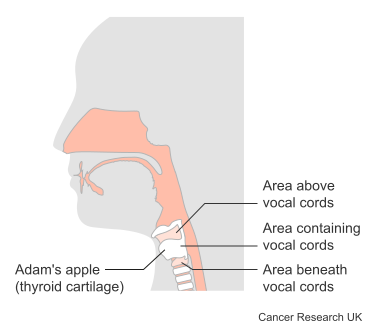
Staging of cancer of the larynx is complex. There are 3 parts of the larynx and doctors stage each part separately. Each part is surrounded by slightly different structures and tissues in the voice box.
The 3 parts of the voice box are the:
area above the vocal cords (supraglottis)
vocal cords (glottis)
the area below the vocal cords (subglottis)
Ask your doctor or specialist nurse about your staging if you are not sure about what it means.
TNM stands for tumour, node and metastasis. The system describes:
the size of a primary tumour (T) and how far it’s grown
whether the cancer has spread to the lymph nodes (N)
whether the cancer has spread to a different part of the body such as the lungs (M)
Number staging systems use the TNM system to divide cancers into stages. Most types of cancer have 4 stages, numbered from 1 to 4. Stage 1 is the earliest stage and stage 4 is advanced cancer.
Read more about TNM and number stages for laryngeal cancer
The grade of a cancer tells you how much the cancer cells look like normal cells under a microscope. Doctors also use the term differentiation to describe how developed a cell is.
There are 3 grades of laryngeal cancer:
Grade 1 (low grade) - the cancer cells look very much like normal larynx cells (they are well differentiated)
Grade 2 (intermediate grade) - the cancer cells look slightly like normal larynx cells (they are moderately differentiated)
Grade 3 (high grade) - the cancer cells look very abnormal and don't look like normal larynx cells (they are poorly differentiated)
The grade of a cancer gives your doctor an idea about how the cancer is likely to behave.
Low grade cancers are usually slower to grow and less likely to spread. This is only a guide. Your doctor and other cancer specialists will consider this, along with all your test results when deciding the best treatment for you.
Last reviewed: 19 Jul 2024
Next review due: 19 Jul 2027
The type of laryngeal cancer means the type of cell the cancer started in. The most common type is squamous cell carcinoma.
There are different ways of staging cancer in the area above the vocal cords (supraglottis). The 2 main ways are the TNM system and the number staging system.
There are different ways of staging cancer in the vocal cords (glottis). The 2 main ways are the TNM system and the number staging system.
There are different ways of staging cancer in the area below the vocal cords (subglottis) The 2 main ways are the TNM system and the number staging system.

About Cancer generously supported by Dangoor Education since 2010. Learn more about Dangoor Education


Search our clinical trials database for all cancer trials and studies recruiting in the UK.

Connect with other people affected by cancer and share your experiences.

Questions about cancer? Call freephone 0808 800 40 40 from 9 to 5 - Monday to Friday. Alternatively, you can email us.
