
About Cancer
Pancreatic cancer is when abnormal cells in the pancreas start to grow and divide in an uncontrolled way. The cells can grow into surrounding tissues or organs and may spread to other areas of the body.
Find out more about cancer and how it starts
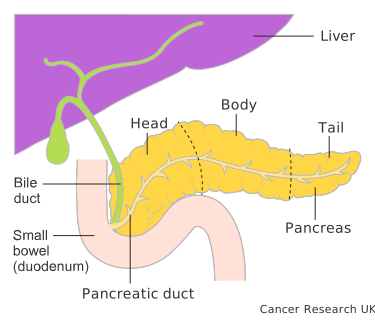
The pancreas is part of the . It sits quite high up in your tummy (abdomen). And lies across your body where your ribs meet at the bottom of your breastbone, just behind your stomach.
The pancreas is about 6 inches (15 centimetres) long and shaped like a leaf. It has 3 parts:
the wide end is called the head
the middle is called the body
the thin end is called the tail
It is a that makes digestive juices and hormones, including .
Watch this 2 minute video to explain what the pancreas is.
The part of the pancreas which produces digestive juices is called the exocrine pancreas. The part which produces hormones is called the endocrine pancreas. The endocrine pancreas is much smaller than the exocrine pancreas.
The digestive system breaks up and digests food. Food starts to be broken down in your mouth when you chew it. It then travels down into your stomach where it it is broken down further by the juices in our stomach. After about 2 to 3 hours in the stomach, the partly digested food moves into the first part of the small bowel (duodenum).
When food reaches the duodenum, the pancreas releases digestive juices. The juices flow down small tubes in the pancreas called ducts. These join the main duct (pancreatic duct) and the juice flows into the duodenum to meet the food.
The pancreatic juices contain that help to break down the food into even smaller pieces. These pieces are then absorbed into the body through the small bowel.
The common joins the duodenum right next to the pancreatic duct. The place where the two ducts join and meet the duodenum is called the ampulla, or the ampulla of Vater.

Very rarely cancer can start in the ampulla. Doctors call this ampullary cancer.
Read more about ampullary cancer
The endocrine pancreas makes insulin. Specialised cells within the pancreas release insulin directly into the bloodstream.
Insulin keeps the level of sugar (glucose) in the blood at a stable level. This means that the body cells get enough sugar, but not too much. The pancreas makes and releases more insulin if the level of sugar in the blood is high. If the level is too low, it doesn't release as much.
You have a condition called diabetes if you don't make enough insulin.
Cancer can start in the exocrine or endocrine part of the pancreas. Exocrine and endocrine cancers are different types of cancer. And they can behave differently and cause different symptoms.
Find out about the symptoms of pancreatic cancer
Most pancreatic cancers are exocrine pancreatic cancers. Rarely, cancer can start in the endocrine part of the pancreas. This type of cancer is called pancreatic neuroendocrine cancer.
Both types of pancreatic cancer can grow into nearby blood vessels or organs such as the small bowel. It can also spread further away in the body to areas including the liver and lungs.
Read about pancreatic neuroendocrine cancer
Pancreatic cancer is more common in older people. Almost half of the people diagnosed are aged 75 and over. It is slightly more common in men than women.
In England, pancreatic cancer is more common in people living in more deprived areas.
The risk of developing pancreatic cancer is also higher in people who:
smoke
are overweight or obese
have a family history of pancreatic cancer or have certain inherited gene changes
have certain medical conditions including long term inflammation of the pancreas (chronic pancreatitis) or diabetes
Around 11,500 people are diagnosed with exocrine or endocrine pancreatic cancer in the UK each year. It is the 10th most common cancer in the UK.
Find out more about the risks and causes of pancreatic cancer
Common symptoms of pancreatic cancer include pain in the tummy or back, yellowing of the skin or whites of the eyes (jaundice), changes to your poo (stool) and weight loss. Find out more about these symptoms.
Factors including increased age, overweight and obesity, smoking, family history and certain medical conditions can all increase the risk of pancreatic cancer.
Most people are diagnosed with pancreatic cancer after they become unwell and go to A&E. Others start by seeing their GP. Find out what to expect when you see your GP and any tests you might have.
Your GP or specialist might arrange for you to have tests. Find out about the tests you might have to diagnose and stage pancreatic cancer, including blood tests, a biopsy, and scans such as a CT scan or MRI scan.
Your treatment depends on the position of the cancer in the pancreas, how big it is, the type of pancreatic cancer, whether it has spread, if they can remove it with surgery and your general health.
Find out about the latest UK research looking at pancreatic cancer, as well as how you can take part in clinical trials.
Last reviewed: 09 Jul 2026
Next review due: 09 Jul 2029



