Stomach neuroendocrine cancer
Stomach neuroendocrine cancers are rare stomach cancers. They start in the neuroendocrine cells of the stomach.
Read about the difference between NETs and NECs
The pathologist looks at a sample of neuroendocrine cancer cells under a microscope.
They look at:
how abnormal the cancer cells look – doctors call this differentiation
how quickly or slowly they are dividing and growing – this is grading
This refers to how different the neuroendocrine cancer cells look. This is in comparison to healthy neuroendocrine cells:
Well differentiated cancers look abnormal. But they still have some similarities to normal neuroendocrine cells.
Poorly differentiated cancers look very abnormal. They are not like normal neuroendocrine cells at all.
Your doctor uses the differentiation to diagnose you with one of the following:
stomach neuroendocrine tumour (stomach NET) – these are well differentiated cancers
stomach neuroendocrine carcinoma (stomach NEC) – these are poorly differentiated cancers
This is about cell division and growth rate. To describe this, you might hear the terms mitotic rate or Ki67%. The higher the mitotic rate or Ki67 %, the faster the growth.
The Ki-67 or mitotic index are ways of describing how many cells are dividing. The pathologist counts the number of cancer cells that have started to divide into 2 new cells (mitoses) under a microscope. And a special stain measures the Ki-67 value.
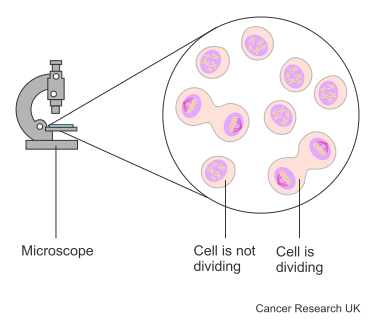
Your doctor might tell you the number of cells that are dividing (number of mitoses), or you may see this on your pathology report. This helps your doctor decide which treatment you need.
There are 3 grades of stomach neuroendocrine tumours (NETs):
Grade 1 cancers grow slowly. They are low grade. They have a Ki-67 index of 2% or lower. This means that fewer than 2 in every 100 cells (2%) are dividing.
Grade 2 cancers grow at a moderate pace (between grade 1 and 3). They are intermediate grade. They have a Ki-67 index between 3% and 20%. This means that between 3 and 20 cells in every 100 cells (3% and 20%) are dividing.
Grade 3a cancers grow rapidly. They are high grade. They have a Ki-67 index higher than 20% This means that more than 20 in every 100 cells (20%) are dividing.
All stomach neuroendocrine carcinomas (NECs) grow quickly and are grade 3b.
Stomach NETs are more common than stomach NECs. There are 3 main types of stomach NET: Type 1, 2 and 3.
The most common type of stomach (gastric) neuroendocrine tumours is type 1. Between 70 and 80 out of 100 stomach NETs (between 70 - 80%) are type 1.
They are often linked to a condition called chronic . This causes inflammation of the stomach cells, which leads to problems with stomach acid production. People with type 1 stomach NETS can have a higher than normal level of the hormone .
It is rare that type 1 stomach NETs cause symptoms. So most people are diagnosed with it during tests for other problems.
These stomach NETs are usually low grade and well differentiated. It’s rare that they spread (metastasise). They are usually small. And there is often more than one tumour, all of which are small.
The outlook () for type 1 stomach NETs is excellent.
Type 2 stomach NETs are much less common than type 1. Around 5 out of 100 stomach NETs (around 5%) are type 2.
Type 2 stomach NETs are linked to a rare condition called Zollinger Ellison Syndrome (ZES). ZES is the name given to the collection of symptoms caused by high levels of the hormone gastrin. The gastrin levels are high because of a rare type of tumour called a . Gastrinomas makes large amounts of gastrin. They usually develop in the small bowel or pancreas.
Type 2 stomach neuroendocrine cancers are also linked to another inherited syndrome called .
It’s rare for type 2 stomach NETs to cause symptoms. The cancers are usually low grade and well differentiated. They are often small and there is usually more than one tumour.
There is a slightly higher risk of type 2 NETs spreading than type 1. Between 10 and 30 out of every 100 type 2 tumours (between 10 and 30%) spread to another part of the body.
The outlook (prognosis) for type 2 stomach NETs is usually good.
Around 15 out of every 100 stomach NETs (around 15%) are type 3.
There is usually one, larger tumour. Type 3 is more likely to be high grade than type 1 and 2 NETs. There is also a higher risk of type 3 NETs spreading. Over 50 out of 100 type 3 stomach NETs (over 50%) spread to another part of the body.
The outlook (prognosis) for type 3 stomach NETs is less good than types 1 and 2.
How doctors group and classify cancers changes all the time. Some experts think that type 3 stomach NETs should be further divided into subtypes. This would depend on how well or poorly differentiated the cancer cells look.
Stomach neuroendocrine cancers (NECs) are poorly differentiated cancers. This means the cancer cells look very different to normal neuroendocrine cells. They are fast growing and have often spread to other parts of the body at diagnosis.
They are less common than stomach NETs. Around 6 – 21% of stomach neuroendocrine cancers are NECs. There are different types of stomach NEC:
small cell stomach NEC
large cell stomach NEC
You can also get neuroendocrine cancer cells mixed in a tumour with a different type of cancer. Doctors call this MiNEN or mixed cell carcinoma.
Unfortunately, stomach NECs are harder to treat than NETs. So the outlook (prognosis) for stomach NEC is worse than for stomach NETs.
Read more about neuroendocrine carcinoma (NEC)
The stage of a stomach neuroendocrine cancer tells you about its size and whether it has spread. Knowing the stage can help your doctor decide which treatment you need.
You have tests and scans which give some information about the stage of the cancer. Sometimes it’s not possible to be certain about the stage until after surgery.
There are different ways to stage stomach neuroendocrine cancer. Doctors usually use the TNM system. TNM stands for tumour, node and metastasis:
T describes the size of the tumour
N describes whether there are any cancer cells in the
M describes whether the tumour has spread to a different part of the body
Your doctor might tell you the number stage of your neuroendocrine cancer. Number staging systems use the TNM system to divide cancers into stages. Most types of cancer have 4 stages, numbered from 1 to 4.
Below we have a simplified description of TNM staging for stomach neuroendocrine cancer.
Treatment depends on what type of stomach neuroendocrine cancer you have. Treatment also depends on:
the stage of the stomach neuroendocrine cancer
where the cancer is
your health and general fitness
Last reviewed: 28 Feb 2025
Next review due: 28 Feb 2028
Stomach neuroendocrine cancers are rare. You might not have symptoms. If you do, these might include tummy pain, feeling or being sick or unexplained weight loss.
Your treatment depends on what type of neuroendocrine cancer you have. Surgery is the most common treatment option for stomach NETs. For stomach NECs you usually have chemotherapy.
A pathologist reports how abnormal the cancer cells look (differentiation) and how quickly they are growing (grading). Your stage is the size of the cancer and whether it has spread.
Survival (prognosis) depends on several factors. This includes your type of neuroendocrine cancer, where it is in your body, and whether it has spread.
Practical and emotional support is available to help you cope with neuroendocrine cancer.
Neuroendocrine cancers develop in cells of the neuroendocrine system. They can develop in different parts of the body including the lungs, stomach, pancreas and bowel.



