Getting diagnosed with laryngeal cancer
The larynx is a tube about 2 inches (5 cm) long in adults that sits above the windpipe (trachea).
You may also hear laryngeal cancer being called throat cancer. Throat cancer is not a precise medical term so doctors don’t usually use it. This is because there are different parts within the throat.
There are 3 main parts to the larynx. These are:
the area above the vocal cords (supraglottis)
the area of the vocal cords (glottis)
the part below the vocal cords (subglottis)
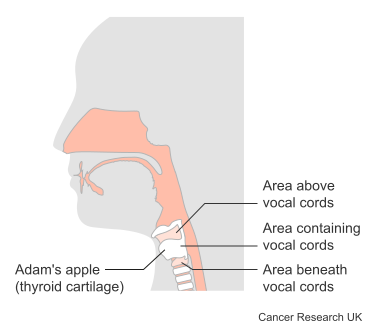
Laryngeal cancer can start in any of these parts.
Most people with symptoms that could be due to cancer start by contacting their GP surgery. Your first appointment may be a telephone appointment. Your GP surgery then might arrange for you to go in and see a doctor or other healthcare professional.
Read about the symptoms of laryngeal cancer
Your GP can do some tests to help them decide if you need to see a specialist. This usually includes:
an examination of your mouth and neck
blood tests
chest x-ray
Your doctor looks inside your mouth and feels around your neck. They feel for any areas that might be swollen or not feel normal. They may also listen to your chest and tummy (abdomen) to find out if they sound normal.
Your GP may also look inside your ears to check for any sign of infection.
Blood tests can check your general health including:
how well your liver and kidneys are working
the number of blood cells in your blood such as , and . You may hear this being called a full blood count
if you have any signs of infection
An x-ray is a test that uses small amounts of radiation to take pictures of the inside of your body. Your GP might request a chest x-ray if you have shortness of breath or a change in your voice (hoarseness) that doesn’t go away.
Read more about having an x-ray
Depending on the results of your tests, your GP might refer you to a specialist doctor at the hospital. This is usually a head and neck doctor or an ENT specialist. ENT stands for ear, nose and throat.
Your specialist doctor usually does more tests. These might include:
a test to look inside your nose, mouth and throat. This is a nasoendoscopy
a test to look inside your throat and the upper part of your food pipe. This is a laryngoscopy
checking your neck or neck lump for cancer
a CT scan
an MRI scan
a PET-CT scan
a video of your vocal cords to see how they move when you speak. This is a videostroboscopy
a test to look at your nose, throat and upper part of your food pipe under . This is a transnasal oesophagoscopy
A nasoendoscopy is often the first test you have at the hospital. You have this in the outpatient clinic.
Your doctor passes a thin and flexible tube through your nose and into your throat. The tube is called a nasoendoscope. The tube has a camera and a light at the end. This can be uncomfortable but does not usually hurt. It only lasts a few minutes.
Find out more about having a nasoendoscopy
A laryngoscopy is similar to a nasoendoscopy but the tube your doctor uses is longer. You have this test under general anaesthetic. This means that you are asleep and won’t feel anything.
Your doctor uses a long and flexible tube to look at the:
the back of your throat
voice box (larynx)
the upper part of the food pipe (oesophagus)
During a laryngoscopy, your doctor can take samples of tissue from any abnormal area. They send these samples to the laboratory where a specialist doctor called a looks at them under a microscope.
You may also hear your doctor call this test examination under anaesthesia (EUA).
Read more about having a laryngoscopy
You might have an ultrasound scan to check the lymph nodes in your neck. Ultrasound scans use high frequency sound waves to create a picture of a part of the body. The ultrasound scanner has a microphone that gives off sound waves. The sound waves bounce off the organs inside your body and are picked up by the microphone. The microphone links to a computer that turns the sound waves into a picture.
If your doctor sees any abnormal area, you might have a fine needle aspiration (FNA) at the same time.
A fine needle aspiration is a way of taking a sample of cells from an abnormal lymph node or lump in your neck. Your doctor uses a fine needle and syringe to take the cells. A pathologist can then look at the cells under a microscope.
Your doctor numbs the area with a local anaesthetic before taking the sample of cells.
Read more about having a neck lymph node ultrasound and biopsy
A CT (or CAT) scan stands for computer (axial) tomography. It is a test that uses x-rays and a computer to create detailed pictures of the inside of your body. The computer puts them together to make a 3 dimensional (3D) image.
You might have a CT scan of your head and neck to show the size of your laryngeal cancer and any enlarged lymph nodes in your neck.
You might also have a CT scan of your chest or abdomen. This can show whether the cancer has spread.
Find out more about having a CT scan
MRI stands for magnetic resonance imaging. It uses magnetism and radio waves to take pictures of the inside of the body.
You might have an MRI scan of your head and neck if your doctor thinks the cancer has spread to the nearby lymph nodes.
Read more about having an MRI scan
A PET-CT scan combines a CT scan and a PET scan. It gives detailed information about your cancer.
You usually have a PET-CT scan in the radiology department. It usually takes between 30 and 60 minutes. You might have a PET-CT scan if your doctor finds cancer cells in the lymph nodes in your neck, but they don’t know where the cancer started. The PET-CT scan can help to show a cancer that other scans have not been able to find.
Find out more about having a PET-CT scan
A videostroboscopy is a video of your vocal cords. Your doctor or uses a long thin tube to examine your voice box and vocal cords while you speak. The tube has a camera and is connected to a video monitor and recorder.
You usually have this test in the outpatient clinic. Your doctor uses an anaesthetic spray to numb your throat.
Read more about having a videostroboscopy
This test allows your doctor to look inside your:
nose
throat
voice box
the upper part of the food pipe (oesophagus)
You have a transnasal oesophagoscopy under local anaesthetic. Your doctor passes a long and thin tube through your nose and into your food pipe. This can be uncomfortable but shouldn’t be painful.
You have this test in the outpatient department. It usually takes about 30 minutes.
Find out more about having a transnasal oesophagoscopy
The tests you have help your doctor find out if you have laryngeal cancer and how far it has grown. This is the stage of the cancer.
Read about the stages of laryngeal cancer
This is important because doctors recommend your treatment according to the stage of the cancer.
Find out about the treatment options for laryngeal cancer
Coping with a diagnosis of laryngeal cancer can be difficult. There is help and support for you and your family.
Read about what you can do to cope with a diagnosis of laryngeal cancer
Last reviewed: 13 Feb 2024
Next review due: 13 Feb 2027
Laryngeal cancer is cancer that starts in the voice box (larynx). It is a type of head and neck cancer.
Symptoms can include a hoarse voice, difficulty swallowing, weight loss and shortness of breath.
A laryngoscopy is a test to look at the back of your throat (pharynx) and voice box (larynx).
You might have surgery, chemotherapy, radiotherapy or a combination of treatments to treat laryngeal cancer.
Find out about tests to diagnose cancer and monitor it during and after treatment, including what each test can show, how you have it and how to prepare.
Laryngeal cancer is cancer that starts in the voice box (larynx). It is a rare type of head and neck cancer



