Wilms tumour (nephroblastoma)
Your child will need a number of tests if their doctor suspects they have a Wilms tumour. These aren’t generally painful but your child will have to keep still for some of them. For some types of tests, your child might need to be drowsy (have ) or have a .
The team caring for your child are used to helping children have these tests. They will explain in detail what tests your child will have. They will also tell you about any special instructions to help prepare for the test. And will do everything they can to help prepare them, and you.
Your child’s doctor will also examine your child and ask you questions about your child’s symptoms and general health.
Tests for a Wilms tumour might include one or more of the following:
blood tests
ultrasound of the tummy area (abdomen)
chest x-ray
CT scan
MRI scan
a biopsy - this means taking a sample of tumour cells to look at under a microscope
Other tests your child might have more regularly, help to work out how well their kidney is working. These include sending a sample of their wee (urine) and doing their blood pressure.
Blood tests can:
check your child’s general health, including how well their liver and kidneys are working
check the numbers of blood cells
A doctor, nurse or person specialising in taking blood (a phlebotomist) takes a small amount of blood from your child. This is usually from the back of the hand, the inside of the elbow or wrist area.
Most blood tests take a couple of minutes.
The specially trained staff will help your child feel as comfortable as possible. Things that can make it easier for your child include:
The phlebotomist might use a local anaesthetic. This means that they apply a numbing spray or cream to your child's skin before they do the test. This should mean it’s less painful for your child, although they might still feel the needle go in.
Distraction can include:
singing
counting
using bubbles
reading them a story
using books that have pop ups or music
watching something on your mobile phone or tablet
If your child has blood tests at the hospital they might have a health play specialist. They can help your child cope and distract them while having the blood test. This can help your child feel less anxious and scared.
Holding your child while they are having their blood test can make them feel safe and secure. You can give them a cuddle afterwards if you’re unable to hold them during their test.
Your child can usually eat, drink and play as normal after a blood test.
Ultrasound scans use high frequency sound waves to build up a picture of the inside of the body.
Ultrasound scans are usually painless. A specialist healthcare professional called a sonographer usually does the test. First, they put some gel on the area of the skin where they want to scan. They gently press a probe that looks a bit like a microphone on your child’s skin.
The sound waves bounce off the organs inside the body, and the probe picks them up. The probe links to a computer that turns the sound waves into a picture on the screen. This can help doctors to understand what an unusual lump might be.
Your healthcare team will let you know how to help your child prepare for the test. For some types of ultrasound, it helps if your child has a full bladder. So you may be asked to make sure they have drunk some water beforehand.
Your child can usually eat, drink and play as normal after an ultrasound scan.
X-rays use high energy rays to take pictures of the inside of your body. Chest x-rays can show:
fluid
signs of infection
an enlarged heart
tumours in the chest
There is no special preparation for an x-ray. Your child usually has a chest x-ray standing up against the x-ray machine if they are old enough to stand. They have it lying on the x-ray couch if they are younger or unable to stand.

X-rays are painless and quick. Your child won’t feel or see anything. You are usually able to stay in the room when your child is having their x-ray. You will need to wear a lead apron to protect yourself from the small amount of radiation.
Your child’s specialist makes sure the benefits of having an x-ray outweighs the risks of the small amount of radiation.
Your child can usually eat, drink and play as normal after a chest x -ray.
Testing your child’s wee (urine) can show how well the kidneys are working. Your child's healthcare team will explain how best to get a urine sample from your child. They will also provide you with the pots and anything else you need to collect the sample.
Your doctor asks your child to give a urine sample into a pot if they are old enough or able to. There are different ways to collect urine from younger children, or from children who might find this difficult. These include:
using a urine collection bag – these are designed with a sticky edge so you can attach them easily. They peel off when your child has had a wee. The wee can be poured into the sample container
putting a layer of sterile cotton wool, urine collection pad or gauze inside a fresh nappy – you can use a syringe to draw up the sample when your child has passed urine
Your child can usually eat, drink and play as normal after giving a urine sample.
MRI stands for magnetic resonance imaging. An MRI scan creates pictures using magnetism and radio waves.
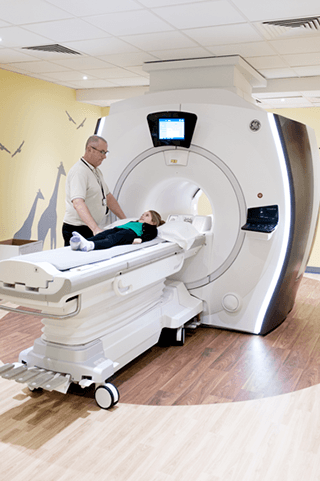
It produces pictures from angles all around the body and shows up soft tissues very clearly. It can help doctors find out what an unusual lump might be.
Many young children have a or to help them lie still on the couch for the scan. An MRI scan can take around 20 to 60 minutes of lying still. Your child might have an injection of a special dye before or during the scan to help make the pictures clearer.
After the MRI scan your child’s nurse will look after them closely when they return and take regular measurements. This is so they can be sure they have recovered and are awake enough from the sedation or general anaesthetic.
The nurses also usually check that your child has had:
something to drink
something to eat or some milk
a pee
This can help the nurses see if your child has recovered from the sedative drugs.
CT stands for computed tomography. A CT scan uses x-rays and a computer to create detailed pictures of the inside of the body. It takes pictures of the body from different angles. A computer then puts them together to make a 3 dimensional (3D) image. It can help doctors find out what an unusual lump might be.
The scan itself is painless. Your specialist team will let you know how:
to help your child prepare
long your child needs to not eat or drink before their sedation
long the scan is likely to be
Your child might have an injection of contrast medium (a type of dye) through a small thin tube in their hand or arm. The tube is called a cannula. Some children might also have a drink of water or juice with some contrast medium in before the scan.
Some young children have a medicine to make them feel sleepy and relaxed (sedative). Or they may need a to help them lie still on the couch for the scan. Other children are able to have the scan while they are awake, with your support and help from the specialist team.
If your child has to drink the contrast medium, the team will let you know how to do this if your child needs sedation or a general anaesthetic.
The couch slowly slides backwards and forwards through the hole of the scanner. The machine takes pictures as it moves.
After the CT scan your child’s nurse will look after them closely and take regular measurements. This is so they can be sure they have recovered and are awake enough from the sedation or general anaesthetic.
The nurses on the unit usually also check that your child has had:
something to drink
something to eat or some milk
a pee
This can help the nurses see if your child has recovered from the sedative drugs.
Your doctor might suggest you give your baby a feed as normal and then wrap them in a soft towel or blanket. This can help your baby lie still for their CT or MRI scan.
Babies that have had a feed and wrap scan don't need the same level of monitoring after. This is because they haven't had any medicine to make them feel sleepy.
Your child’s doctor might want to take a sample of the abnormal area seen on a scan. This is called a biopsy. A specialist doctor called a pathologist looks at the cells down a microscope to find out exactly what the lump is. However, in children suspected to have a Wilms tumour (based on what the tumour looks like on CT or MRI images), biopsies are not often needed before starting treatment.
Your child is likely to have a general anaesthetic for this test. This means they are asleep and can’t feel anything during the test.
An experienced doctor called a radiologist, or sometimes a children’s kidney surgeon, takes a small sample of cells using a needle. The doctor uses an ultrasound scan or another type of scan to help them choose the best place to biopsy.
When they wake up, your child has a small dressing over the needle site. Children can usually go home the same day, unless they need to stay in hospital for other tests.
A kidney biopsy is a safe test. Your child’s doctor goes through the risks and benefits with you. The most common risks are bleeding from the site or infection. Your team gives you a telephone number to call if you have any problems at home. Do call if you have any questions or concerns about your child,
You should get your child's results within 1 or 2 weeks.
Waiting for test results can be a very worrying time. You might have contact details for a children’s cancer specialist nurse and you can contact them for information if you need to. It can help to talk to a close friend or relative about how you feel.
Children with a Wilms’ tumour are treated in a children’s cancer centre.
Last reviewed: 28 Dec 2023
Next review due: 28 Dec 2026
Wilms tumour is a type of kidney cancer that most commonly affects young children. Read about the causes, symptoms and treatment.
Get information about staging Wilms tumours and treatment by stage.
Chemotherapy and surgery are the main treatments for Wilms tumour.
Find out about what to expect when your child is first diagnosed.



