Smoking is the leading cause of cancer and preventable death in the UK. Smoking prevalence has been declining across the UK for some decades, yet there are still around 4.9 million people who smoke in England, more than 325,000 who smoke in Wales, more than 689,000 in Scotland and more than 206,000 who smoke in Northern Ireland.It is crucial to address smoking prevalence as there are around 75,800 tobacco-attributable deaths in the UK every year.
England, Scotland and Wales have government-set smokefree ambitions to achieve 5% average adult smoking prevalence by 2030 in England and Wales, and 2034 in Scotland. There is currently no official ambition to achieve smokefree in Northern Ireland.
Smoking prevalence remains higher in more deprived groups. Therefore, it is important to prioritise reducing smoking prevalence in groups with the highest smoking rates.
In this report we estimate whether the smokefree ambitions are likely to be realised based on recent trends, and when smokefree will be achieved by deprivation groups. We have projected average adult smoking prevalence, and smoking prevalence by deprivation decile or quintile, for the four nations of the UK, until 2050. These projections use smoking prevalence data from the Annual Population Survey, Scottish Health Survey and Health Survey Northern Ireland.
By updating previous adult smoking prevalence projections for England, Wales, Scotland and Northern Ireland that used data up to 2018-2019, with data up to 2023, we aim to estimate:
What year each nation will reach 5% average adult smoking prevalence
What years each deprivation decile or quintile in each nation will reach 5% adult smoking prevalence, if they do, up to 2050
We analysed data from published health surveys for each nation. The criteria for selecting the appropriate health survey were as follows:
Availability of nationally representative adult smoking prevalence trends data with a minimum 5 years of data
Availability of adult smoking prevalence trends data by deprivation (indices of multiple deprivation [IMD] deciles where possible. IMD quintiles if deciles not available)
Data is used to inform policy in each of the UK nations*
Country | Health Survey | Years available | Deprivation | Years available |
England | Annual Population Survey (APS) ref 3,11 | 2011-2023 | Index of Multiple Deprivation (IMD) deciles, based on lower layer super output areas (LSOAs)** | 2012-2023 |
Wales* | Annual Population Survey (APS) ref 3,12 | 2011-2023 | Welsh IMD (WIMD) deciles based on LSOAs** | 2017-2021 |
Scotland | Scottish Health Survey (SHeS) ref 14 | 2008-2023 | Scottish IMD quintiles based on data zones** | 2008-2023 |
Northern Ireland | Health Survey Northern Ireland (HSNI) ref 15 | 2010/11-2023/24 | NI Multiple Deprivation Measure quintiles, based on super output areas (SOAs)** | 2010/11-2023/24 |
*Wales uses National Survey for Wales (NSW) to inform smoking policy. However, NSW does not provide a long enough time series for projections, due to method changes in 2020/21. Prior to NSW, Wales smoking prevalence data were obtained from the Welsh Health Survey (WHS) which ceased in 2015; WHS and NSW data cannot be treated as a continuous time series. Annual Population Survey (APS) is therefore the only viable data source for Wales smoking projections.
Whilst APS report yearly estimates for smoking prevalence by deprivation decile in England, the APS survey is not routinely linked to WIMD. Therefore, the best available time series for smoking prevalence by deprivation in Wales was for 2017-2021, obtained from a publicly available APS data release. **Measures of deprivation groups and spatial distribution have been updated during the timeframe of the observed data for England, Wales, Scotland and Northern Ireland. More detailed information can be found in the technical reports.
When projecting smoking prevalence by nation, a separate univariate beta regression model was fit for each constituent UK nation, with year as the predictor variable. Beta regression was used because the outcome variable was smoking prevalence (percentage; value between 0 and 1). Using the add_predictions package in R, the models were used to project average adult smoking prevalence from 2024 to 2050 in each constituent nation.
A new set of models were fit to project smoking prevalence by deprivation. A bivariate beta regression model was fit, separately for each UK constituent nation, with year and deprivation as predictors. The outcome variable was smoking prevalence (percentage; value between 0 and 1). Using the add_predictions package in R, the models were used to project adult smoking prevalence from 2024 and from 2022 to 2050 for each deprivation decile for England and Wales respectively, as observed deprivation data were only available to 2021 for Wales. Due to the lack of data for deprivation decile for Scotland and Northern Ireland, the models projected adult smoking prevalence from 2024 to 2050 for each deprivation quintile.
We report yearly projections until 2050 as any changes to policy or other environmental factors may decrease the robustness of the projection the further into the future it looks. It should be noted that the projections presented in this Analysis Brief are based on recent trends only, and they do not take into account any anticipated effect of the proposed Tobacco & Vapes Bill on smoking prevalence.
Statistical analyses were performed in R software version 4.3.1.
In Scotland, field work for the years 2020 and 2021 was significantly disrupted by the COVID-19 pandemic. Similarly, Northern Ireland’s 2020 survey was also impacted.When testing for outliers using Cook’s distance plot test, these three data points were shown to be significant influential data points. As a result, smoking prevalence data for affected years in Scotland (2020 and 2021) and Northern Ireland (2020) were excluded prior to running the projection models.
To account for these missing data points in the charts presented, imputation was applied after the projection models were completed. Missing values were linearly imputed based on the prevalence estimates for the year immediately before and after the affected years. Smoking prevalence for 2020 in Northern Ireland was imputed as the midpoint between 2019 and 2021 values. In Scotland, the 2020 and 2021 prevalence values were estimated using a linear model based on data from 2019 and 2022.
For England and Wales, Office for National Statistics (ONS) has weighted the source data to account for discontinuity because of changes in survey method due to the COVID-19 pandemic. Therefore, no data points were dropped or imputed for these nations.
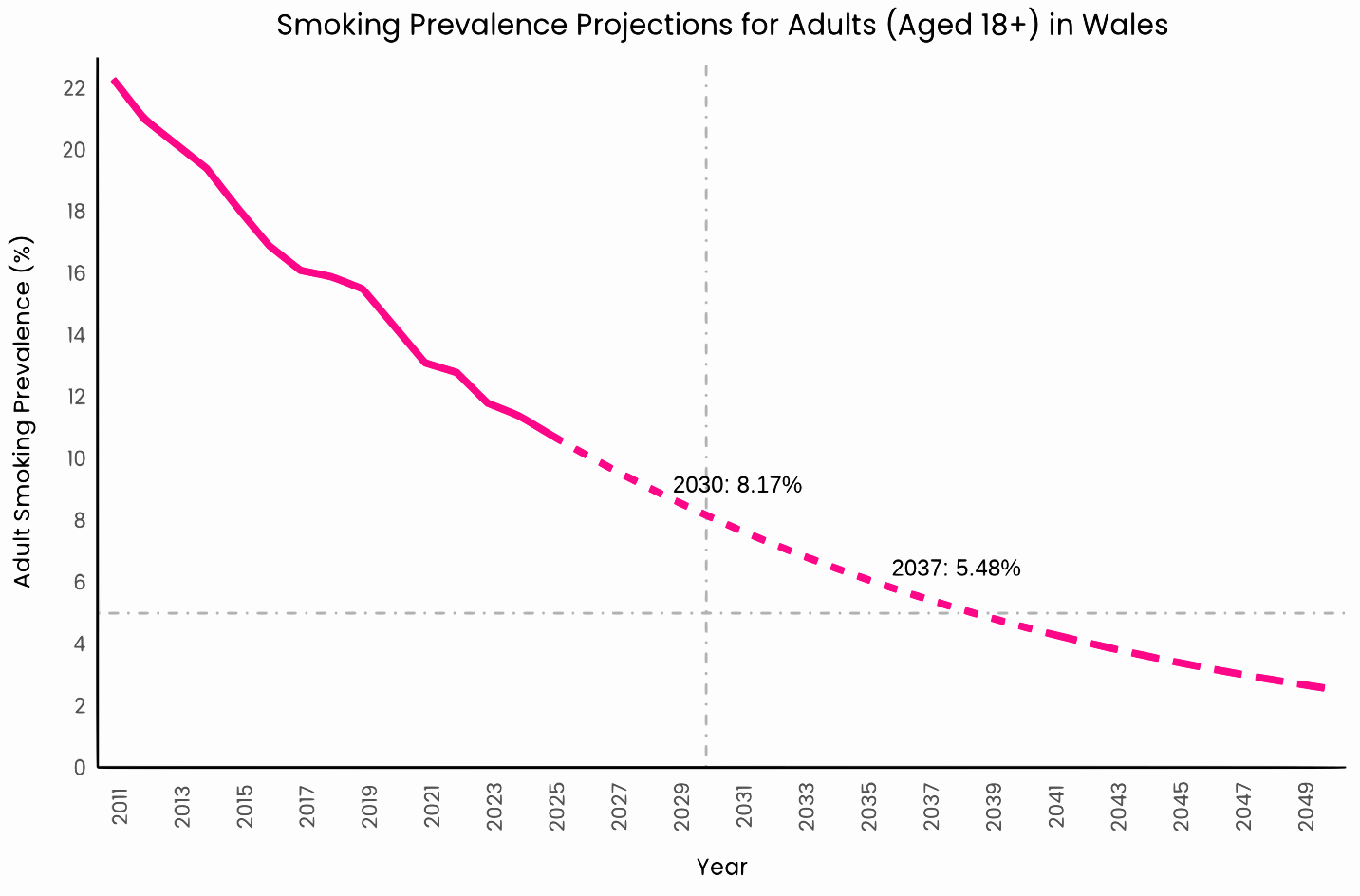
In Figures 1-8, solid lines denote observed values, broken lines denote projections.
Projections for 2041 onwards (shown with longer dashes) should be interpreted with caution as the robustness of any projection decreases the further into the future it projects. Because of this, we report specific-year projections only until 2040. Results for 2041-49 are reported as ‘the early/mid/late 2040s’ and everything after is reported as ‘after 2050’, to reflect the inherent uncertainty of projections looking this far ahead. The dashed horizontal line denotes 5% smoking prevalence which is the set smoking prevalence to be reached in the smokefree ambition. The dashed vertical lines denote smokefree targets if set out by the nation’s government (available for England, Wales and Scotland). Imputed values are denoted with a solid white circle outlined in grey.
Comparisons between UK nations should not be made, because the results are based on different datasets for each nation.
If recent smoking prevalence trends continue, average adult smoking prevalence in England will reach 5% (5.49%) in 2039 (Figure 1). Previous projection estimates, using data up to 2018, suggested that smoking prevalence would reach 5% (5.23%) in 2037.
The projections suggest that adult smoking prevalence in the least deprived decile in England could have already reached 5% (5.49%) in 2024, while in the most deprived decile, adult smoking prevalence will not fall below 5% by 2050 (Figure 2) if recent smoking prevalence trends continue. Only the least deprived two deciles (deciles 9 and 10) will reach the 5% smokefree threshold by 2030.


If recent smoking prevalence trends continue, average adult smoking prevalence in Wales will reach 5% (5.33%) in the early 2040s (Figure 3). Previous projection estimates, using data up to 2018, suggested that smoking prevalence would reach 5% (5.24%) in 2037.
If recent smoking prevalence trends continue, adult smoking prevalence in the least deprived decile in Wales will reach 5% (5.33%) in 2026, while in the most deprived decile, adult smoking prevalence will not fall below 5% by 2050 (Figure 4). Only the least deprived decile will achieve the smokefree ambition by 2030, with the other nine deciles falling behind schedule.

If recent smoking prevalence trends continue, average adult smoking prevalence in Scotland will reach 5% (5.30%) in the late 2040s (Figure 5). Previous projection estimates, using data up to 2018, suggested that average adult smoking prevalence in Scotland would not fall below 5% until after 2050.
If recent smoking prevalence trends continue, adult smoking prevalence in the least deprived quintile in Scotland will reach 5% (5.43%) in 2029, while in the most deprived quintile, adult smoking prevalence will not fall below 5% by 2050 (Figure 6). Only the least deprived quintile will achieve smokefree target by 2034, while the other four quintiles fall behind schedule.


If recent smoking prevalence trends continue, average adult smoking prevalence in Northern Ireland will reach 5% (5.29%) in the early 2040s (Figure 7). Previous projection estimates, using data up to 2018, suggested that smoking prevalence would reach 5% (5.32%) in the late 2040s.
If recent smoking prevalence trends continue, adult smoking prevalence in the least deprived quintile in Northern Ireland will reach 5% (5.44%) in 2031, while in the most deprived quintile, adult smoking prevalence will not fall below 5% by 2050 (Figure 8).


Smoking is the leading cause of cancer and preventable death in the UK Smokefree ambitions – to reduce average adult smoking prevalence to 5% by a specific year – have been set in England, Wales and Scotland; Northern Ireland is yet to set an ambition. To help understand the future resources needed for tobacco control in order to achieve these smokefree ambitions, we projected future adult smoking prevalence in the UK’s constituent nations, based on a continuation of current trends. These projections provide an estimated trajectory of smoking prevalence if there are no changes to the current environment around smoking.
The results indicate that although smoking prevalence rates are decreasing, if current adult smoking prevalence trends continue, none of the UK constituent nations will achieve their smokefree ambitions. For Wales and Scotland, smokefree ambitions could be missed by more than a decade.
The most deprived quintiles and deciles in each of the nations are expected to be the furthest away from achieving smokefree targets, and none of the most deprived groups are projected to reach smokefree by 2050. Projections for each constituent nation indicate that the most deprived tenth or fifth within each nation may be more than two decades behind the least deprived tenth or fifth in achieving 5% smoking prevalence.
To project smoking prevalence, we applied inferential statistics to published health survey data. We used established statistical methods. The projections method was tested and refined previously.
For any projections, the key limitation is the assumption that past trends will continue in the future, and the inability to predict changes in the environment around smoking; any potential impact of possible future legislation, such as the Tobacco and Vapes Bill, is not captured by these projections. Projections are dependent on data availability: a longer data series may capture fluctuations in past smoking prevalence trends better and therefore produce more robust projections for future trends. For all but one of the projections (Wales deprivation projection), the most policy-relevant data series has run for at least a decade, which makes these projections highly relevant to policy and more robust than projections based on shorter time series. However, the further into the future projections look, the more uncertain they become. It is important to update projections regularly and to interpret longer-range projections with caution.
The impact of the COVID-19 pandemic on smoking behaviour, and the collection of data around smoking, may have affected these projections. To account for disruptions in survey field work, certain values in Scotland and Northern Ireland’s datasets were removed prior to projections and imputed after. Source data for England and Wales was weighted by ONS to account for discontinuity due to changes in survey method.
Measures of multiple deprivation are updated periodically to reflect changes in the data and improve the quality of the indicators. Updates to the measure of deprivation were implemented for England, Wales, Scotland and Northern Ireland during the timeframe of the observed data. As methodologies have remained relatively similar across deprivation measure versions, they are sufficiently comparable to allow for comparisons between areas over time. Whilst these updates are welcomed, and unavoidable, they could impact the continuity of the time series used for analysis. The general patterns observed remain informative, but some caution should be exercised when interpreting the deprivation results.
Our models do not consider other factors that relate to smoking prevalence, such as age, sex, and ethnic group. It is relevant to do this where the population structure has changed/is expected to change markedly on these variables within the observed and projected data period. Future research should explore the impact of such demographic factors on projections.
Our updated projections based on the continuation of recent trends indicate that smoking prevalence will continue to fall in England, Wales, Scotland and Northern Ireland, but not fast enough to achieve the Smokefree ambitions set out.
If recent trends continue, England, Wales and Scotland will achieve 5% average adult smoking prevalence target almost a decade or more behind schedule.
The deprivation gap persists, with the most deprived groups estimated to reach smokefree more than two decades later than the least deprived, within every constituent nation.
Read the report as a PDFSofia Migues, Nadine Zakkak, Lucy Clark, Magda Mikolajczyk, Katrina Brown, for the Cancer Intelligence Team at Cancer Research UK.
If you have any comments, questions or feedback, please reach out to our team.
Brown KF, Rumgay H, Dunlop C, et al. The fraction of cancer attributable to modifiable risk factors in England, Wales, Northern Ireland and the United Kingdom in 2015. Br J Cancer 2018, 118(8).
Global Health Data Exchange. Global Burden of Disease (GBD) Results Tool, 2021. Available from https://vizhub.healthdata.org/gbd-results/. Accessed October 2024.
Office for National Statistics. Smoking habits in the UK and its constituent countries. Annual Population Survey. Available from https://www.ons.gov.uk/peoplepopulationandcommunity/healthandsocialcare/healthandli feexpectancies/datasets/smokinghabitsintheukanditsconstituentcountries Accessed January 2025.
Office for National Statistics. Adult smoking habits in Great Britain. Annual Population Survey. Available from https://www.ons.gov.uk/peoplepopulationandcommunity/healthandsocialcare/drugusealc oholandsmoking/datasets/adultsmokinghabitsingreatbritain
Cabinet Office & Department of Health & Social Care. Advancing our health: prevention in the 2020s. Consultation document (2019). Available from https://www.gov.uk/government/consultations/advancing-our-health-prevention-in-the 2020s/713af73f-5588-4757-b643-ed940dcbc930
Llywodraeth Cymru, Welsh Government. A smoke-free Wales: Our long-term tobacco control strategy. Available from https://www.gov.wales/tobacco-control-strategy-wales html
Scottish Government, Riaghaltas na h-Alba. Tobacco and vaping framework: roadmap to 2034. Available from https://www.gov.scot/publications/tobacco-vaping-framework roadmap-2034/pages/5/
Department of Health & Social Care. Fingertips, Smoking Profile 2023. Available from https://fingertips.phe.org.uk/profile/tobacco control/data#page/7/gid/1938132885/pat/159/par/K02000001/ati/15/are/E92000001/iid/92 443/age/168/sex/4/cat/-1/ctp/-1/yrr/1/cid/4/tbm/1/page-options/ine-vo-0_ine-ct 221_ine-pt-0_ine-yo-1:2023:-1:-1 . Accessed October 2024
Office for National Statistics. Deprivation and the impact on smoking prevalence, England and Wales: 2017 to 2021. Available from https://www.ons.gov.uk/peoplepopulationandcommunity/healthandsocialcare/drugusealc oholandsmoking/bulletins/deprivationandtheimpactonsmokingprevalenceenglandandwal es/2017to2021
Llywodraeth Cymrum, Welsh Government. StatsWales. Adult lifestyles by area deprivation, 2020-21 onwards Available from: https://statswales.gov.wales/Catalogue/National-Survey for-Wales/Population-Health/Adult-Lifestyles/adultlifestyles-by-areadeprivation-from 202021
Scottish Government, Riaghaltas na h-Alba. The Scottish Health Survey 2023 – volume 1: main report. Available from https://www.gov.scot/publications/scottish-health-survey 2023-volume-1-main-report/documents/
Department of Health. Health Survey Northern Ireland: First Results 2023/24. Available from https://www.health-ni.gov.uk/publications/health-survey-northern-ireland-first-results 202324
Cancer Intelligence Team, Cancer Research UK. Smoking prevalence projections for England, Scotland, Wales, and Northern Ireland, based on data to 2018/19. Published 2020. Available from https://assets.ctfassets.net/u7vsjnoopqo5/5j96lpBPuQv0md8RxlERF4/d975a269c82bdfee446e74f67a63646e/cancer_research_uk_smoking_prevalence_projections_february_2020_final.pdf(PDF)
Department of Health & Social Care. Technical Guidance. Using the index of multiple deprivation. Available from https://fingertips.phe.org.uk/static-reports/public-health technical-guidance/Data_processing_methods/Using_IMD.html
Llywodraeth Cymrum, Welsh Government. Welsh Index of Multiple Deprivation: index guidance. Available from https://www.gov.wales/welsh-index-multiple-deprivation-index guidance
Scottish Government, Riaghaltas na h-Alba. SIMD 2020 technical notes. Available from https://www.gov.scot/publications/simd-2020-technical-notes/
Northern Ireland Statistics and Research Agency. NIMDM 2017 – Technical Report. Available from https://www.nisra.gov.uk/publications/nimdm17-results
UK Parliament. Parliamentary Bills. Tobacco and Vapes Bill. Available from https://bills.parliament.uk/bills/3879
