The 62-day target in England sets out that 85% patients who receive an urgent referral should begin treatment for their cancer within 62 days of that referral. However, this target has not been met for more than a decade. The National Cancer Plan for England committed to meet all cancer waiting times targets, including the 62-day target, by March 2029. Key milestones have also been set by the NHS to establish progress towards this goal, with interim targets of 75% by March 2026, and 80% by March 2027.
This analysis used historical trends to project forward performance of the 62-day cancer waiting times and assess whether the interim targets and 2029 commitment were likely to be met. If not, we aimed to estimate how many additional people would need to be treated on time to meet the interim and 85% targets by March 2029. Further modelling explored the additional performance improvement that would be needed to meet the target, and how wide the gap would be if the previous trend of improvement had stalled.
Our analysis estimates that around 1,230,000 people will start treatment for cancer following an urgent referral in England, between March 2026 and March 2029.
If recent trends in performance continue then:
Performance is projected to reach only 77.8% by March 2029. This is 7.2 percentage points below the 85% standard. The March 2029 commitment would not be reached until April 2032, over 3 years late.
To meet the interim targets and 85% standard in March 2029, around 51,500 additional people would need to start treatment within 62 days, on top of current projections (or around an extra 1,400 people per month).
Performance would still need to improve by a further 2.4 percentage points per year, above current projections, to reach the 85% target by March 2029.
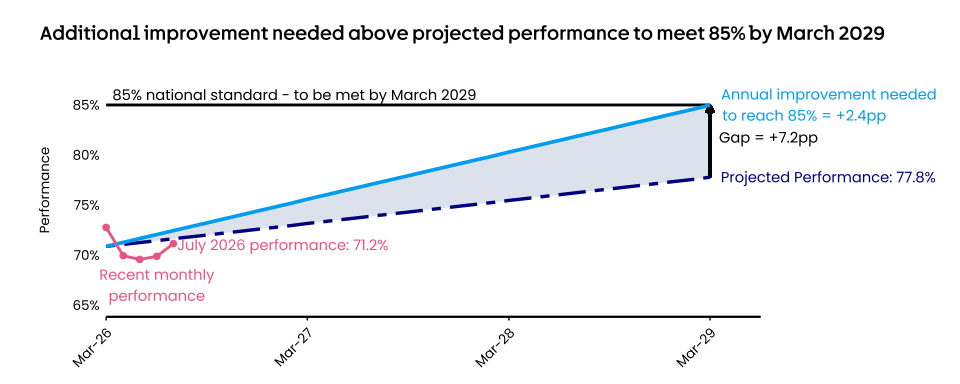
A scenario looking at if improvements should stall was also assessed. Performance against the 62-day standard between October 2025 and March 2026 was 70.1%. Should performance remain at this level rather than continue to improve, we estimate more than 104,000 fewer people would start treatment between March 2026 and March 2029 compared to if the targets were achieved. This is more than twice the additional patients compared to if performance continued as projected.
Waiting to start cancer treatment can be a stressful and difficult time for cancer patients, with lengthy waits potentially impacting patient experience and treatment outcomes. This analysis shows that despite modest improvements to cancer waiting times performance over recent years, the commitments set out by the Government and the NHS are likely to be missed.
There is a short window for the UK Government to correct the performance trajectory set out in this analysis and achieve the National Cancer Plan commitment to meet cancer waiting time targets by March 2029. Doing so is essential if the Government is to keep its promise to people affected by cancer. To make meaningful improvements, the Government will need to guarantee greater operational focus and sufficient resources for cancer services.
The next Spending Review, anticipated in early 2027, will be an important opportunity for Government to make any additional investments required to expand capacity in pursuit of achieving cancer waiting time targets.
Read the report in fullKatie Sutton, Martina Slapkova, Matt Grant, Scarlett Cartwright-Hughes, Lucy Ironmonger, Sophia Lowes, Jon Shelton, Matt Sample, Holly Norman for the Health Policy and Evidence Department at Cancer Research UK.
If you have any comments, questions or feedback, please reach out to our team.