This analysis aimed to estimate the number of people not up to date with screening in the UK, using publicly available data from each of the UK’s national cancer screening programmes.
Eligibility across breast, bowel and cervical screening was considered. For each individual screening programme:
Around 6.2 million women are not up to date with their cervical screening in the UK.
Around 3.7 million people are estimated to not be up to date with their bowel screening in the UK.
Around 2.3 million women are estimated to not be up to date with their breast screening in the UK.
We used data from the individual programmes to generate a minimum estimate of the number of people who are not up to date with cancer screening in the UK. Between the ages of 50-70, women are eligible for multiple screening programmes. Therefore for these age groups, only one programme was counted to avoid double-counting an individual who might not attend both cervical and bowel screening, for example.
This produced a final estimate of: At least 9 million people in the UK are not up to date with their cancer screening.
There are currently three nationally implemented cancer screening programmes across the four UK nations; breast, bowel and cervical. These programmes aim to detect cancer early or prevent it developing in the first place.
Participation in these programmes varies by cancer site, year of data, and UK nation, ranging from 75.6% (Scotland – Breast screening 22/23) to 63.3% (Scotland – Cervical screening 23/24) in the most recent data available . Taking part in screening is a choice, but it is a choice that must be equally available to everyone. The reasons for not taking part vary across programmes, but include barriers such as worry about pain, concern around who would carry out the test and messiness of completing a bowel screening kit.
Understanding the size of the population not taking up screening offers could help inform campaigns to increase awareness and reduce barriers to screening. The objective of this project was to estimate the number of people not up to date with screening in the UK.
Data on screening attendance are reported separately by each screening programme. However, people can be eligible for more than one screening programme, and it is not possible to determine one individual’s attendance across multiple programmes (e.g. we cannot see whether the same person attended breast and cervical screening) without access to patient-level data. This means that we could not sum figures on non-attendance from each programme to determine the total number of people not up to date with screening, as that would lead to multiple counting of persons.
Instead, we examined age and sex breakdowns where screening eligibility is mutually exclusive and counted or estimated the unique number of people for each sex and age group that are up to date with screening (See Fig 1). This could then be deducted from the total number of people eligible to generate an estimated minimum number not up-to-date with screening
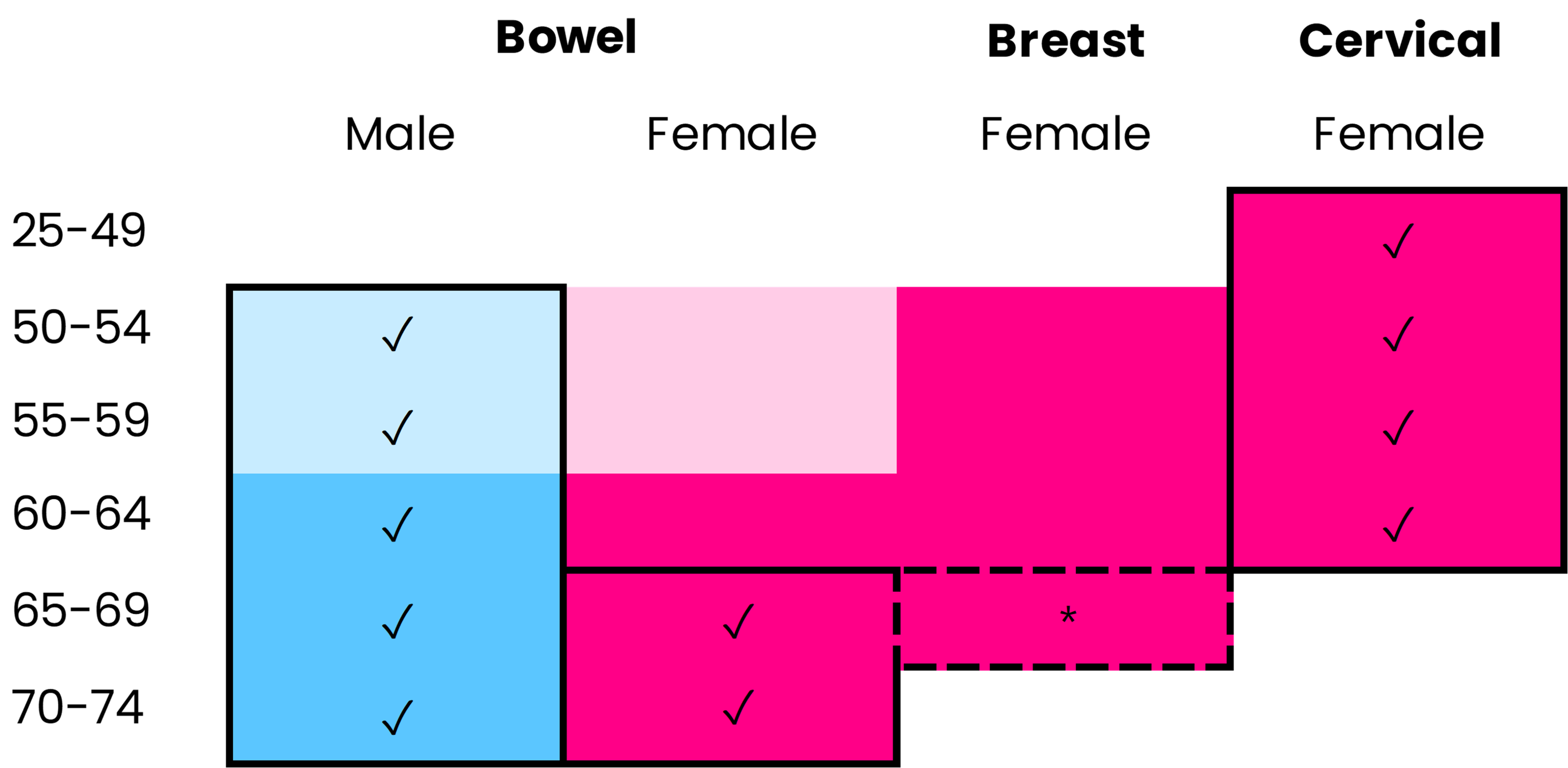
Highlighted cells represent populations eligible for each screening programme. Those highlighted in lighter pink and blue represent screening populations in some UK countries only due to the difference in age ranges. Ticked boxes represents populations included in this modelling. Asterix indicates an alternative group for inclusion which was investigated as a sensitivity analysis.
We therefore estimated the number of:
all males who have not attended bowel screening in the past 30 months (50/55/60-74 year olds, depending on the UK country),
all females who have not attended cervical screening in the past 3 or 5 years (25-64; age-dependent),
females aged 65-74 who have not attended bowel screening in the past 30 months. Or as an alternative, females aged 65-69 who have not attended breast screening in the past 3 years and females aged 70-74 who have not attended bowel screening in the past 30 months.
Data for 2023-24 were used where possible, but earlier data years were substituted where this was not available.
Data on cervical screening coverage were available for all four UK nations. Data were extracted on the number of people eligible for screening and those adequately screened (coverage) in England (2023/24) , Scotland (2023/24) , Wales (2023/24) and Northern Ireland (2023/24) at an age-appropriate interval (3/5 years). The number of people adequately screened was deducted from those eligible in the age-appropriate screening cycle to yield the number of women not adequately screened.
Data on bowel screening coverage were not available by age and sex in any UK nation. Overall coverage was available for England (2023/24) and Wales (2022/24) , and estimated for Scotland and Northern Ireland using two years of uptake data (2022-24). Scotland had data on bowel screening uptake by sex and age (but not coverage), and Wales provided coverage data by sex (but not age and sex).
The proportion of men not screened out of all people were estimated using Wales data, and for women at specific age ranges using Scotland data.
We extracted the number of men and women eligible and screened in Wales and calculated the percentage of those not screened that were made up by men. For other nations, the total number eligible and number screened/not screened were extracted. This proportion from Wales was then applied to the number not 8 screened in each UK country to get an all-male figure.
The remainder provided the total number of women not screened, which needed to be broken down into age bands. Scottish data on uptake were used to look at the age distribution among women who had not taken up their screening invitation. We calculated the proportion of women not screened aged 65-69 and 70-74 out of all women aged 50-74, as well as out of all women aged 55-74 and aged 60-74. This is because each UK country has a different age range, so the denominator of the proportion had to be changed for each country. These proportions were then applied to each UK country to estimate the number of women not screened in each of the age brackets.
Data on breast screening coverage by age were only available for England (2023/24) . Limited data on coverage and eligible populations were available for Wales (2019/20) . The number eligible and number not screened for other UK nations was estimated using three years of uptake data (2020-23 for Scotland and 2021-2024 for Northern Ireland) .
Using England data, we calculated the number of women not screened by age group and the proportion of 65-69 year old women out of those aged 50-70. The proportion among of those age 65-69 were then applied to the number of women not screened in each UK country.
Key statements:
At least 9 million people in the UK are not up to date with their cancer screening.
Around 6.2 million women are not up to date with their cervical screening in the UK.
Around 3.7 million people are estimated to not be up to date with their bowel screening in the UK.
Around 2.3 million women are estimated to not be up to date with their breast screening in the UK.
Estimated number of people not up to date | |
Cervical screening | 6,165,808* |
Bowel screening | 3,736,870 |
Breast screening | 2,333,905 |
Across all UK programmes | |
Scenario 1 (Cervical + Male Bowel + Female Bowel 65-74) | 8,982,007 |
Scenario 2 (Cervical + Male Bowel + Female Breast 65-69 + Female Bowel 70-74) | 8,961,804 |
*Cervical screening is a count not an estimate as figures are reported by all four UK nation
Estimates of bowel screening non-attendance included 1,948,416 men, 517,622 women aged 65-69 and 350,161 women aged 70-74. Estimates of breast screening non-attendance included 497,419 women aged 65-69.
Summing together bowel and cervical data, we estimated 8,982,007 people in the UK were not up to date with at least one screening programme. When considering breast (65-69) and bowel non-attendance (women 70-74) - instead of bowel screening for 65-74 year old women - we estimated 8,961,804 people in the UK were not up to date with at least one cancer screening programme.
This analysis estimated that there are at least 9 million people in the UK not up to date with at least one cancer screening programme. The substantial number of people not up to date with their screening invite shows that there is more to be done in understanding and addressing some of the barriers to engaging with these programmes. While raising awareness of these programmes and their eligible groups is an important first step, we must also ensure we address the multifaceted reasons why people may not feel able to or comfortable attending their screening appointments.
There are several limitations of this estimate. First, data for 2023/2024 were not available across all programmes and nations. Therefore, older years of data had to be substituted. This may underestimate the population eligible for screening and the coverage estimate will not reflect the true recent uptake. Furthermore, for several UK nations, data on coverage by age and sex were not available. This therefore had to be estimated from coverage estimates from other nations, and uptake patterns may not be the same across the UK. Data on lung screening could not be considered because this programme has not been rolled out across the UK and national reporting has not been established. Finally, a key assumption is that if one individual does not attend cervical screening, they will also not attend bowel or breast screening.
This final assumption means that the estimate is likely conservative, reflected in the “at least” 9 million. This estimate could be improved with access to patient level data, linked to screening records across all programmes. However, in the absence of this, the figure helps provide a basic understanding of the minimum number of people who might not be up to date with cancer screening in the UK. Understanding the scale of non-attendance can help with planning engagement activities and reducing barriers to people taking part in screening in future.
Martina Slapkova, Lorna Wills, Scarlett Cartwright-Hughes and Sophia Lowes for the Cancer Intelligence Team at Cancer Research UK.
If you have any comments, questions or feedback, please reach out to our team.
Calculated by the Cancer Intelligence team at Cancer Research UK. This is based on the number of people eligible for cervical screening and those adequately screened (coverage). Using data from all four UK nations, the number of people adequately screened was deducted from those eligible in the age-appropriate screening cycle to yield the estimated number of women not adequately screened.
Calculated by the Cancer Intelligence team at Cancer Research UK. This is based on actual coverage data for England and Wales, and estimated coverage for Scotland and Northern Ireland. The number of men not up to date with bowel cancer screening across the 4 UK nations was estimated from coverage by gender data for Wales. The estimated number of women not up to date with bowel cancer screening aged over the cervical cancer screening eligibility age (65-74) was estimated by the coverage by gender data for Wales and uptake by age group data for Scotland.
Calculated by the Cancer Intelligence team at Cancer Research UK. This is based on breast screening coverage by age data for England, and limited data on coverage and eligible population in Wales. The number eligible and not screened for other UK nations was estimated using three years of uptake data, with coverage by age group based on England proportions.
Calculated by the Cancer Intelligence team at Cancer Research UK. This is based on the number of people not up to date with cervical screening, the estimated number of men not up to date with bowel cancer screening and the estimated number of women not up to date with bowel cancer screening aged over the cervical cancer screening eligibility age (65-74). Number of men not up to date with bowel cancer screening across the 4 UK nations estimated from coverage by gender for Wales. Number of women aged 65-74 not up to date with bowel cancer screening across the 4 UK nations estimated from coverage by gender for Wales and uptake by age group for Scotland.
Public Health Scotland. Scottish breast screening programme statistics: Annual update to 31 March 2023. 2024. https://publichealthscotland.scot/publications/scottish-breast-screeningprogramme-statistics/scottish-breast-screening-programme-statisticsannual-update-to-31-march-2023/.
Public Health Scotland. Scottish cervical screening programme statistics: Annual update to 31 March 2022. 2023. https://publichealthscotland.scot/publications/scottish-cervical-screening- 12 programme-statistics/scottish-cervical-screening-programme-statisticsannual-update-to-31-march-2022/.
Whitelock V. Cancer Research UK’s September 2024 Cancer Awareness Measure ‘Plus’ (CAM+). Data collected via YouGov’s online panel that surveyed 6,844 UK representative adults. 2024. https://www.cancerresearchuk.org/health-professional/awareness-andprevention/the-cancer-awareness-measures-cam-plus.
NHS England. Cervical Screening Programme, England - 2023-2024. 2024. https://digital.nhs.uk/data-andinformation/publications/statistical/cervical-screening-annual/england2023-24.
Public Health Wales. Cervical Screening Programme Reports. 2024. https://phw.nhs.wales/services-and-teams/cervical-screeningwales/information-resources/programme-reports/.
HSC Public Health Agency. Director of Public Health core tables 2023. 2025. https://www.publichealth.hscni.net/publications/director-public-healthcore-tables-2023.
UK Government. Bowel Cancer Screening: Annual Report 2023 to 2024. 2025. https://www.gov.uk/government/publications/bowel-cancer-screeningannual-report-2023-to-2024.
Public Health Wales. Bowel screening Wales annual statistical report 2022- 23. 2024. https://phw.nhs.wales/services-and-teams/screening/bowelscreening/programme-reports/bowel-screening-wales-annual-statisticalreport-2022-23/bowel-screening-wales-annual-statistical-report-2022-23/.
Public Health Scotland. Scottish bowel screening programme statistics: For the period of invitations from May 2022 to April 2024. 2025. https://publichealthscotland.scot/publications/scottish-bowel-screeningprogramme-statistics/scottish-bowel-screening-programme-statisticsfor-the-period-of-invitations-from-may-2022-to-april-2024/.
NHS England. Breast Screening Programme, England, 2023-24. 2025. https://digital.nhs.uk/data-and-information/publications/statistical/breastscreening-programme/england---2023-24.
Public Health Wales. Breast screening programme reports. 2025. https://phw.nhs.wales/services-and-teams/screening/breastscreening/programme-reports/.
