Types of vulval cancer
Melanoma starts in cells called melanocytes. These are pigment producing cells found mostly in the skin.
Most melanomas develop in parts of the body exposed to the sun. But you can get them anywhere, including organs. This is because there are melanocytes in these areas too.
It’s not clear why melanomas can form in parts of the body that are not exposed to the sun.
Vulval melanoma can start anywhere on the vulva. The most common place for it to start is the inner lips (labia) and clitoris.
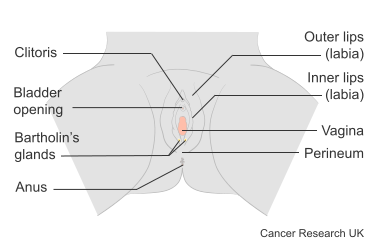
Vulval melanoma is the second most common type of vulval cancer. Less than 10 in every 100 vulval cancers (less than 10%) are melanomas.
It is most often found in women who no longer have periods (post menopause). White women are at higher risk of vulval melanoma than Black women.
The symptoms of vulval melanoma include:
changes in the colour of the vulva
itching
bleeding
a lump
an open sore visible on the skin
You usually have a number of tests to find out if the symptoms you have could be due to vulval melanoma. If you have vulval melanoma you then need more tests to find out how far it has grown.
The tests you might have include:
a vulval examination
taking a sample of tissue called a biopsy
blood tests
scans to look at your pelvis and the rest of your body. This includes a CT and MRI scan
Find out more about these tests
The tests you have helps your doctor find out if you have vulval cancer and how far it has grown. This is the stage of the cancer.
Your doctor might also use a scale to describe how deeply the melanoma has grown into your skin. This is called the Breslow thickness.
You can read about Breslow thickness in our melanoma skin cancer section.
Read more about Breslow thickness
A team of doctors and other professionals recommend the best treatment and care for you. They are called a multidisciplinary team (MDT). The team includes melanoma specialists, specialists in gynaecological cancers and specialist cancer nurses.
The treatment you have depends on:
where the melanoma is
the size of the tumour
whether it has spread
your general health
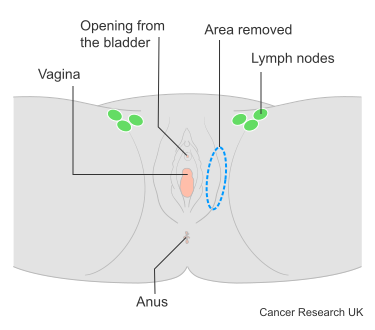
The main treatment for vulval melanoma is surgery. You usually have a type of surgery called a wide local excision.
A wide local excision means that the surgeon removes the area containing the cancer and a border of healthy tissue around it. The border of healthy tissue is called the margin.
After the operation, a looks at the tissue removed. They check the margins for cancer cells. They say that you have clear margins if there are no cancer cells at this border. This lowers the risk of the cancer coming back.
You may need more surgery if there are cancer cells at the margin. You may also need the from the groin removed. Your surgeon will explain in more detail if you need this.
Other treatments you might have include:
targeted cancer drugs and immunotherapy
radiotherapy
Find out more about these treatments in the general treatment section
You may also have treatment as part of a clinical trial. Doctors and researchers do trials to make existing treatments better and develop new treatments. Your doctor will discuss this with you if there is a trial suitable for you.
Find out about the latest research into vulval cancer
You have regular check ups once you finish your treatment. Your doctor will examine you and ask about your general health. This is your chance to ask questions and to tell your doctor if anything is worrying you.
You usually have a check up every 3 months. After 3 years, you may have a check up every 6 months.
Coping with a diagnosis of a rare cancer can be especially difficult, both practically and emotionally. Being well informed about your cancer and its treatment can make it easier to make decisions and cope with what happens.
Find out about coping with vulval cancer
Talking to other people who have the same thing can also help.
Our discussion forum Cancer Chat is a place for anyone affected by cancer. You can share experiences, stories and information with other people who know what you are going through.
Last reviewed: 02 Sept 2025
Next review due: 02 Sept 2028
Vulval cancer is when abnormal cells in the vulva start to divide and grow in an uncontrolled way.
Melanoma skin cancer starts in skin cells called melanocytes. You can get it anywhere on your skin including in a mole, on your palms, the soles of your feet and under your nails.
You have a number of tests to find out if you have vulval cancer. These include a vulval examination and a biopsy.
Advice and support is available to help you cope with vulval cancer and its treatment.
Survival for vulval cancer depends on several factors including the age at the time of diagnosis and the type of vulval cancer.
Vulval cancer is a rare cancer. It can start in any part of the female external sex organs, the vulva. The treatment you need depends on how big the cancer is and whether it has spread.

About Cancer generously supported by Dangoor Education since 2010. Learn more about Dangoor Education


Search our clinical trials database for all cancer trials and studies recruiting in the UK.

Connect with other people affected by cancer and share your experiences.

Questions about cancer? Call freephone 0808 800 40 40 from 9 to 5 - Monday to Friday. Alternatively, you can email us.
