Treatment for cervical cancer
A team of doctors and other professionals discuss the best treatment and care for you. They are called a multidisciplinary team (MDT).
Most people are referred to a cervical cancer MDT. You might go to a different hospital if there isn't a specialist MDT at your local hospital.
The team usually includes:
a doctor who treats conditions of the female reproductive system (gynaecologist)
a specialist surgeon
cancer specialists (oncologists) who specialise in treating cancer with cancer drugs (medical oncologist) and radiotherapy (clinical oncologist)
a specialist cancer nurse (also called clinical nurse specialist)
a pathologist (an expert who examines any cancer or tissue the surgeon removes)
a pharmacist
a radiologist (who looks at your scans and x-rays)
a dietician (who offers support and advice about eating and drinking)
The MDT may also include health professionals who look after people with metastatic (advanced) cervical cancer. They can help with symptom control. They include:
the team
a clinical nurse specialist for palliative care
Your doctor will talk to you about the treatment they suggest. They will explain its benefits and the possible side effects.
Your treatment will depend on:
where your cancer is
how big it is and whether it has spread (the stage)
the type of cancer
how abnormal the cells look under a microscope (the grade)
your general health and level of fitness
Deciding about treatment can be difficult when you have metastatic cancer.
It helps to understand:
what treatment can do for you
how it might affect your quality of life
what side effects it has
Your doctor or specialist nurse can talk to you about the benefits and possible side effects. You can ask them questions.
You might also find it helps to talk things over with a close relative, a friend or a counsellor at the hospital.
Your doctor might offer you a choice of treatments. Discuss each treatment with them and ask how they can control any side effects. This helps you make the right decision for you. You also need to think about the other factors involved in each treatment, such as:
whether you need extra appointments
if you need more tests
the distance you need to travel to and from hospital
You might have to make further choices as your situation changes. It helps to find out as much as possible each time. You can stop a treatment whenever you want to if you find it too much to cope with.
You may decide not to have cancer treatments, such as chemotherapy. But you can still have medicines to help control symptoms, such as sickness or pain.
Your doctor or nurse will explain what could help you. You can also ask them to refer you to a local symptom control team to give you support at home.
The main treatments are:
chemotherapy and radiotherapy together ()
plus chemotherapy with or without a
You have one or more of these treatments. This depends on the stage of your cancer and also how well the treatment works.
Find out about the stages of cervical cancer
If you have abnormal cervical cells which were picked up through screening, this isn’t the right section for you.
Go to treatment for abnormal cervical cells
Early stage cervical cancer means the cancer:
is only in the neck of the womb (stage 1A or 1B)
has started to grow into the top of the vagina (stage 2A)
Read more about stage 1 and 2 cervical cancer
It can usually be cured with:
surgery
a combination of chemotherapy and radiotherapy (chemoradiotherapy)
For some very early cervical cancers (stage 1A1), it might be possible to remove all of the cancer with a:
large loop excision of the transformation zone (LLETZ)
cone biopsy
Doctors usually use these treatments for women with abnormal cervical cells picked up through cervical screening.
Read about having a LLETZ or cone biopsy
Surgery usually means that you have your womb and cervix completely removed (hysterectomy).
If you have stage 1 cervical cancer and want to have children, it may be possible to have an operation called a radical trachelectomy. This removes most of the cervix but leaves enough behind so that you might be able to become pregnant and carry a baby afterwards.
You need to talk to your doctor to find out if you can have this type of operation. It’s not possible to do it for everyone with early cervical cancer. If you do have a trachelectomy, your doctor still can’t guarantee that you will be able to have children afterwards.
If the cancer has started to grow further into the tissues of the cervix (stage 1A2 and above), your doctor will also remove the lymph nodes in your pelvis (lymphadenectomy). This is because there is a risk the cancer may have spread from the cervix to nearby lymph nodes.
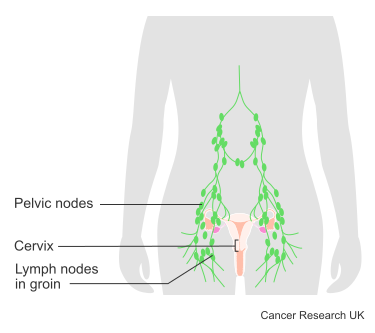
If you have surgery and your doctor is not sure that all the cancer cells have been removed, they may recommend that you have a course of chemoradiotherapy afterwards. This lowers the risk of the cancer coming back.
For some larger early stage cancers (stage 1B or stage 2A), your doctor may suggest chemoradiotherapy instead of surgery.
You have daily external radiotherapy for 5 days every week for around 5 weeks. You also have a boost of internal radiotherapy ( ) at the end of your course.
During your course of radiotherapy, you also have chemotherapy once a week.
Chemoradiotherapy for cervical cancer
Advanced cervical cancer means cancer that has grown into the tissues around the cervix or has spread further.
For stages 2B, 3 and 4A (locally advanced) cervical cancer, you are most likely to have chemoradiotherapy. You might have chemotherapy before these treatments. This is called neoadjuvant chemotherapy.
Read more about the stages of cervical cancer
For cervical cancer that has spread further away in the body, such as the lungs (stage 4B or metastatic cancer), you might have:
chemotherapy
radiotherapy
the immunotherapy drug pembrolizumab plus chemotherapy with or without the targeted cancer drug bevacizumab
other medicines to help with symptoms (symptom control)
surgery – to relieve symptoms, your doctor might suggest an operation if the cancer is causing a blockage in the kidneys or bowel
Health problems might mean you can’t have surgery, or you could decide you don’t want it. You have tests to check how fit you are before you have any treatment including heart and lung tests.
When surgery isn’t possible, you might have one or more of these treatments:
chemoradiotherapy
radiotherapy
chemotherapy
symptom control
Your doctor might ask if you’d like to take part in a clinical trial. Doctors and researchers do trials to make existing treatments better and develop new treatments.
Last reviewed: 26 Oct 2023
Next review due: 26 Oct 2026
Your treatment depends on several factors. These include what type of cervical cancer you have, how big it is, whether it has spread (the stage) and the grade. It also depends on your general health.
Your biopsy result may show you have abnormal cell changes called CIN or CGIN. You might need treatment for the cell changes.
Advanced cervical cancer means the cancer has spread from the cervix to another area of the body.
There is support available during and after treatment to help you cope. This includes support from your clinical nurse specialist, cancer charities, community services, and family and friends.
Cervical cancer is when abnormal cells in the lining of the cervix grow uncontrollably and eventually form a growth (tumour).



