Stages, types and grades of cervical cancer
The stage of a cancer tells you how big it is and whether it has spread. It helps your doctor decide which treatment you need.
Doctors use the International Federation of Gynecology and Obstetrics (FIGO) staging system for cervical cancer. There are 4 stages, numbered 1 to 4.
Stage 1 means that your cancer is within the neck of the womb (cervix). It hasn’t spread to nearby tissues or other organs. It is divided into:
stage 1A
stage 1B
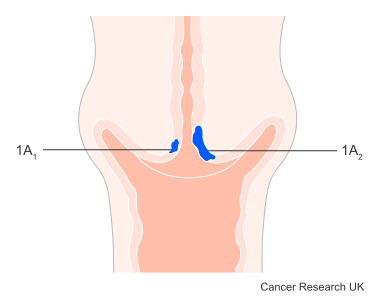
In stage 1A the growth is so small that it can only be seen with a microscope or colposcope. It can be divided into 2 smaller groups:
stage 1A1
stage 1A2
Stage 1A1 means the cancer has grown 3 millimetres (mm) or less into the tissues of the cervix.
Stage 1A2 means the cancer has grown between 3 and 5 mm into the cervical tissues.
In stage 1B the cancerous areas are larger, but the cancer is still only in the tissues of the cervix and has not spread. It has grown deeper than 5mm. It can usually be seen without a microscope, but not always. It can be divided into 3 groups:
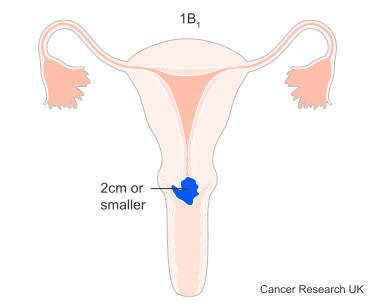
stage 1B1
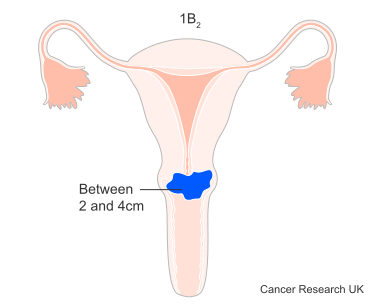
stage 1B2
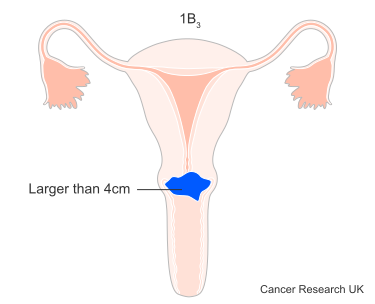
stage 1B3
In stage 1B1 the cancer is deeper than 5mm but no more than 2cm in size.
In stage 1B2 the cancer is at least 2cm but not bigger than 4cm in size.
In stage 1B3 the cancer is larger than 4cm but is still only in the cervix.
The stage of your cancer helps your doctor to decide which treatment you need. Treatment also depends on:
your type of cancer (the type of cells the cancer started in)
where the cancer is
other health conditions that you have
Stage 1 cervical cancer is usually treated with:
cone biopsy or surgery
combined chemotherapy and radiotherapy (chemoradiotherapy)
Read more about how your doctor decides which treatment you need
For stage 1A1 cancers, it might be possible to remove all of the cancer with a cone biopsy or a large loop excision of the transformation zone (LLETZ). These treatments are also used for women with abnormal cervical cells that are picked up through cervical screening.
If the cone biopsy has positive margins (the border around the tumour contains cancer cells), you will have another cone biopsy.
Some people with stage 1A1 cancer may also have lymph nodes removed if there is a risk that the cancer cells may spread to lymph nodes. Your doctor may offer this if the cancer cells show lymphovascular space invasion (LVSI).
If you have completed your family or preserving fertility is not a concern for you, treatment might be a simple hysterectomy. This includes removal of the:
cervix
womb
fallopian tubes
Read about having a LLETZ or cone biopsy
If you wish to preserve your fertility, your doctor may offer you one of the following treatments for stage 1A2 cancer:
a cone biopsy
removal of the cervix only (simple trachelectomy)
removal of the cervix, tissue around the cervix and upper part of the vagina (radical trachelectomy)
Whether you’d be able to have these treatments will depend on whether:
the surgeon can achieve a clear margin (a border with no cancer cells around the tumour)
no lymph nodes with cancer cells are found
If the above treatments are not possible, you might have a simple or radical hysterectomy. Which surgery you will have, will depend on your individual circumstances.
A simple hysterectomy includes the removal of the:
cervix
womb
fallopian tubes
A radical hysterectomy includes the above, as well as the:
tissue around the cervix
the upper part of the vagina
lymph nodes in the area between the hip bones (pelvis)
it might include removal of the ovaries
Your doctor might offer you to participate in a clinical surgery trial. If not, the standard treatment is a radical hysterectomy. This includes the removal of the:
cervix
womb
fallopian tubes
tissue around the cervix
the upper part of the vagina
it might include the removal of the ovaries
During surgery, your surgeon may also remove the lymph nodes in the area between the hip bones (pelvis).
Find out about surgery for cervical cancer
With this treatment, you have chemotherapy during your course of radiotherapy.
You might have chemoradiotherapy if:
you have cancer cells in lymph nodes or the tissues around the cervix
the border around the tumour contains cancer cells (positive margins)
there is a high level of lymphovascular space invasion
your tumour is larger than 4cm (stage 1B3)
you are not fit for surgery but your doctor think you are fit enough for chemoradiotherapy
You have daily external radiotherapy for 5 days every week for 5 to 5 and a half weeks.
During your course of radiotherapy, you also have chemotherapy once a week.
You also have a boost of internal radiotherapy (brachytherapy) at the end of your course of external radiotherapy.
Find out more about chemoradiotherapy
Last reviewed: 23 Oct 2023
Next review due: 23 Oct 2026
The stage of a cancer tells you about its size and whether it has spread. The type means the type of cell the cancer started from. The grade means how abnormal the cells look under the microscope.
If you have been diagnosed with cervical cancer, you might have surgery, chemotherapy with radiotherapy (chemoradiotherapy), chemotherapy, radiotherapy, or a targeted cancer drug and an immunotherapy drug. What treatment you'll have will depend on several things.
Your treatment depends on several factors. These include what type of cervical cancer you have, how big it is, whether it has spread (the stage) and the grade. It also depends on your general health.
You usually start by seeing your GP if you have symptoms that could be due to cervical cancer. Your doctor will then decide whether to do tests or refer you to a specialist.
Survival depends on many factors including the stage and type of your cervical cancer.
Cervical cancer is when abnormal cells in the lining of the cervix grow uncontrollably and eventually form a growth (tumour).

About Cancer generously supported by Dangoor Education since 2010. Learn more about Dangoor Education


Search our clinical trials database for all cancer trials and studies recruiting in the UK.

Connect with other people affected by cancer and share your experiences.

Questions about cancer? Call freephone 0808 800 40 40 from 9 to 5 - Monday to Friday. Alternatively, you can email us.
