Surgery for rectal cancer
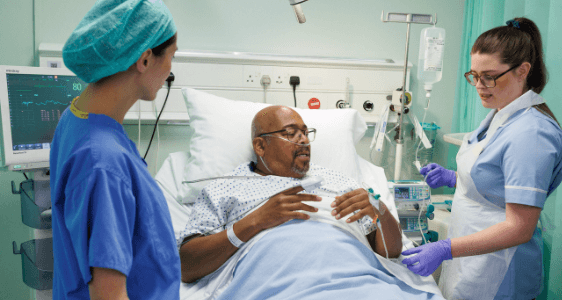
After a big operation, you might wake up in the (ICU) or (HDU). You usually move back to the ward in a day or so.
In ICU you have one to one nursing care. And in the high dependency unit you have very close nursing care. Your surgeon and anaesthetist also keep an eye on your progress.
These units are busy and often noisy places that some people find strange and disorientating. You might feel drowsy because of the anaesthetic and painkillers.
When you wake up, you'll have several tubes in you. This can be frightening, so it helps to know what they're for.
You are likely to have a drip into your arm (intravenous infusion) to give you fluids until you are eating and drinking again. You might also have:
a tube into your bladder (catheter) to drain urine
a fine tube (called a wound drain) near the wound to drain away any fluid that collects and help it to heal
a tube down your nose into your stomach (nasogastric tube) for 24 hours, to drain fluids and stop you feeling sick
fine tubes into the muscles either side of the wound to deliver continuous - these are only used after open operations and are called rectus sheath catheters
You may also have an oxygen mask on.
Electronic pumps may control any medicines you have through your drip.
It's normal to have pain for the first week or so. Your doctor and nurses will give you painkillers.
Tell your doctor or nurse as soon as you feel pain. They need your help to find the right type and dose of painkiller for you. Painkillers work best when you take them regularly.
Immediately after surgery you can have painkillers through either:
a drip into your bloodstream that you control (PCA or patient controlled analgesia)
small thin tube put into your back and connected to a pump that gives you a constant dose of painkiller (epidural)
You'll have painkillers to take home. Follow the instructions your nurse gives you about how often and how to take them. Contact your doctor if you still have pain or if it gets worse.
You are usually able to eat and drink again soon after surgery. You might have nutritional supplement drinks for a few days, to help your recovery. A dietitian will give you advice on diet.
If you have problems with eating and drinking some people might need a feeding tube to help maintain their nutrition. The tube can go into the small bowel through your nose, or into a vein (drip).
Find out more about coping with eating and drinking
Your nurses and physiotherapists will help you to move around as soon as possible. They check you're doing your breathing and leg exercises. This helps you recover.
You might be sitting in a chair within 12 hours of your operation. The day after, you might be walking around your bed. And within a few days you'll be able to walk along the hospital corridor.
During the first 24 hours after your operation, you’ll start to feel better. The drips will come out, you’ll start eating and can move about better.
You’ll begin to feel like you’re making progress.
Most people go home about a week after surgery.
You have dressings over your wounds.
You have 1 wound if you have open surgery.
You may have 3-5 smaller wounds if you have keyhole (laparoscopic) surgery. You may also have a 5-6cm wound where part of your bowel was taken out. This wound can be in different areas of the body, depending on the type of operation, previous scars and your body shape.
After a couple of days your nurse changes the dressings and cleans your wounds.
Most hospitals use stiches that dissolve. These do not need removing. Otherwise your stiches stay in for at least 10 days.
Your doctor or nurse will tell you when the stitches need to come out. The nurse might remove them before you go home. Or you might go home with the stitches in, and a district nurse or practice nurse takes them out.
Before you go home the nurse gives you information about how to care for your wound. If you have a stoma (ileostomy or colostomy) the nurse will show you how to care for your stoma.
Read more about coping with a stoma
You'll need help when you first go home. The dietitian will talk to you and your family about what to eat. It can take some time to find what works for you.
You're likely to feel very tired for several weeks and sometimes months after your surgery. It helps to do more every day. Try:
sitting for less time each day
walking around the house a bit more each day
building up to walking outside
What you can do depends on how fit you were before surgery and any problems you have afterwards. Talk to your physiotherapist or your doctor if you're unsure about what you should be doing.
Contact your doctor or specialist nurse if you have any problems or symptoms you are unsure about.
You'll have follow up appointments to check your recovery and sort out any problems. They're also your opportunity to raise any concerns you have about your progress.
There is a risk of problems or complications after any operation. Possible problems after bowel cancer surgery include a leak where the surgeon has joined the ends of your colon together, or your bowel not working properly. Other possible problems include infection, blood clots and bleeding.
Last reviewed: 04 Mar 2025
Next review due: 04 Mar 2028
This section is about treatment for cancer that starts in the back passage (rectal cancer). The main treatments are chemotherapy, surgery, radiotherapy and chemoradiotherapy.
After treatment, you have regular check ups and tests at the hospital. The doctors check how you are and see whether you have any problems or worries.
Coping with cancer can be difficult. You might need emotional, practical and financial support. There is support available from your hospital team.
You might have a colostomy or ileostomy after surgery for bowel cancer. The end of your bowel is brought out into an opening on your tummy. The opening is called a stoma or ostomy.
On the day of your operation, you need to do things including stopping eating for a few hours.
Bowel cancer means cancer that starts in the colon (large bowel) or back passage (rectum). It is also known as colorectal cancer.



