Stages, types and grades
Stage 3 bowel (colon and rectal) cancer has spread to nearby , but hasn't spread to distant body parts. It's divided into 3 groups - 3A, 3B and 3C.
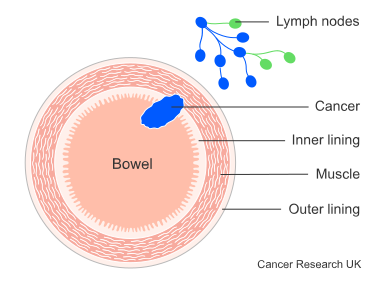
Stage 3A means one of the following:
the cancer is still in the inner or muscle layer of the bowel wall, and it has spread to between 1 to 3 nearby lymph nodes or to areas of tissue close to the lymph nodes
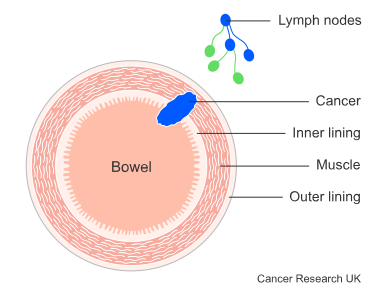
the cancer is in the inner layer of the bowel wall and has spread to between 4 and 6 nearby lymph nodes
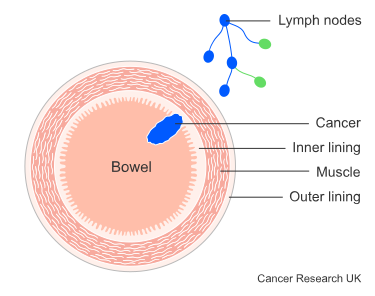
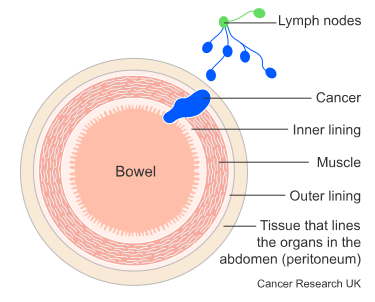
Stage 3B means one of the following:
the cancer has grown into the outer lining of the bowel wall or into the tissue layer covering the organs in the tummy (abdomen) and it has spread to between 1 and 3 nearby lymph nodes or to areas of fat close to the lymph nodes
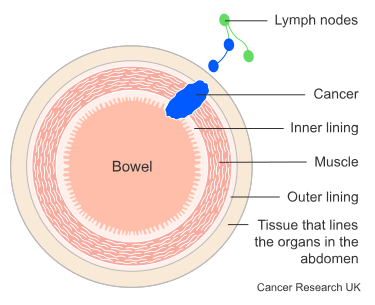
the cancer has grown into the muscle or outer lining of the bowel wall and between 4 to 6 nearby lymph nodes contain cancer
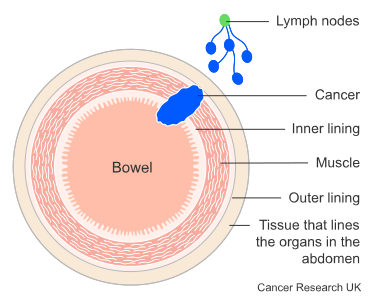
the cancer is still in the inner or muscle layer of the bowel wall and it has spread to 7 or more nearby lymph nodes
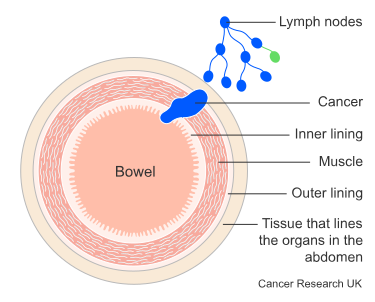
Stage 3C means one of the following;
the cancer has grown through the outer lining of the bowel wall into the tissue layer covering the organs in the tummy (abdomen) and between 4 to 6 nearby lymph nodes contain cancer
the cancer has grown into the outer lining of the bowel wall or into the tissue layer covering the organs in the abdomen and it has spread to 7 or more nearby lymph nodes
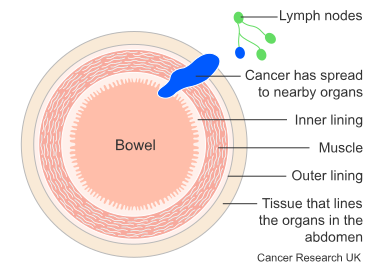
the cancer has grown through the bowel wall into other nearby organs and it has spread to at least one nearby lymph node or to areas of fat close to the lymph nodes
The TNM staging system stands for Tumour, Node, Metastasis.
In TNM staging stage 3A is one of the following:
T1 - T2, N1 - N1c, M0
T1, N2a, M0
In TNM staging, stage 3B is one of the following:
T3 - T4a, N1 - N1c, M0
T2 - T3, N2a, M0
T1 - T2, N2b, M0
In the TNM staging, stage 3C is the same as one of the following:
T4a, N2a, M0
T3 - T4a, N2b, M0
T4b, N1 - N2, M0
You have surgery to remove your cancer.
Your surgeon might suggest before or after surgery.
Chemotherapy before surgery can shrink the cancer to make it easier for to remove. Chemotherapy after surgery can lower the chance of your cancer coming back after surgery.
You might be offered your chemotherapy treatment as part of a .
Read more about treatment for colon cancer
The main treatments are:
surgery
radiotherapy
chemotherapy
chemotherapy combined with radiotherapy (chemoradiotherapy)
You might have:
surgery as your only treatment
a short course of radiotherapy, followed by surgery
a course of chemoradiotherapy, followed by surgery
a course of chemotherapy, followed by surgery
total neoadjuvant therapy (TNT) – this might be chemoradiotherapy and a course of chemotherapy all before surgery
Your doctor might offer you chemotherapy after surgery. This might be if tests on your cancer after surgery show there is a high risk of it coming back. You're more likely to have chemotherapy after surgery if you did not have it before surgery.
Read more about treatment for rectal cancer
Last reviewed: 09 Jan 2025
Next review due: 09 Jan 2028
The stage of a cancer tells you how far it has grown through the bowel wall and whether it has spread to nearby lymph nodes or other organs. It helps your doctor to know which treatment you need.
Treatment depends on whether you have colon or rectal cancer, as well as your cancer stage. You might have surgery, radiotherapy or chemotherapy or a combination of these.
Living with bowel (colorectal) cancer may mean you have changes to your diet, sex life or body image. There is support to help you cope.
You usually start by seeing your GP and they might refer you to a specialist and organise tests. Get information on what happens, and read about screening for bowel cancer.
Bowel cancer means cancer that starts in the colon (large bowel) or back passage (rectum). It is also known as colorectal cancer.

About Cancer generously supported by Dangoor Education since 2010. Learn more about Dangoor Education


Search our clinical trials database for all cancer trials and studies recruiting in the UK.

Connect with other people affected by cancer and share your experiences.

Questions about cancer? Call freephone 0808 800 40 40 from 9 to 5 - Monday to Friday. Alternatively, you can email us.
