Surgery for soft tissue sarcoma
Surgery to an arm or leg (limb) for soft tissue sarcoma is a very specialised treatment. A surgeon who is trained and experienced in this area will do your operation.
You might need to travel to a specialist centre to have your surgery.
Your surgeon mostly will be able to remove the cancer without removing the affected limb. This is called limb sparing or limb salvaging surgery.
Rarely, the only possible treatment is to remove the limb or part of the limb. This is called amputation. You might need to have an amputation rather than limb sparing surgery if:
the cancer has grown into the major nerves and blood vessels around it
the position of the tumour means that limb sparing surgery is not possible
it is not possible to completely remove the cancer with limb sparing surgery
Your surgeon might recommend you have an amputation. This might be if the sarcoma comes back after limb sparing surgery.
A team of health professionals will look after you. They are called the multidisciplinary team (MDT). They include:
specialist sarcoma surgeons
cancer specialists (oncologists)
a specialist nurse
an anaesthetist (a specialist doctor who looks after you during the operation and gives you the medicines you need)
physiotherapists or occupational therapists
a prosthetist (a person who is trained to make and fit artificial body parts, for example, arms or legs)
a specialist looking at cells under the microscope (pathologist)
a doctor specialising in diagnosing disease through imaging such as x-rays and MRI scans (radiologist)
The team will help you prepare for your operation. They will also help with your recovery and rehabilitation afterwards.
Limb sparing surgery removes as much of the cancer as possible without removing the affected arm or leg.
Your surgeon will try to completely remove the cancer. This includes a border of healthy tissue (margin) around it. Removing a border of healthy tissue with no cancer cells lowers the risk of the sarcoma coming back.
During some operations for soft tissue sarcoma, your surgeon might need to remove a large area of tissue. So, you might need some plastic surgery to repair the area. This happens at the same time as your operation to remove your cancer.
Plastic surgery aims to give you a result that is as natural looking as possible. It also tries to keep normal functioning or movement in that area of the body.
The exact operation you have will be unique to you. It will depend on where you have the sarcoma in the body and how much tissue the surgeon has to remove.
With any operation, the risks include infection and bleeding. Your surgeon can talk you through your operation and any problems you might have.
Read more about plastic surgery
Removing all or part of your limb is called an amputation.
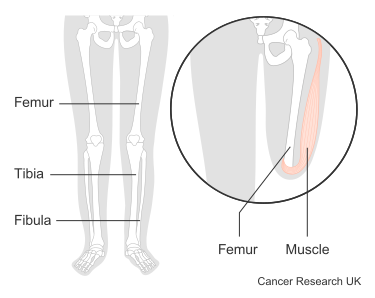
Removing a limb is major surgery. Your MDT will talk with you about what to expect during and after your amputation.
The remaining stump of your limb is covered with tightly fitting bandages when you wake up. This maintains the shape of the stump. It also helps to make sure your artificial limb (prosthesis) will fit well.
Once the stump has healed, you will have an artificial (prosthetic) arm or leg fitted. A prosthetist will visit you before and after your operation. They will explain the types of artificial limbs you can have and to take measurements.
They make a plaster cast of your stump. Then, they use the cast and sometimes computer assisted design (CAD) to create an artificial limb that fits over the stump. They work with you to adjust the prosthesis so that it works as well as possible.
Infection is a risk with any surgery. It is a particular risk for people also having chemotherapy. You will have antibiotics during and after your operation, to try to reduce the risk of infection.
After amputation, some people feel pain in the limb that has been amputated. This is called phantom limb pain. Most people find that this eases off after a while. Some people have more long-term problems with phantom limb pain. If you experience this, discuss this with your doctor. They can prescribe a certain type of painkiller that helps with nerve pain.
There are other risks of having an amputation. Your doctor will talk them through with you. Your doctors will make sure the benefits of having surgery outweigh these possible risks.
Normally you will be fitted with a temporary artificial (prosthetic) limb while your permanent limb is being made. This helps you to become familiar with using one.
You will have physiotherapy and occupational therapy. It will help you to learn how to use your prosthesis. This can be a difficult and frustrating time, but there is a lot of support to help you.
Read more about what to expect after surgery
Having limb sparing surgery or an amputation can be difficult to cope with. Psychological support is very important. If you need to have a limb removed, you are likely to have many strong feelings.
How you look can be an important part of your self esteem. It affects your body image (the way you see yourself). It can be very hard to accept sudden changes to your body.
There are people that can support you. For example, you can ask your doctors and nurses about the support services available to you. There are also support groups and organisations that may be able to help you.
Read more about organisations that can help
At your first appointment, your doctor checks how you are, and asks if you have any problems. They examine you and discuss the results of your operation.
This is also your opportunity to ask any questions. Write down any questions you have before your appointment to help you remember what to ask. Taking someone with you can also help you to remember what the doctor says.
How often you have follow up appointments depends on your situation. Ask your doctor how often you need to have check ups and what they will involve.
Find out more about follow up appointments after surgery for soft tissue sarcoma
Last reviewed: 19 Jul 2024
Next review due: 19 Jul 2027
Before you have surgery for a soft tissue sarcoma you will meet the team caring for you and have some tests to check you are well enough to have the operation.
You have a general anaesthetic so you can't feel anything during the operation. This sends you into a deep sleep.
How you feel after surgery depends on what operation you have. You will need to spend time in the hospital and then give yourself time to recover once you are home.
Soft tissue sarcomas are cancers that develop in the supporting tissues of the body. These include tissues such as the muscle, nerves, fat and blood vessels.



