Surgery
You might have this type of operation for a small stage 1 cancer.
Read about stage 1 cervical cancer
You have the operation while you are asleep (under general anaesthetic). During the operation, your surgeon removes:
the cervix
tissue around the cervix
upper part of the vagina
The womb is left in place. So, it may be possible to have a baby afterwards.
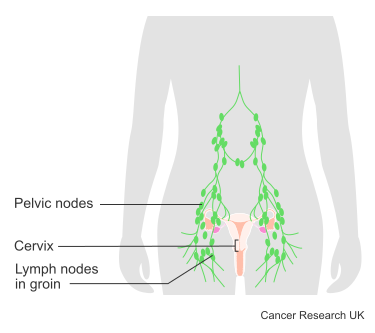
You might also have lymph nodes removed in the area between the hip bones (the pelvis). This is called a pelvic lymphadenectomy. The lymph nodes are part of the lymphatic system. If cancer cells break away from a tumour, they can first travel to the nearest lymph nodes. So, your doctor removes them and checks for cancer cells.
Find out about the lymphatic system
Your doctor will check that you are fit and well enough for a general anaesthetic. They will talk to you about the operation and answer any questions you might have. The operation can be done in several ways. This includes:
a vaginal trachelectomy – the surgeon removes the tumour through the vagina
an abdominal trachelectomy – the surgeon cuts into the tummy (abdomen)
keyhole surgery (laparoscopic surgery) – the surgeon operates through small cuts (keyholes) in your abdomen. They use tools that have a tiny camera attached. This way, they can see the inside of your body on a screen
robotically – the surgeon uses a computer system to help them guide the surgical tools
Having a general anaesthetic means you won’t be able to eat or drink for several hours beforehand. You usually stop eating at least 6 hours before the procedure. You can usually drink water up to 2 hours beforehand. Your nurse will give you instructions about this.
Read more about preparing for surgery
The anaesthetist inserts a small plastic tube (a cannula) into a vein in your arm or hand. This is used to give you fluids and medications. Once you’re asleep from the general anaesthetic, a tube to drain urine (catheter) is inserted into your bladder.
The surgeon removes all of the cervix but leaves behind the internal opening. They stitch this tight, leaving a small opening to allow blood to escape during your period.
The stitch is strong enough to support a growing baby in the future. The baby would have to be delivered by caesarean section.

During the operation, your surgeon removes the lymph nodes around your cervix and womb to check if the cancer has spread. They usually do this by keyhole surgery.
Keyhole surgery is also called minimal access or laparoscopic surgery. Instead of one large wound site on your abdomen, you have several smaller wounds, each usually less than a centimetre long.
Your surgeon usually makes up to 5 small cuts through the skin in your lower abdomen. They put small surgical instruments and a laparoscope through these to carry out the operation. A laparoscope is like a narrow telescope that lights and magnifies the inside of your body. Your doctor can see the images on a TV screen.

In a few specialist hospitals, the doctor may use a special machine (robot) to help with minimally invasive surgery. This is called robotic assisted surgery.
The surgeon sits at a control unit a few feet away from the patient. They control the movement of a set of robotic surgical equipment guided by a video camera. This gives them a 3D view, which they can magnify several times. This helps the surgeon carry out complex operations using very precise movements.
The photo below is an example of robotic surgery. The surgeon sits at the control unit on the right of the picture.

Your surgeon sends the tissue they remove, including the lymph nodes, to the laboratory. This is to check that they have removed all of the cancer in the cervix and to see if there are any cancer cells in the lymph nodes.
Your specialist will offer you more treatment if there is a risk that cancer cells have been left behind or if there is any sign that the cancer has spread. This might include:
surgery to remove your womb (hysterectomy)
chemotherapy with radiotherapy (chemoradiotherapy)
Having further treatment means that you will no longer be able to become pregnant in the future. This can be very upsetting if you are hoping to have a family. Your doctors and nurses will do all they can to support you.
Read more about treatment for cervical cancer
You usually stay in hospital for 1 or 2 nights. It can take up to 4 to 6 weeks to fully recover from the operation.
Find out what to expect after surgery
There are risks with any type of surgery, but most women don’t have problems after a radical trachelectomy. Your doctor ensures the benefits of having the surgery outweigh any possible risks.
Read about the possible problems after surgery for cervical cancer
Last reviewed: 26 Oct 2023
Next review due: 26 Oct 2026
Before surgery for cervical cancer, you have tests to check your fitness and you meet members of your treatment team.
After surgery to remove your cervix or womb, most people can go back to normal activities after a few weeks, but it can take up to 3 months to fully recover.
A radical hysterectomy is an operation to remove the cervix, tissues around the cervix, womb, fallopian tubes and top part of the vagina. It might also include removal of the ovaries.
Treatment for cervical cancer during pregnancy depends on the type of cervical cancer, its stage, how many weeks pregnant you are and what your wishes are.
Cervical cancer is when abnormal cells in the lining of the cervix grow in an uncontrolled way. The cervix is part of the female reproductive system.



