After surgery
Before offering surgery to you, your surgeon makes sure the benefit of having the operation outweighs the possible risks.
Your surgeon will talk to you about the possible complications of the surgery and having a before you sign the consent form to have the operation. Your doctors and nurses monitor you very closely after the operation to check for any problems.
Most problems are minor but some can be serious. Treating them as soon as possible is important.
Some of the complications below are caused by the mastectomy. Others are related to surgery to remove the lymph nodes in your armpit (axilla) which you have at the same time.
Your nurse will give you the phone numbers of who to contact if you have any problems when you are at home.
After surgery, you're at risk of blood clots developing in your legs. There is also a small risk of a blood clot in your lungs.
To prevent blood clots, your nurses get you up as soon as possible after your operation. They encourage you to move around or do your leg exercises.
To help reduce the risk of blood clots you may have injections to thin the blood (anticoagulants) before, during and after your surgery. Your surgeon will talk to you about this beforehand if you need to have this.
Also, during and after your operation, you wear special stockings (called anti embolism stockings or TEDS).
Most people feel weak and lack strength for some time after surgery. How long this lasts varies between people.
Tell your doctor or nurse if the weakness continues for more than a few weeks. They can suggest things to help, such as physiotherapy.
You might have a small amount of blood on your wound dressing after surgery, which is normal. Your nurse will regularly check your dressing after the operation. Tell your healthcare team straight away if there is more bleeding.
Infection is a risk after any surgery. If you develop an infection you will need to take antibiotics. Usually, this clears up the infection. You might need to stay in hospital longer or go back into hospital if you need antibiotics through a drip.
Tell your doctor, nurse or contact your 24 hour advice line if you have symptoms of an infection. Symptoms can include:
a temperature of above 37.5ºC or above
a temperature below 36ºC
redness or a change in the normal colour of your breast
your breast feels warm
a painful or swollen breast
fluid seeping from the wound (discharge)
feeling cold and shivery
feeing generally unwell
Sometimes fluid collects near the wound and around the armpit. This might happen after your nurse removes the wound drain if you have one.
It can cause:
swelling
pain
an increased risk of infection
The fluid normally goes away on its own within a few weeks.
Your nurse or doctor can drain the fluid with a needle and syringe if the seroma is painful. Sometimes the fluid can build up again after being drained.
Tell your doctor or nurse if you think a seroma is developing.
Occasionally blood collects in the tissues around the wound. This can cause pain and swelling, and the area might feel hard.
The haematoma normally goes away on its own, but it can take a few months. Your doctor or nurse can drain the swelling if needed.
Tell your doctor or nurse if you have any swelling around the wound.
You might have numbness, tingling or a shooting pain in your armpit, upper arm, shoulder or chest wall. This is due to damage to the nerves during surgery. The nerves usually repair themselves, but it can take many weeks or months.
Your doctor or nurse can give you medicines to help with nerve pain.
You might get a fold of excess tissue at the end of your mastectomy scar. This is sometimes called dog ear or coning. This can occasionally cause discomfort if you are wearing a bra or prosthesis. You may need another operation to remove the excess tissue.
Your shoulder might become stiff and painful after breast surgery or removal of the . Your nurse or a physiotherapist will show you exercises to do after your operation to help improve movement in the shoulder.
Read about exercises to do after your operation
You might have some slight swelling in your arm or hand after your operation. This should settle soon after your surgery.
Tell your doctor or nurse as soon as possible if the swelling does not settle or if you have pain or tenderness in your arm or hand.
You are at risk of long term swelling (lymphoedema) in your hand and arm after surgery to remove the lymph nodes in your armpit. This is swelling caused by that can't drain away. It can happen any time after surgery.
Once you have lymphoedema it can’t be cured but early treatment can help to control it. Your nurse will talk to you about ways of preventing lymphoedema.
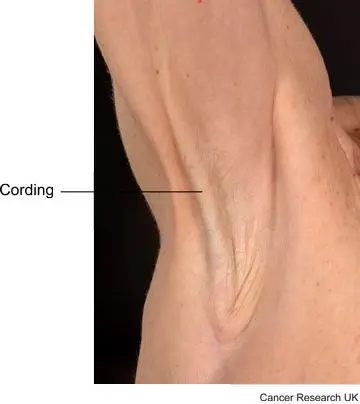
Some women develop scar tissue in the armpit after lymph node removal. The connective tissues in the armpit get inflamed, which forms one or more tight bands. This usually happens within the first few weeks or months after the operation.
The scar tissue is called cording, banding or axillary web syndrome. It can feel something like a guitar string. It can extend down the arm past the elbow, possibly as far as the wrist or thumb.
Cording is harmless but can be painful and may limit your arm movement. Massaging the area regularly can help. Tell your breast care nurse if you develop cording. They can refer you to a physiotherapist. They can show you how to massage the area and teach you stretching exercises. It usually gets better within a few months. Taking anti inflammatory painkillers may also help. Speak to your nurse or doctor about taking these.
Find out about lymph node removal
Last reviewed: 16 Jun 2026
Next review due: 15 Jun 2029
Read about what happens after breast surgery, exercises you need to do, and how to cope with possible problems.
Most people begin their breast cancer treatment with surgery. There are different types of surgery for breast cancer including lumpectomy and mastectomy.
Treatment for breast cancer depends on a number of factors. The main treatments are surgery, chemotherapy, radiotherapy, hormone therapy, and targeted and immunotherapy drugs.
You may find it difficult coping with a diagnosis of breast cancer both practically and emotionally. There are things you can do and people who can help you to cope with your diagnosis.
Breast cancer and its treatment can affect the fluid drainage channels of the lymphatic system. Fluid doesn't drain in the normal way, so the area swells. It is called lymphoedema.
Breast cancer is cancer that starts in the breast tissue. It’s the most common cancer in the UK. It mainly affects women, but men can get it too.



