Stages and grades
Bile duct cancer is also known as cholangiocarcinoma. There are 3 types of bile duct cancer. Your type depends on where the cancer starts in the bile ducts.
This page is about the stages of perihilar bile duct cancer. This cancer starts in the bile ducts just outside the liver.

The other main types of bile duct cancer are:
intrahepatic bile duct cancer
distal bile duct cancer
The stages are different for each type of bile duct cancer.
Find out about the stages of intrahepatic and distal bile duct cancer
The stage of a cancer tells you how big the cancer is and whether it has spread. Your doctor looks at your test results to work out the stage.
Knowing the stage of a cancer is important. This is because it helps your doctor decide which treatment is best for you.
Read about tests for bile duct cancer
There are different ways of staging perihilar bile duct cancer. In the UK, doctors use the:
Bismuth-Corlette classification
TNM system
number staging system
The Bismuth-Corlette classification explains where in the perihilar bile ducts the cancer is. Doctors use this as well as the number or TNM staging system.
The Bismuth-Corlette classification divides perihilar cancers into 4 main types. The type you have depends on where the cancer is in the perihilar bile ducts.
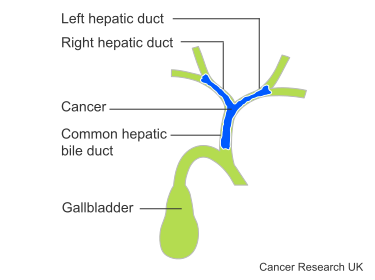
This means the cancer is in the common hepatic duct.

This means that the cancer is in the common hepatic duct. It is also in the junction where the left and right hepatic bile ducts meet.

This is split into two groups:
Type 3A means that the cancer is in the common hepatic duct. It is also in the junction where the left and right hepatic bile ducts meet. And it is in the right hepatic duct.

Type 3B means that the cancer is in the common hepatic duct. It is also in the junction where the left and right hepatic bile ducts meet. And it is in the left hepatic duct.

This means that the cancer is in the common hepatic duct. It is also in the junction where the left and right hepatic bile ducts meet. And it is in both the left and right hepatic ducts.
TNM stands for Tumour, Node and Metastasis. The system describes:
the size of the primary tumour (T)
whether the cancer has spread to the (N)
whether the cancer has spread to another part of the body (M)
There are 4 main T stages for perihilar bile duct cancer. They are numbered T1 to T4.
T1 means the tumour is within the bile duct. But it hasn’t grown outside of the bile duct walls.
T2 is split into 2 groups:
T2a means the tumour has grown through the wall of the bile duct and into the fatty tissue around it
T2b means the tumour has grown into the liver next to the bile duct
T3 means the tumour has grown into the left or right portal vein or hepatic artery.
T4 means the tumour has grown into one of the following:
the main portal vein
the common hepatic artery
both branches of the portal vein
a hepatic bile duct on one side of the liver and a main blood vessel on the other side

There are 3 stages:
N0 means there are no cancer cells in the nearby lymph nodes.
N1 means there are cancer cells in 1 to 3 nearby lymph nodes.
N2 means there are cancer cells in 4 or more nearby lymph nodes.
There are two M stages:
M0 means there is no signs that the cancer has spread.
M1 means the cancer has spread to other parts of the body. Common places for perihilar bile duct cancer to spread include the lungs and parts of the liver further away from the bile ducts.
The number staging system splits perihilar bile duct cancer into 4 main stages. These are numbered from 1 to 4.
This means the tumour is within the bile duct. It has not grown outside the bile duct walls or spread anywhere else.
Stage 1 is the same as T1, N0, M0 in the TNM staging system.
This means the cancer has grown outside of the bile duct walls. It has spread into either:
the fatty tissue around the bile duct
the liver next to the bile duct
Stage 2 is the same as T2, N0, M0.
Is split into 3 groups:
Stage 3a means the cancer has grown into the branches on one side of the portal vein or hepatic artery. These are main blood vessels that carry blood to the liver. They split into two branches as they go into the liver.
It is the same as T3, N0, M0.
Stage 3b means the cancer has grown into either:
the main portal vein
the main hepatic artery
both branches of the portal vein
a hepatic bile duct on one side and one of the main blood vessels on the other side
This is the same as T4, N0, M0.
Stage 3c means the cancer is any size and has spread to between 1 and 3 nearby lymph nodes.
This is the same as any T, N1, M0.
Find out about lymph nodes and cancer
Is split into 2 groups:
Stage 4a means that the cancer is any size and has spread to 4 or more nearby lymph nodes.
This is the same as Any T, N2, M0.
Stage 4b means that the cancer has spread to another part of the body. This can include the lungs and parts of the liver further away from the bile ducts
This is the same as any T, any N, M1.
The stage of the cancer helps your doctor decide which treatment is best for you. Treatment also depends on:
where in the perihilar bile ducts the cancer is
how well your liver works
your general health and level of fitness
if there are changes in the cancer cells
Depending on where the cancer is, you might have surgery. When deciding who can have surgery, doctors usually look at the Bismuth-Corlette type. Your might need an operation for your doctor to find out what the Bismuth-Corlette type is.
Unfortunately, your doctor might not be able to remove the cancer once they know what type it is.
If you can have surgery to remove the cancer, your doctor normally takes out:
the bile ducts outside the liver
gallbladder
nearby lymph nodes
part of the liver
This is a major operation. Your doctor will make sure that you are well enough to have it.
Your doctor might also suggest other treatments to reduce your symptoms and help you feel better. This can include chemotherapy or putting a small tube (stent) in the bile duct. The stent opens up a bile duct that is blocked by the cancer. It means that bile can start to flow again.
Last reviewed: 03 Jul 2024
Next review due: 03 Jul 2027
Bile duct cancer is when abnormal cells in the bile ducts divide in an uncontrolled way. It is also called cholangiocarcinoma.
There are 3 main types of bile duct cancer. Intrahepatic bile duct cancer starts in the liver. Perihilar and distal bile duct cancers start in the bile ducts outside the liver.
Intrahepatic bile duct cancer starts in the bile ducts in the liver. Doctors usually use the number or TNM staging systems to describe intrahepatic bile duct cancer.
Distal bile duct cancer starts in the bile ducts near the pancreas and small bowel. Doctors usually use the number or TNM staging systems to describe distal bile duct cancer.
Treatments for bile duct cancers include surgery, chemotherapy and treatments to control symptoms. The treatments you have depend on the stage of the cancer.
Bile duct cancer is also called cholangiocarcinoma. It is a rare type of cancer that develops in the small tubes that connect the liver and gallbladder to the small bowel.



