What is cancer?
Inside almost every cell in your body is a structure called the nucleus. This is the control centre of the cell. Inside the nucleus are 23 pairs of chromosomes. These are long strings of DNA.
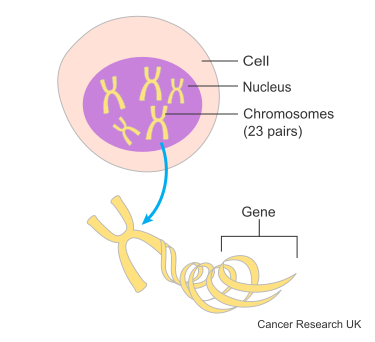
DNA stands for deoxyribonucleic acid (pronounced dee-oxy-rye-bow-nu-clay-ik acid). Each string of DNA looks like a twisted ladder. Scientists call this a double helix.

You have more than 2 metres of DNA inside every cell. But is very tightly coiled up so it all fits. DNA is like a code containing all the instructions that tell a cell what to do. It is made up of genes. Humans have around 25,000 genes in total.
You inherit half your DNA from your mother and half from your father. So you have 2 copies of every gene.
Your genes carry all the information that makes you, you. For example they tell your body to have blonde hair, or brown skin, or green eyes. And they tell your cells:
what sort of cell to be
how to behave
when to grow and reproduce
when to die
Some genes control how much each cell grows and divides.
Our genes pick up mistakes that happen when cells divide. These mistakes (or faults) are called mutations. Mutations can happen throughout our lives, during natural processes in our cells. Or they can happen because of other factors such as:
tobacco smoke
high energy (ionising) radiation, such as x-rays
ultraviolet radiation from the sun
some substances in food
chemicals in our environment
Sometimes people inherit certain faulty genes from their parents. This can mean that they have an increase in their risk of cancer.
It is usual for cells to repair faults in their genes. When the damage is very bad the cell may self destruct instead. Or the may recognise them as abnormal and kill them. This helps to protect us from cancer.
Sometimes mutations in important genes cause a cell to no longer understand instructions. The cell can start to multiply out of control. It doesn't repair itself properly, and it doesn't die when it should. This can lead to cancer.
There are 4 main types of genes involved in cell division. Most tumours have faulty copies of more than 1 of these types. You can read more about the 4 types below.
Oncogenes are genes that, under normal circumstances, tell cells to multiply and divide. In adults this doesn't happen very often.
We can think of oncogenes as being a bit like the accelerator pedal in a car. When they become active they speed up a cell's growth rate. When one becomes damaged, it is like the accelerator pedal becoming stuck down. That cell, and all the cells that grow from it, are permanently instructed to divide. So a cancer develops.
It is usual for cells to repair faults in their genes. When the damage is very bad, tumour suppressor genes may stop the cell growing and dividing.
Mutations in tumour suppressor genes mean that a cell no longer understands the instruction to stop growing. The cell can then start to multiply out of control. This can lead to cancer.
The best known tumour suppressor gene is p53. Researchers know that the p53 gene is damaged or missing in most cancers.
The DNA in every cell in our body is constantly in danger of becoming damaged. But cells contain many different proteins whose job is to repair damaged DNA. Most DNA damage gets repaired straight away because of these proteins.
But if the DNA damage occurs to a gene that makes a DNA repair protein, a cell has less ability to repair itself. So errors will build up in other genes over time and allow a cancer to form.
Scientists have found damaged DNA repair genes in some cancers, including bowel cancer.
Some genes tell a cell to self destruct if it has become too old or damaged. This is called apoptosis or programmed cell death. It is a very complex and important process. Cells usually die whenever something goes wrong, to prevent a cancer forming.
There are many different genes and proteins involved in apoptosis. If these genes get damaged, a faulty cell can survive rather than die and it becomes cancerous.
Last reviewed: 10 Oct 2023
Next review due: 10 Oct 2026
Cancer is the name given to a collection of related diseases. Cancer starts when cells change abnormally.
Unlike normal cells, cancer cells don't stop growing and dividing when there are enough of them. So the cells keep doubling, forming a lump (tumour) that grows in size.
The grade of a cancer tells you how much the cancer cells look like normal cells. The grade gives your doctor some idea of how the cancer might behave.
To start with, cancer cells stay inside the body tissue from which they have developed. The cancer cells grow and divide to create more cells and will eventually form a tumour. Once a cancer can stimulate blood vessel growth, it can grow bigger.
Choose your cancer type from our A-Z list.

About Cancer generously supported by Dangoor Education since 2010. Learn more about Dangoor Education


Search our clinical trials database for all cancer trials and studies recruiting in the UK.

Connect with other people affected by cancer and share your experiences.

Questions about cancer? Call freephone 0808 800 40 40 from 9 to 5 - Monday to Friday. Alternatively, you can email us.
