About Cancer
Upper urinary tract urothelial cancer used to be called transitional cell cancer (TCC) of the kidney or ureter. This is because it starts in cells called transitional cells.
There are many different types of cells in the body, each with a particular job to do. Transitional cells line the renal pelvis, ureters, bladder and urethra. They can change shape and stretch. This means these parts of the body can expand to store urine or to let urine flow through them.
The kidneys are two bean shaped organs, each about the size of a fist. They are near the middle of your back, one on either side of your spine. They are part of the body’s urinary system. They filter waste products out of the blood and make urine. The ureters are the tubes that carry urine from the kidney to the bladder.
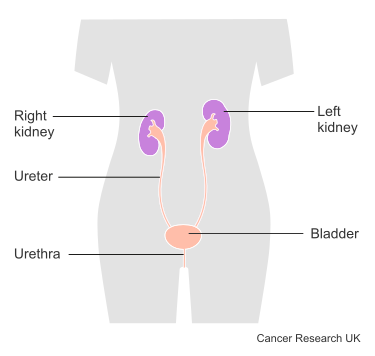
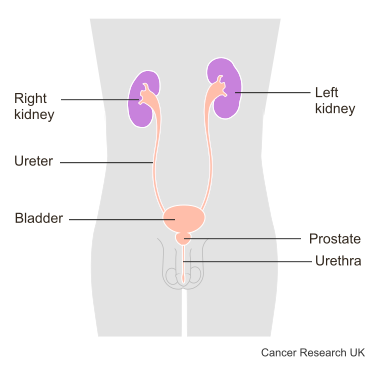
Upper urinary tract urothelial cancer can start in a part of the kidney called the renal pelvis. Or it can start in the ureters.
The renal pelvis is in the middle of the kidney. Urine collects here then drains through the ureter into the bladder. When you empty your bladder, the urine leaves your body through a tube called the urethra.
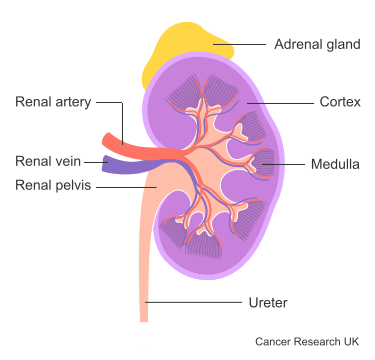
Upper urinary tract urothelial cancer of the kidney is rare. Upper urinary tract urothelial cancer of the ureter is even less common.
You can also get urothelial cancer of the bladder. The bladder is where urine collects before you pee it out. It is in the lower urinary tract. Urothelial cancer of the bladder is the most common type of bladder cancer.
Read more about bladder cancer and its treatment
Anything that can increase your risk of getting a disease is called a risk factor. Different cancers have different risk factors. Having one or more risk factors doesn't mean you will definitely get that cancer.
Upper urinary tract urothelial cancer is more common in older people. It's also diagnosed more often in men than women.
Other factors that increase your risk of upper urinary tract urothelial cancer include:
smoking
aristolochic acid - this is produced by aristolochia plants. It may be found in some herbal remedies and can cause kidney damage
Lynch syndrome – this inherited syndrome increases the risk of several cancers, including urothelial cancer
if you have bladder cancer or have had it in the past
The symptoms of upper urinary tract urothelial cancer include:
blood in your urine
pain in your side between the ribs and the hip (flank)
They are similar to the symptoms of kidney cancer.
Sometimes upper urinary tract urothelial cancer is found when you’re having a scan for something else.
Read more about the symptoms of kidney cancer
Your GP will examine you and test your urine for blood. You may also have blood tests to check your general health.
They may refer you to a specialist doctor (urologist) for further tests to find out the cause of your symptoms. These tests might include:
a test using a CT scan and special dye (contrast medium) to look at the urinary system (CT urogram)
a CT scan of your chest
using a thin flexible tube to look inside your bladder (cystoscopy) or your ureter and kidney (ureteroscopy) to check for abnormal areas - your doctor may take a small piece of tissue (biopsy) to check for cancer
looking for cancer cells in your urine – your doctor sends a sample of your urine to the laboratory to be looked at under a microscope
Occasionally your doctor may want you to have other tests. They will explain what the tests are for and how to prepare for them.
Find out more about tests in our A to Z list
Your doctor considers many factors when deciding which treatment is suitable for you. This includes:
the size of the cancer and whether it has spread to other parts of your body
how abnormal the cancer cells look under the microscope (the grade)
how well your kidneys work
your general health
Surgery is the most common treatment for upper urinary tract urothelial cancer. This is a big operation, so your doctor will check if you’re healthy enough to make a good recovery.
If you have a small cancer that has a low risk of spreading, or your kidneys don’t work very well, you may be able to have a smaller procedure. This means you don’t need to have your kidney removed. This is only possible for a very small number of people. Your doctor will tell you if this is suitable for you.
If the cancer is advanced, or you can’t have surgery, you may have cancer drugs instead of an operation.
Your doctor will talk to you about the treatment options, including the benefits and possible side effects. Some people find it helpful to have a relative or friend with them when they see their doctor. They can:
support you
ask questions
take notes for you
You may find it helpful to talk to your specialist nurse about any worries you have about the treatments before you make your decision.
You usually have surgery if the cancer hasn't spread, and you’re well enough. Your surgeon removes your kidney, ureter and part of your bladder. This is called a radical nephroureterectomy (neff-roh-your-ee-ter-eck-toh-mee).
They might also remove some of the near your kidney and some surrounding tissue.
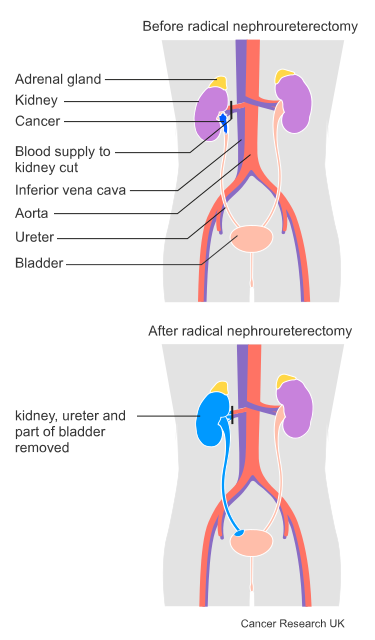
If the cancer is in your ureter, your surgeon may only remove the part with the cancer and not the kidney. This operation has a higher risk of the cancer coming back. So, it’s only recommended for a small number of people with cancer that has a low chance of spreading.
Find out more about having surgery for cancer
For some very small cancers that have a lower chance of spreading, you may have heat or laser treatment to treat the cancer. Your doctor puts a small flexible tube up into your bladder to the ureter. They then use heat or a laser to kill the cancer cells.
Your doctor and specialist nurse will talk with you about preparing for this procedure and how long it may take to recover. They will also talk with you about any side effects you may get and how to manage them.
There is a risk the cancer may come back after this treatment. So, you will have regular follow up appointments to check the area.
Your doctor may recommend you have chemotherapy after surgery if the cancer has:
grown into the layer of muscle or deeper
spread to the nearby lymph nodes
This is to reduce the risk of the cancer coming back. It’s called adjuvant chemotherapy.
Chemotherapy uses anti cancer (cytotoxic) drugs to destroy cancer cells. You usually have 2 chemotherapy drugs. These may be either:
gemcitabine with cisplatin (GC)
gemcitabine with carboplatin (GemCarbo)
Having chemotherapy means that you have to go to the hospital a number of times each month. Tell your doctor and specialist nurse if this might be difficult. They will talk with you about any support that is available.
You have chemotherapy as cycles of treatment. Each cycle of GC or GemCarbo takes 3 weeks, and you have 4 cycles
day 1 – you have gemcitabine with cisplatin or carboplatin
day 8 – you have gemcitabine again
At the end of 3 weeks (21 days) you start a new cycle and go back to day 1. You may find it helpful to write down when you are having treatment in a diary or calendar. You may also want to write down any side effects you get and when. This can help you plan for future cycles.
You have the treatment as a drip into your bloodstream (intravenously). There are different ways to have these drugs.
Read about the different ways to have intravenous chemotherapy
If you have a medical condition that means you can’t have chemotherapy, you may have an immunotherapy drug called nivolumab after surgery. But only if the cancer cells have a protein called PD-L1 on their surface.
PD-L1 stops the immune system from working properly and attacking cancer cells. Immunotherapy drugs like nivolumab help your immune system find and kill the cancer cells.
If you have a nephroureterectomy, your doctor may put a single dose of chemotherapy straight into your bladder. This is called intravesical chemotherapy. You normally have this a few days after your operation while you are still in hospital. It reduces the risk of the cancer coming back in your bladder.
The chemotherapy comes out in your urine. It drains into a bag if you have a catheter in your bladder. You need to be careful to stop the pee touching your skin. Your nurse will explain how to do this.
Advanced upper urinary tract urothelial cancer means that the cancer has grown outside the kidney or ureter (locally advanced). Or has spread to another part of the body (metastatic cancer).
Cancer drugs are the main treatment if either:
the cancer is advanced
you can't have an operation to remove the cancer
You normally have a combination of cancer drugs. Which ones you have depends on a number of factors.
Your doctor might recommend a combination of enfortumab vedotin and pembrolizumab. Enfortumab vedotin is a and pembrolizumab is an immunotherapy.
Find out more about cancer drugs and their side effects from our A to Z list
You may have a combination of chemotherapy drugs. This is either:
gemcitabine with cisplatin (GC)
gemcitabine with carboplatin (GemCarbo)
Occasionally your doctor might recommend you have a combination of the chemotherapy drugs methotrexate, vinblastine, doxorubicin and cisplatin. This is also called MVAC.
If the chemotherapy works well, after 4 to 6 cycles you might have an immunotherapy drug called avelumab. This is to try and control the cancer for longer. It’s called a maintenance treatment.
You have avelumab through a drip into your bloodstream every 2 weeks. You can have it for up to 5 years.
If the cancer cells have PD-L1 protein on their surface, you usually have the immunotherapy drug atezolizumab (Tecentriq).
If the cancer cells don’t have PD-L1 on their surface, your doctor will speak with you about treatment to help relieve any symptoms and improve your quality of life. They call this supportive care or palliative care.
Find out more about supportive or palliative care
Radiotherapy isn't often given for upper urinary tract urothelial cancer. You may have it after surgery if the cancer has spread to the tissue around the kidney.
A very small number of people may have radiotherapy if the cancer has spread to the tissue around the ureter.
Find out more about radiotherapy
Your doctor will speak with you about what treatment is best for you. This depends on what treatment you have already had.
If there are any clinical trials suitable for you, your doctor might ask if you want to take part.
You have regular follow up appointments after your treatment.
You usually have appointments:
every 3-6 months during the first year
every 6 months in the second and third year
yearly afterwards
At these appointments your doctor looks for signs of the cancer coming back or spreading.
As part of your follow ups you have a test to look inside your bladder (cystoscopy). This is because upper urinary tract urothelial cancer can sometimes come back in your bladder. You may also have CT scans.
If the cancer does come back, your doctor will talk to you about further treatment. Unfortunately, this means the cancer is advanced.
If you have advanced upper urinary tract urothelial cancer, when and how often you see your doctor or nurse specialist will vary. This depends on several things including:
how well the treatment is working
if there are other treatments you can have
if you’re taking part in a clinical trial
what symptoms you have
You may also be under the care of doctors and nurses who are experts in symptom control.
It is important that you do not miss your tests and follow up appointments. Make sure you know who to contact if you need to change the date or need help getting to the hospital.
If you move out of the area:
tell your old hospital as soon as you know where you are moving to – depending on where you are going, they might be able to transfer your care to a nearby hospital
tell your new GP that you are being followed up for upper urinary tract urothelial cancer
keep hold of the contact details for your CNS at the old hospital – you may need to talk to them about getting your information to your new doctor
make sure your contact details are up to date
Researchers are looking into developing new treatments and improving existing treatments for upper urinary tract urothelial cancer. These are called clinical trials. Your doctor might talk to you about taking part in a trial. But if they don't, ask them if there are any trials that are suitable for you.
Read more about research and clinical trials
Coping with a diagnosis of a rare cancer can be especially difficult. Being well informed about your cancer and its treatment can help. It can make it easier to make decisions and cope with what happens.
Your CNS and their team are a good source of support. They can talk with you about any support services for you and your family. And they can refer you specialist teams to help you cope.
Find out more about coping with cancer
Email the Cancer Research UK infomation nurses
Talking to other people who have the same thing can also help.
Our discussion forum Cancer Chat is a place for anyone affected by cancer. You can share experiences, stories and information with other people.
This is an alliance of over 100 organisations working to address inequality in funding for rare cancers and improving outcomes for patients.
Email : info@cancer52.org.uk
EURACAN connects patients who have rare adult to expert health care centres across Europe.
RareCan allows people with rare cancer types to share their information with researchers. By doing this they hope to speed up the finding of new treatments and ways to diagnose people with rare cancer. RareCan also allows people to connect with other people who have a rare cancer.
You can find more resources in the kidney and bladder cancer sections of the Cancer Research UK website.
Last reviewed: 28 Mar 2024
Next review due: 28 Mar 2027
A rare cancer is one that affects a small number of people. This can include cancers that start in an unusual place in the body. Or an unusual type of a more common cancer.
Kidney cancer is cancer that starts in the kidneys. The kidneys filter waste products out of your blood as urine. Kidney cancer develops when abnormal cells in either of the kidneys start to divide and grow in an uncontrolled way.
Bladder cancer is cancer that starts in the lining of the bladder.
Find out about tests to diagnose cancer and monitor it during and after treatment, including what each test can show, how you have it and how to prepare.
Treatments can include surgery, radiotherapy and drug treatments (such as chemotherapy, hormone therapy or targeted cancer drugs). Find out about treatments and how to cope with side effects.
Coping with cancer can be difficult. There is help and support available. Find out about the emotional, physical and practical effects of cancer and how to manage them.
This section has been written, reviewed and updated by Cancer Research UK’s Patient Information Web Team. Thanks to the expert medical professionals and people affected by cancer who have helped to review this information.
Professor Alison Birtle (Honorary Clinical Professor & Consultant Oncologist)
Marta Marchetti (Urology and Robotics Surgical Care Practitioner)

About Cancer generously supported by Dangoor Education since 2010. Learn more about Dangoor Education


Search our clinical trials database for all cancer trials and studies recruiting in the UK.

Connect with other people affected by cancer and share your experiences.

Questions about cancer? Call freephone 0808 800 40 40 from 9 to 5 - Monday to Friday. Alternatively, you can email us.
