Stages of stomach cancer
The stage of a cancer tells you how big it is and how far it’s spread. It helps your doctor decide which treatment you need.
Tumour, node and metastasis (TNM) staging is the most common way that doctors stage stomach cancer. They may also use the number staging system.
Your scans will give some information about the stage of your cancer, but your doctor may not be able to tell you the exact stage until you have surgery.
Find out about the number staging system
Tumour describes the size of the tumour.
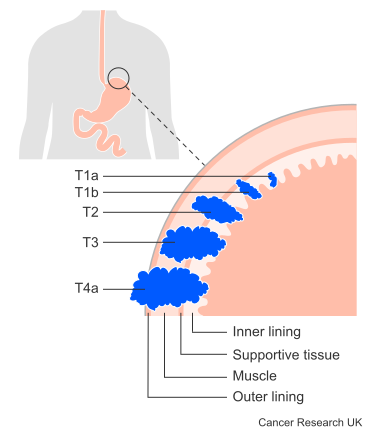
There are 4 main stages of tumour size in stomach cancer.
T1 means the tumour has started to grow into the wall of the stomach. It’s divided into T1a and T1b:
T1a means the tumour is within the inner layers of the stomach (the mucosa)
T1b means the tumour has grown through the mucosa and into a layer of supportive tissue called the submucosa
T2 means the tumour has grown into the muscle layer of the stomach
T3 means the tumour has grown into the outer lining of the stomach
T4 means that the tumour has grown through the outer lining of the stomach. It’s divided into T4a and T4b:
T4a means the tumour has broken through the outer lining of the stomach wall
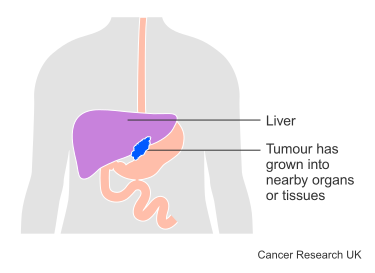
T4b means the tumour has grown through the stomach wall and into other organs or body structures nearby such as the liver, food pipe (oesophagus) or abdominal wall
T4b
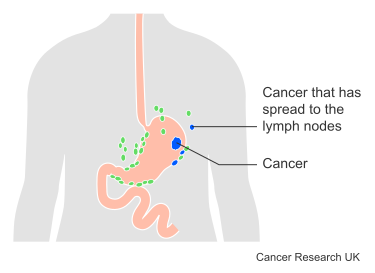
Node (N) describes whether the cancer has spread to the lymph nodes. Lymph nodes are a network of glands throughout the body, for example in your armpits, neck and groins. They drain away waste fluid, waste products and damaged cells, and contain cells that fight infection.
There are 4 possible stages describing whether cancer cells are in the lymph nodes – N0, N1, N2 and N3:
N0 means there are no lymph nodes containing cancer cells.
N1 means there are cancer cells in 1 to 2 lymph nodes near to the stomach.
N2 means there are cancer cells in 3 to 6 nearby lymph nodes.
N3 is split into N3a and N3b:
N3a means there are cancer cells in 7 to 15 nearby lymph nodes
N3b means there are cancer cells in 16 or more nearby lymph nodes
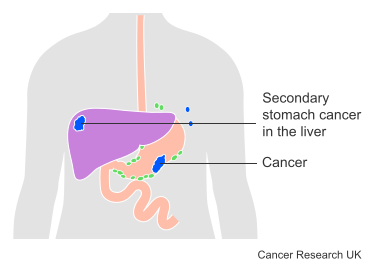
Metastasis describes whether the cancer has spread to a different part of the body.
There are 2 stages of metastasis: • M0 means the cancer has not spread to other organs • M1 means the cancer has spread to other parts of the body
Metastases that have spread from the stomach are also called secondary stomach cancer.
The stage of your cancer helps your doctor to decide what treatment you need. Treatment also depends on:
your type of cancer (the type of cells the cancer started in)
where the cancer is in your stomach
other health conditions
Treatment might include:
surgery to remove part or all your stomach
chemotherapy
radiotherapy
targeted or immunotherapy cancer drugs
symptom control treatment
Chemotherapy in combination with radiotherapy (chemoradiotherapy) is sometimes a treatment to shrink stomach cancer. It is not a common treatment.
You may have treatment as part of a clinical trial.
Last reviewed: 06 Mar 2025
Next review due: 06 Mar 2028
Survival depends on many factors including the stage of your stomach cancer when you are diagnosed and how it has responded to treatment. The figures for stomach cancer survival can only be used as a general guide.
You should see your GP if you notice a change that isn't normal for you. They will do some tests and may refer you to a specialist if they think your symptoms could be due to stomach cancer.
Your treatment depends on whereabouts your cancer is in the stomach. How big it is, whether it has spread anywhere else in your body and your general health.
Coping with cancer can be difficult. Help and support is available. There are things you can do, people to help and ways to cope with a diagnosis of stomach cancer.
The stage of a cancer tells you how big it is and how far it’s spread. It helps your doctor decide which treatment you need.
Stomach cancer is cancer that starts anywhere inside the stomach or the stomach wall. It’s also called gastric cancer.



