Gallbladder cancer
The stage of a cancer describes how big it is and if it has spread elsewhere in the body.
Gallbladder cancer can extend or grow into nearby organs, and tissues. Cancer cells can also break off and spread to nearby and to lymph nodes and parts of the body further away from the original (primary) cancer.
Your tests and scans give some information about the stage of the cancer. But your doctor may not be able to tell you the exact stage until after surgery. And unfortunately, surgery isn't suitable for everyone with gallbladder cancer.
Knowing the stage of a cancer helps your doctor recommend the best treatment for you.
Staging for gallbladder cancer can be difficult to understand. Speak to your doctor or specialist nurse if you have any questions about the stage of the cancer.
For support and information, you can call the Cancer Research UK information nurses. They can give advice about who can help you and what kind of support is available. Freephone: 0808 800 4040 - Monday to Friday, 9am to 5pm.
Doctors normally use the TNM staging system for gallbladder cancer. TNM stands for Tumour, Node and Metastasis.
T - describes how deep the cancer has grown into the layers of the gallbladder. It also tells you if it has grown into nearby blood vessels or organs such as the liver.
N - describes whether there are cancer cells in the nearby lymph nodes.
M - describes whether the cancer has spread further away in the body.
Together the T, N and M stages give a complete description of the stage of the cancer.
There are different layers of the gallbladder. Knowing about the layers helps you understand the T stages. The stages are called Tis (Tumour in situ) and T1 to T4.
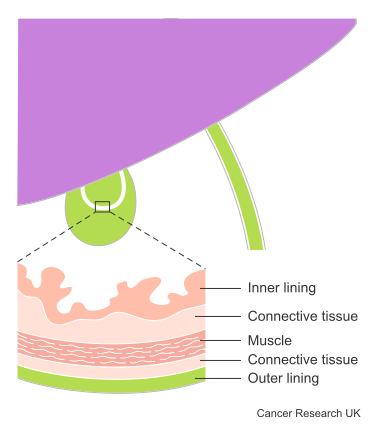
Tis is the earliest possible stage of gallbladder cancer. It is also called . The cancer cells are all inside the inner lining of the gallbladder. It hasn't grown into the other layers of the gallbladder or spread anywhere else in the body.
Unfortunately, gallbladder cancers are rarely found this early. This is only likely if you have had your gallbladder removed for other reasons, such as gallstones.
T1 means the cancer has grown deeper into the layers of the gallbladder. T1 is divided into T1a and T1b:
T1a - the cancer has started to grow into the connective tissue layer underneath the inner lining.
T1b - the cancer has started to grow into the muscle layer underneath this connective tissue.
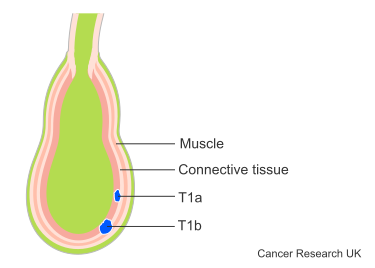
T2 means the cancer is still completely in the gallbladder but has grown through the muscle layer and into the connective tissue underneath.
Some of the gallbladder sits under the liver. T2 is divided into T2a and T2b depending on whether the cancer has grown into the connective tissue near the liver or not.
T2a - means the cancer has grown through the muscle layer into the connective tissue on the part of the gallbladder that is not near the liver. This part of the body is called the .
T2b - means the cancer has grown through the muscle layer and into the connective tissue on the liver side of the gallbladder. It has not spread to the liver.
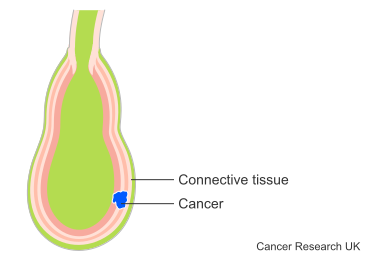
T3 means the cancer has grown in one or more of the following ways:
through all the layers of the gallbladder
into the liver
into one of the other nearby organs such as the stomach, bowel, , or the outside of the liver

T4 means the cancer has grown into either:
one of the main blood vessels of the liver - these are the hepatic portal vein and the hepatic artery
2 or more nearby organs such as the stomach, bowel, omentum or bile ducts outside the liver

There are 3 lymph node (N) stages of gallbladder cancer. Lymph nodes near the gallbladder include those along the main bile duct (common bile duct), hepatic artery and hepatic portal vein.
N0 - means there are no cancer cells in any of the nearby lymph nodes.
N1 - means there are cancer cells in 1 to 3 nearby lymph nodes.
N2 - means there are cancer cells in 4 or more nearby lymph nodes.
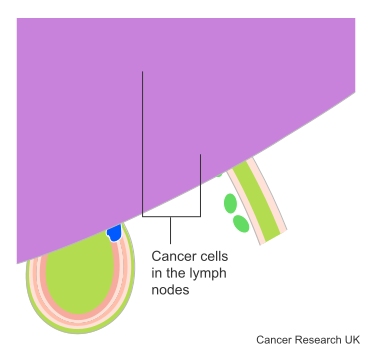
There are 2 metastasis (M) stages of gallbladder cancer.
M0 - means the cancer has not spread to organs or lymph nodes further away from the gallbladder.
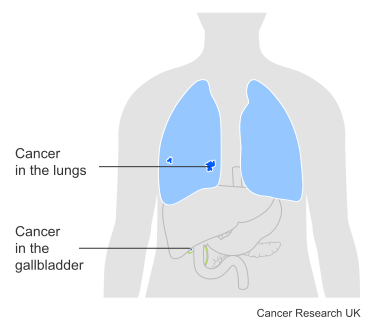
M1 - means the cancer has spread to parts of the body further away from the gallbladder such as the lungs. Your doctor might call this distant metastasis.
Sometimes doctors use another staging system called the number staging system. This has 4 main stages numbered 1 to 4. Some doctors describe carcinoma in situ as stage 0.
This means there are only cancer cells in the inner lining of the gallbladder. Because the cancer cells haven't grown or spread out of this lining, stage 0 isn't seen as an .
It is unusual for gallbladder cancer to be found this early because there are few or no symptoms at this stage. Sometimes it is found in people who have their gallbladder removed for gallstones.
Stage 0 is the same as Tis, N0, M0.
This is the earliest stage of invasive gallbladder cancer. It means the cancer has grown into the connective tissue under the inner lining, or into the muscle below. It has not grown or spread outside of the gallbladder.
Stage 1 is the same as T1, N0, M0.
Stage 2 is split into 2A and 2B.
This means the cancer on the peritoneum side of the gallbladder, has grown through the muscle layer and into the connective tissue below. It has not grown or spread outside of the gallbladder.
Stage 2A is the same as T2a, N0, M0.
This means the cancer on the liver side of the gallbladder, has grown through the muscle layer and into the connective tissue below. It has not grown or spread outside of the gallbladder.
Stage 2B is the same as T2b, N0, M0.
This is divided into 3A and 3B.
This means the cancer has grown through all the layers of the gallbladder, or into the liver or into one of the nearby organs. It may have grown in more than one of these ways.
There are no cancer cells in the nearby lymph nodes. And the cancer hasn't spread further away from the gallbladder.
Stage 3A is the same as T3, N0, M0.
This means the cancer is still within the gallbladder. Or it has grown in one or more of the following ways:
through all the layers of the gallbladder.
into the liver.
into one of the other nearby organs.
There are also cancer cells in 1 to 3 nearby lymph nodes. But the cancer hasn't spread further away in the body.
Stage 3B is the same as T1 to T3, N1, M0.
Stage 4 is divided into stage 4A and 4B. Unfortunately, stage 4 means the cancer is .
This means the cancer has grown into either:
one of the main blood vessels of the liver
2 or more organs near the liver
It may have also spread into 1 to 3 nearby lymph nodes. It has not spread further away in the body.
Stage 4A is the same as T4, N0 or N1, M0.
Stage 4B means the cancer has either:
grown into any layer of the gallbladder or into nearby blood vessels or organs. There are cancer cells in 4 or more nearby lymph nodes. It has not spread further away in the body. This is the same as any T stage, N2, M0
grown into any layer of the gallbladder or into any nearby blood vessels or organs. There may be cancer cells in the nearby lymph nodes. The cancer has spread further away in the body. This is the same as any T stage, any N stage, M1
The grade of a cancer is a way of describing how abnormal cancer cells look when compared to normal cells. It also gives an idea of how quickly a cancer may grow and whether it is likely to spread.
Doctors find out the grade of a cancer by looking at the cells under a microscope.
Low grade cancers are usually slower growing and less likely to spread. High grade cancers tend to be faster growing and more likely to spread.
There are 3 grades of gallbladder cancer – grade 1 to grade 3.
This means the cancer cells look similar to normal gallbladder cells. This is called low grade or well differentiated cancer.
This means the cancer cells look a bit abnormal when compared to normal gallbladder cells. This is called intermediate grade cancer or moderately differentiated cancer.
This means the cancer cells look very abnormal when compared to normal gallbladder cells. This is called high grade or poorly differentiated cancer.
Knowing the cancer stage helps your doctor recommend the best treatment. Which treatment they recommend also depends on factors including:
the type of cell the cancer started in
where in the gallbladder the cancer is
whether your surgeon can remove the cancer
any treatment you have already had
if there are any changes in the cancer cells
your general health and level of fitness
The stage of the cancer and these other factors can also give an idea of your outlook (prognosis).
Treatments for gallbladder cancer include:
surgery
Your doctor will talk with you about which treatment they recommend and why.
Last reviewed: 26 Oct 2026
Next review due: 26 Oct 2029
Gallbladder cancer is cancer that starts in part of the digestive system called the gallbladder. It is a rare cancer in the UK and more common in women than men.
The type of cancer tells you which type of cell it started in. There are several types of gallbladder cancer.
You usually start by seeing your GP. They might refer you for tests or to a specialist if you have symptoms that could be caused by gallbladder cancer.
The treatment you might have depends on the size and type of your gallbladder cancer and whether it has spread.
Advanced gallbladder cancer is cancer that has spread outside the gallbladder into lymph nodes or nearby organs. Or that has spread to another part of the body such as the lungs (secondary or metastatic gallbladder cancer).
Get practical and emotional support to help you cope with a diagnosis of gallbladder cancer, and life during and after treatment.



