Having surgery for stomach cancer
You might have endoscopic surgery to remove:
high grade dysplasia in the stomach
very early stage cancers that are small and within the inner layers of the stomach
Go to information about the staging of stomach cancer
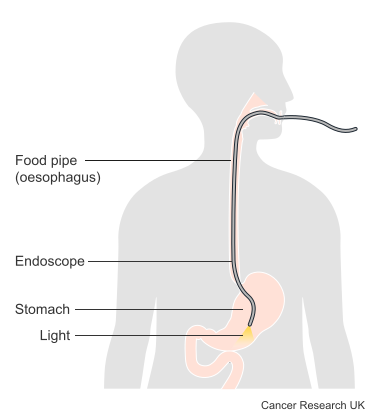
Your doctor uses a long flexible tube (endoscope) with a tiny camera and light on the end to look inside your stomach. They remove the abnormal area by passing special instruments through the tube.
Your doctor will use one of the following to do this:
endoscopic submucosal dissection (ESD)
endoscopic mucosal resection (EMR)
These operations are very similar. Your doctor will tell you which one you are going to have.
You will have a blood test 2 days beforehand to check how well your blood clots.
Tell your doctor if you're having medicine that changes how your blood clots. This includes:
aspirin
clopidogrel
arthritis medicines
warfarin or heparin
apixaban or rivaroxaban
Your doctor will tell you if you need to stop taking any other medicines.
You can't eat for 6 to 8 hours before the surgery, but you might be able to drink sips of water up to 2 hours before your appointment. Your doctor or nurse gives you written instructions about this beforehand.
Talk to your doctor if not eating could be a problem for you. For example, if you have diabetes.
You have the surgery in the endoscopy unit in hospital. It is done by a specialist endoscopist. You will have had a gastroscopy as one of the tests to diagnose the cancer. The preparation for EMR and ESD is the same as for a gastroscopy.
Your doctor will explain what they are going to do and you sign a consent form. This is a good time to ask any questions you might have.
When you arrive, the nurse will ask you to go into a cubicle to change into a hospital gown.
You lie down on the couch and an anaesthetist puts a small tube (cannula) into a vein in your arm or hand. They then attach a drip that contains a . This will make you very sleepy. It takes a few minutes for this to work. You will have oxygen through a small plastic tube or sponge which sits just inside your nostril. A plastic clip on your finger will measure your heart rate and oxygen levels, and your nurse will check your blood pressure.
The doctor will also spray local anaesthetic in the back of your throat to make it easier to swallow the endoscope.
Some people need to have the operation under a general anaesthetic. So you will be unconscious. Your doctor will tell you if this applies to you.
Once you’re sleepy, your doctor passes the endoscope down your throat. Using the endoscope they inject fluid into the layer of cells below the cancer or abnormal area. The fluid lifts the abnormal area away from the deeper layers of the stomach wall.
Your doctor removes the abnormal area of tissue using a thin wire (snare). The tissue is sometimes removed in pieces.
Your doctor uses a small knife to remove the abnormal area of tissue, as well as a small amount of the normal tissue around it. The tissue is usually removed in one piece.
They collect the tissue and send it to the laboratory to look at under a microscope.
Both operations take between 30 minutes and 2 hours depending on how much of the lining they need to remove.
You need to rest for a while afterwards. You probably won’t remember having the operation.
Whether you can go home the same day or stay in hospital overnight will vary. If you go home on the same day, you need someone to take you home and stay with you for 24 hours.
You usually only drink liquids for the first day or so. Then you can move onto a soft diet and gradually build up to a normal diet again. Your nurse will give you specific information about what you can eat and drink.
You could have:
mild chest pain like heartburn
mild discomfort when you eat food
bloating and discomfort lasting a few hours
You can take paracetamol to control any pain you might have. Don’t take aspirin or non-steroidal painkillers such as ibuprofen.
Your doctors will make sure the benefits of having the surgery outweigh the possible risks. These include:
bleeding – contact the hospital if you start vomiting blood or if your poo is black
a sore throat that can last for up to 24 hours – contact the hospital if you have severe pain in your throat, chest or tummy (abdomen)
fluid going into your lungs from your mouth – this rarely happens as a nurse removes the fluid from your mouth during the operation
a reaction to the sedative making you breathless
a small tear (perforation) in the food pipe, stomach or small bowel - this is rare but can be serious
At your first follow up appointment, your doctor:
gives you the results of the surgery
examines you
asks how you are and if you've had any problems
This is also your opportunity to ask any questions. Write down any questions you have before your appointment to help you remember what to ask. Taking someone with you can also help you to remember what the doctor says.
How often you have follow up appointments depends on the results of your surgery. Ask your doctor how often you need to have these and what they will involve.
You usually have an endoscopy 3 months later to check that your stomach is healing.
Last reviewed: 13 Mar 2025
Next review due: 13 Mar 2028
The stage of a cancer tells you how big it is and how far it’s spread. It helps your doctor decide which treatment you need.
The type of stomach cancer you have depends on what type of cell it started in. The grade tells you how abnormal the cells look under a microscope. Adenocarcinoma is the most common type of stomach cancer.
Coping with cancer can be difficult. Help and support is available. There are things you can do, people to help and ways to cope with a diagnosis of stomach cancer.
Survival depends on many factors including the stage of your stomach cancer when you are diagnosed and how it has responded to treatment. The figures for stomach cancer survival can only be used as a general guide.
Your treatment depends on whereabouts your cancer is in the stomach. How big it is, whether it has spread anywhere else in your body and your general health.
A gastroscopy is a test that looks at the inside of your food pipe (oesophagus), stomach and the first part of your small intestine (small bowel).

About Cancer generously supported by Dangoor Education since 2010. Learn more about Dangoor Education


Search our clinical trials database for all cancer trials and studies recruiting in the UK.

Connect with other people affected by cancer and share your experiences.

Questions about cancer? Call freephone 0808 800 40 40 from 9 to 5 - Monday to Friday. Alternatively, you can email us.
