How does cancer start, grow and spread?
usually grow quite slowly
don't spread to other parts of the body
usually have a covering made up of normal cells
Benign tumours are made up of cells that are quite similar to normal cells. They only cause a problem if they:
grow very large
become uncomfortable or painful
are visible and unpleasant to look at
press on other body organs
take up space inside the skull (such as a brain tumour)
release hormones that affect how the body works
Malignant tumours are made up of cancer cells. They:
usually grow faster than benign tumours
spread into surrounding tissues and cause damage
may spread to other parts of the body in the bloodstream or through the lymph system. They can then form secondary tumours. This is called metastasis
To start with, cancer cells stay inside the body tissue from which they have developed. For example, the lining of the bladder or the breast ducts. Doctors call this superficial cancer growth or .
The cancer cells grow and divide to create more cells and will eventually form a tumour. A tumour may contain millions of cancer cells.
All body tissues have a layer (a membrane) that keeps the cells of that tissue inside. This is the basement membrane. Cancer cells can break through this membrane. The cancer is called invasive cancer if it breaks through this membrane.
As the tumour gets bigger, its centre gets further and further away from the blood vessels in the area where it is growing. So the centre of the tumour gets less and less oxygen and nutrients.
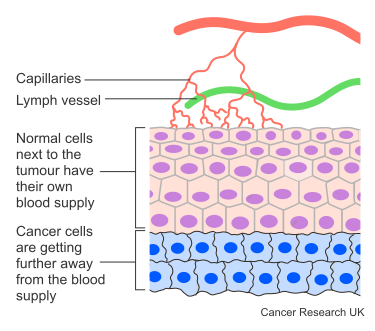
Like healthy cells, cancer cells can't live without oxygen and nutrients. So they send out signals called angiogenic factors. These encourage new blood vessels to grow into the tumour. This is called angiogenesis. Without a blood supply, a tumour can't grow much bigger than a pin head.
Once a cancer can stimulate blood vessel growth, it can grow bigger. It stimulates hundreds of new small blood vessels (capillaries):
to grow
to bring in nutrients and oxygen
This 1 minute video explains how cancer gets a blood supply.
There is a lot of research looking at angiogenesis. We know from research so far that the amount of angiogenic factors is very high at the outer edges of a cancer.
Some cancer drugs can stop cancers from growing their own blood vessels. These drugs are called anti angiogenic drugs.
They can't get rid of a cancer but might be able to shrink it or stop it growing. More of these drugs are being developed and tested all the time.
Read about drugs that block blood vessel growth
As a tumour gets bigger, it takes up more space in the body. The cancer can:
press on surrounding structures
grow into body structures nearby
This is called local invasion. Researchers don't fully understand how cancer grows into the surrounding tissues
A cancer might grow out in a random direction from where it started. We know from research that tumours can spread into some tissues more easily than others. For example, large blood vessels that have strong walls and dense tissues such as cartilage are hard for tumours to grow into. So, tumours tend to grow along the 'path of least resistance'. This means that they probably take the easiest route.
We know from research that there are 3 different ways that tumours may grow into surrounding tissues. A tumour probably uses all 3 of these ways of spreading. The way it uses most depends on:
the type of tumour
where the cancer is growing in the body
The 3 ways that tumours may grow into surrounding tissues are:
pressure from the growing tumour
using
cancer cells moving through the tissue
As the tumour grows and takes up more space, it begins to press on the normal body tissue nearby. The tumour growth will force itself through the normal tissue, as in the diagram below.
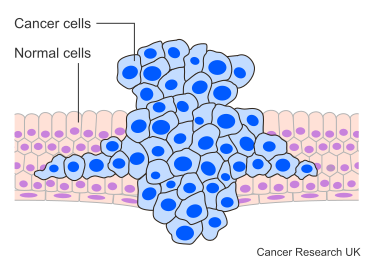
The growth has a finger like appearance. This happens because it is easier for the cancer to force its way through some paths than others. For example, cancers may grow between sheets of muscle tissue rather than straight through the muscle.
As the cancer grows, it squeezes and blocks small blood vessels in the area. Low blood and oxygen levels cause some of the normal tissue to die off. This makes it easier for the cancer to continue to push its way through.
Some normal cells produce chemicals called enzymes. These break down cells and tissues. The cells use the enzymes to:
attack invading bacteria and viruses
break down and clear up damaged areas in the body
This is all part of the natural healing process.
Many cancers contain:
larger amounts of these enzymes
a lot of normal white blood cells, which produce the enzymes
They are part of the body's immune response to the cancer. Researchers are not yet sure where the enzymes come from. But they think the enzymes make it easier for the cancer to spread through the healthy tissue.
As the cancer pushes through and breaks down normal tissues it might cause bleeding. This is because there is damage to nearby blood vessels.
One of the ways that cancer cells are different to normal cells is that it is easier for cancer cells to move about. So one of the ways that cancers spread into nearby tissues is by the cells directly moving.
Scientists have discovered a substance made by cancer cells which stimulates them to move. They don't know for sure yet, but it seems that this substance might be involved in the local spread of cancers.
This is interesting research. If a substance can help cancer cells move, it means that researchers can look for ways to stop the substance working. They may also be able to find ways to stop the cancer cells making the substance in the first place.
Researchers are also trying to understand how cancer cells change shape as they move and spread to other parts of the body.
Find out more about how cancer may spread to other parts of the body
Last reviewed: 09 Oct 2023
Next review due: 09 Oct 2026
DNA stands for deoxyribonucleic acid. It is like a code containing all the instructions that tell a cell what to do. It is made up of genes. Your genes carry all the information that makes you, you.
Body tissues grow by increasing the number of cells. Cells in many tissues in the body divide and grow very quickly until we become adults.
Unlike normal cells, cancer cells don't stop growing and dividing when there are enough of them. So the cells keep doubling, forming a lump (tumour) that grows in size.

About Cancer generously supported by Dangoor Education since 2010. Learn more about Dangoor Education


Search our clinical trials database for all cancer trials and studies recruiting in the UK.

Connect with other people affected by cancer and share your experiences.

Questions about cancer? Call freephone 0808 800 40 40 from 9 to 5 - Monday to Friday. Alternatively, you can email us.
