Cancer Research UK on Google+ Cancer Research UK on Facebook Cancer Research UK on Twitter


Being inactive can increase your risk of cancer

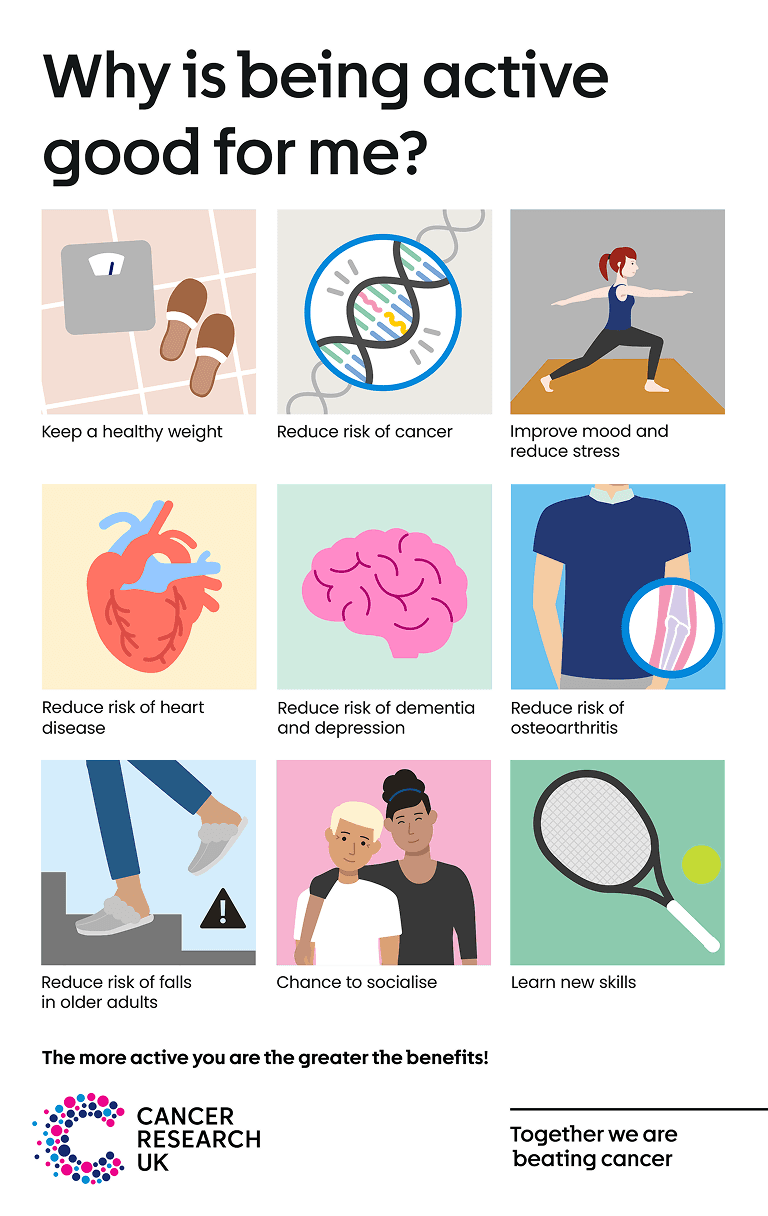
Scientists have shown that low levels of physical activity can increase the risk of certain cancers 1. And in the UK more than 3,000 cancers every year are linked to being inactive. 2

A 2011 study showed that 3 - 4% of all bowel, breast and womb cancers in the UK are linked to physical inactivity. 2

Inactive lifestyles can lead to many other health problems. These include diabetes, osteoporosis, stroke and heart disease. One study estimated that diseases caused by inactivity kill 2 million people every year worldwide 3.


High levels of physical activity reduce the risk of some cancers

While inactivity can increase cancer risk, regular physical activity protects against some cancers. 4 Regular exercise also helps to keep body weight at a healthy level, and being overweight or obese can greatly increase the risk of cancer. But the exercise itself also has a protective effect, which is independent of its effects on bodyweight.

People with the lowest cancer risks are those who have healthy body weights and who engage in the most physical activity (all other risk factors being equal) 5, 6.

One study of 40,000 men found that daily physical activity can reduce the chances of getting cancer or dying from it. 7 The study showed that:

  • people who walked or cycled for an hour a day were 16% less likely to develop cancer.
  • people who walked or cycled for just half an hour a day were 34% less likely to die of cancer, and 33% more likely to beat the disease.
 

Physical activity reduces the risk of bowel cancer

Over 50 scientific studies around the world have shown that physical activity can reduce the risk of bowel cancer. The largest of these studies agree that people who are physically active can reduce their risk of bowel cancer by a quarter. 8, 9 And the EPIC study found that people can more than halve their risk of bowel cancer if they keep a healthy body weight too. 8 Scientists have also found that people who are involved in active jobs are less likely to develop bowel cancer 10, 11.


Physical activity could protect against bowel cancer in many ways

Experiments have shown that physical activity can reduce the risk of bowel cancer in many different ways:

  • Physical activity leads to regular bowel movements. So cancer-causing substances in undigested food pass through the bowel more quickly 12.
  • Physical activity reduces the levels of insulin, some hormones and some growth factors. At high levels, these substances can encourage the growth of tumours 12.
  • Physical activity can reduce inflammation in the bowel, which might otherwise lead to bowel cancer 13.
 

Physical activity reduces the risk of breast cancer

The majority of studies on physical activity and breast cancer have found that being active reduces breast cancer risk by 20-40%. 14 One review calculated that every additional hour of physical activity per week reduced the risk of breast cancer by 6%. 15

Women experience even greater benefits if they also have a healthy bodyweight, those who do the most intense activity, or those who keep active throughout their lives. 14

Physical activity protects against breast cancer in women both before and after their menopause. But scientists have seen the greatest risk reductions in women who are active early on in life before menopause 16, 17. The EPIC study also found that increasing physical activity, notably activity in and around the home such as housework, DIY or gardening, was associated with a reduced risk of breast cancer in post- and pre-menopausal women. 18

As with bowel cancer, physical activity probably reduces breast cancer risk by lowering levels of insulin, hormones and growth factors. There is some evidence that physical activity can alter oestrogen metabolism to produce weaker versions of this hormone 19.

Physical activity reduces the risk of womb cancer

A recent analysis of five prospective studies into physical activity and endometrial (womb) cancer risk concluded that physical activity was clearly associated with reduced risk of the disease, with active women having an approximately 30% lower risk than inactive women 20


Physical activity may also reduce the risk of other cancers

There is some evidence that physical activity could reduce the risk of prostate cancer. 21


30 minutes of moderate physical activity, five times a week, can reduce your cancer risk

Based on the current evidence, many health organisations have recommended people should do at least 30 minutes of moderate physical activity, five times a week, to reduce their risk of cancer 4, 22. And some organisations, such as the WHO, recommend at least 60 minutes a day. 23

30 minutes a day is a minimum recommended level. Studies have shown that you can reduce your breast and bowel cancer risk even more by exercising:

  • more frequently 24,
  • more intensely 14
  • for longer periods of time 24,
  • throughout your lifetime 14
 

It’s never too late to start keeping fit

An American study looked at over 10,000 men, some of whom had years of inactivity behind them. Those who took up moderate regular exercise managed to reduce their risks of diseases related to inactivity by about a quarter. This means that the negative effects of an inactive lifestyle can be reversed. 25

Rate this page:
Submit rating
Rate this page
Rate this page for no comments box
Please enter feedback to continue submitting
Send feedback
Question about cancer? Contact our information nurse team

Visit our A-Z topic pages


References

  1.  Stein, C.J. and G.A. Colditz, Modifiable risk factors for cancer. Br J Cancer, 2004. 90(2): p. 299-303. PubMed
  2.  Parkin, M., et al., The fraction of cancer attributable to lifestyle and environmental factors in the UK in 2010. BJC 2011. 105, Supp. 2, 6 December 2011.
  3.  Ezzati, M., et al., Selected major risk factors and global and regional burden of disease. Lancet, 2002. 360(9343): p. 1347-60. PubMed
  4.  IARC, Weight Control and Physical Activity. IARC Handbooks of Cancer Prevention, ed. H. Vainio and F. Bianchini. Vol. 6. 2002, Lyon: IARC.
  5.  Hou, L., et al., Commuting physical activity and risk of colon cancer in Shanghai, China. Am J Epidemiol, 2004. 160: p. 806-867. PubMed
  6.  Slattery, M., et al., Energy balance and colon cancer--beyond physical activity. . Cancer Res, 1997. 57: p. 75-80. PubMed
  7.  Orsini, N., C.S. Mantzoros, and A. Wolk, Association of physical activity with cancer incidence, mortality, and survival: a population-based study of men. Br J Cancer, 2008. 98(11): p. 1864-9. PubMed
  8.  Friedenreich, C., et al., Physical activity and risk of colon and rectal cancers: the European prospective investigation into cancer and nutrition. Cancer Epidemiol Biomarkers Prev, 2006. 15(12): p. 2398-407. PubMed
  9.  Howard, R.A., et al., Physical activity, sedentary behavior, and the risk of colon and rectal cancer in the NIH-AARP Diet and Health Study. Cancer Causes Control, 2008. PubMed
  10.  Levi, F., et al., Occupational and leisure-time physical activity and the risk of colorectal cancer. Eur J Cancer Prev, 1999. 8: p. 487-493. PubMed
  11.  Tavani, A., et al., Physical activity and risk of cancers of the colon and rectum: an Italian case-control study. . Br J Cancer, 1999. 79: p. 1912-1916. PubMed
  12.  Potter, J., Risk factors for colon neoplasia: epidemiology and biology. . Eur J Cancer, 1995. 31A: p. 1033-1038. PubMed
  13.  Hauret, K., et al., Physical activity and reduced risk of incident sporadic colorectal adenomas: observational support for mechanisms involving energy balance and inflammation modulation. Am J Epidemiol, 2004. 159: p. 983-92. PubMed
  14.  Friedenreich, C.M. and A.E. Cust, Physical Activity and Breast Cancer Risk: Impact of Timing, Type and Dose of Activity and Population Sub-group Effects. Br J Sports Med, 2008. PubMed
  15.  Monninkhof, E.M., et al., Physical Activity and Breast Cancer: A Systematic Review. Epidemiology, 2006. PubMed
  16.  Bernstein, L., et al., Physical exercise and reduced risk of breast cancer in young women. J Natl Cancer Inst, 1994. 86: p. 1403-1408. PubMed
  17.  Slattery, M.L., et al., Physical Activity and Breast Cancer Risk Among Women in the Southwestern United States. Ann Epidemiol, 2007. 17(5): p. 342-353. PubMed
  18.  Lahmann, P.H., et al., Physical Activity and Breast Cancer Risk: The European Prospective Investigation into Cancer and Nutrition. Cancer Epidemiol Biomarkers Prev, 2006. PubMed
  19.  Bentz, A.T., C.M. Schneider, and K.C. Westerlind, The relationship between physical activity and 2-hydroxyestrone, 16alpha-hydroxyestrone, and the 2/16 ratio in premenopausal women (United States). Cancer Causes Control, 2005. 16(4): p. 455-61. PubMed
  20.  Moore, S.C, et al. Physical activity, sedentary behaviours, and the prevention of endometrial cancer. Br J Cancer 2010. 103 (7): 933-8. PubMed
  21.  British Association of Sport and Exercise Sciences (BASES). Physical activity in the prevention of chronic disease. . in Consensus meeting on physical activity in the prevention of chronic disease. . 2007. Brunel, London: BASES.
  22.  Boyle, P., et al., European Code Against Cancer and scientific justification: third version (2003). Ann Oncol, 2003. 14(7): p. 973-1005. PubMed
  23.  WHO, FAO/WHO consultation on the health implications of acrylamide in food: summary report. 2002, WHO: Geneva. p. 1-12. Link
  24.  Thune, I. and A.S. Furberg, Physical activity and cancer risk: dose-response and cancer, all sites and site-specific. Med Sci Sports Exerc, 2001. 33(6 Suppl): p. S530-50; discussion S609-10. PubMed
  25.  Paffenbarger, R.J., et al., The association of changes in physical-activity level and other lifestyle characteristics with mortality among men. N Engl J Med, 1993. 328: p. 538-545. PubMed