Diet and cancer: the evidence
This page contains information about the links between diet and cancer. Click on the links below to read about specific topics.
On this page
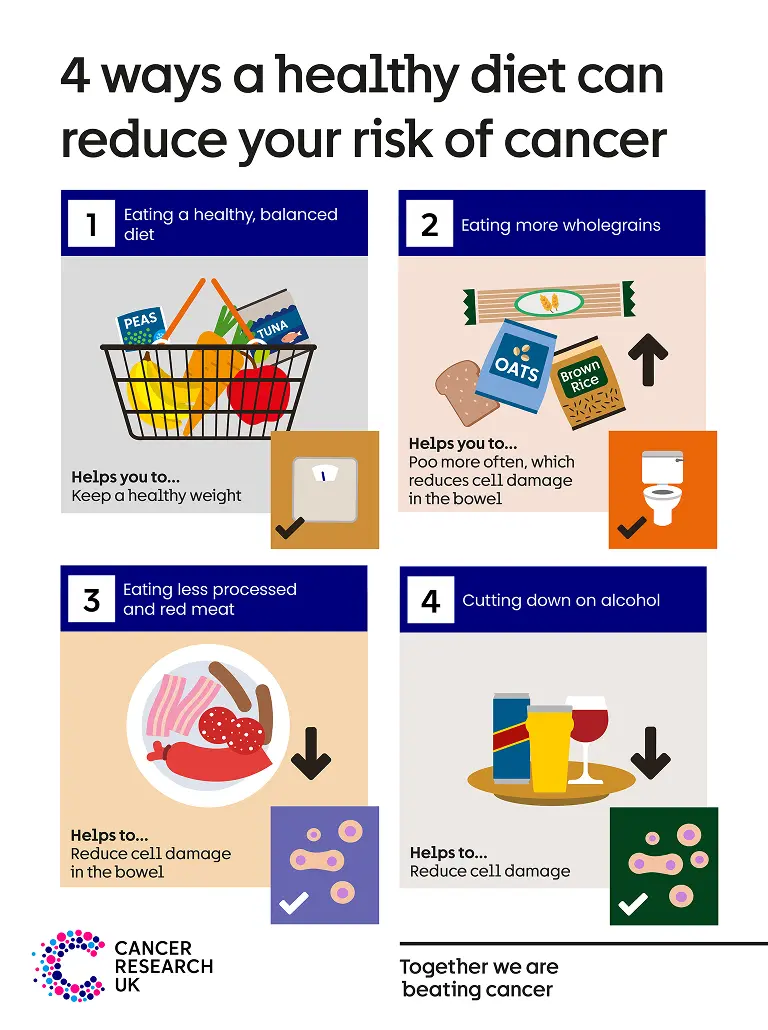
- An unhealthy diet can increase the risk of cancer
- Eating lots of fibre could reduce the risk of bowel cancer
- Fibre triggers the production of helpful chemicals, and increases the frequency of bowel movements
- Fruit and vegetables may reduce the risk of many cancers
- Fruit and vegetables are a good source of vitamins, minerals, and fibre.
- Fruit and vegetables have wide health benefits
- Eating lots of red or processed meat can increase the risk of cancer
- Red and processed meat contain chemicals that could cause bowel cancer
- Eating lots of salt can increase the risk of stomach cancer
- Eating lots of fish could reduce the risk of bowel cancer
- Eating lots of saturated fat may increase the risk of breast cancer
Scientists have estimated that unhealthy diets cause nearly one in ten cancer cases in the UK1.
Very few specific foods or drinks have been convincingly shown to increase or reduce the risk of cancer. 2 This is because a person’s diet consists of many different foods, nutrients and chemicals that affect their risk of cancer. It is very difficult to design studies that can accurately look at the effect of a single food item. This page will tell you about those aspects of our diet that are reasonably linked to cancer by the current scientific evidence.
Cancer Research UK currently funds the UK arm of a massive international study called EPIC, which is studying the links between diet and cancer. EPIC scientists recently found that eating foods high in fibre can reduce the risk of bowel cancer. 3 People who ate the most fibre had 25-40% lower risk of bowel cancer compared to people who ate the least. Some other large studies have supported these findings. 4,5,6,7
A recent study found more than one in ten bowel cancers linked to a low fibre diet.1
Not all studies agree. Some have found that fibre does not affect bowel cancer risk. 8,9,10 But these studies only investigated populations from single countries, and may have looked at ranges of fibre that were too low. For example, Americans eat very little fibre on average. So a large study that focused on Americans would not be able to see the benefits of the high levels of fibre that, for example, an Italian person would eat.
The EPIC study covers 10 European countries, with a wide range of fibre intake and can detect connections that other studies may have missed. 11
Fibre could protect against bowel cancer in a few different ways
Bacteria in the bowel interact with fibre to produce several chemicals including butyrate. 12 Butyrate changes the conditions in the bowel, so that tumours are less likely to develop. Lab experiments have shown that butyrate can also stop the growth of cancer cells and cause them to die off. 13
Fibre also increases the weight of the stools and the frequency of bowel movements. This reduces the contact time between the bowel and chemicals in the stools. 12
The EPIC study has found that eating lots of fruit and vegetables could reduce the risk of mouth, oesophageal and lung cancers, 14,15 as well as some types of stomach cancer. 16EPIC has also found that fruit and vegetables are unlikely to reduce the risk of breast, prostate, ovarian or kidney cancers. 17,18,19
Some studies have found that people who eat the most fruit and vegetables can lower their risk of cancer by about a quarter compared to those who eat the least.20,21,22Specifically, eating lots of fruit and vegetables could reduce the risk of mouth, oesophageal and laryngeal cancers by at least a third, 14,23 and the risk of lung cancer by at least a quarter. 24
A recent study suggested nearly one in 20 cancers may be linked to diets low in fruit and vegetables.1
Fruit and vegetables contain a wide range of nutrients. Researchers are still trying to work out which of these might reduce cancer risk. Studies are looking at specific nutrients such as vitamin E, 25 and folate. 26
But it may be that you need these nutrients in balanced combinations to reduce the risk of cancer effectively. 27 Differently coloured fruit and vegetables contain different nutrients so it is important to eat a wide range of colours. 28 One study found that people who eat the widest range of fruit and vegetables have 22% lower risk of mouth cancer than those who eat the narrowest range. 29
There is strong evidence that the nutrients in fruit and vegetables do not reduce the risk of cancer when they are taken as supplements. High doses of supplements could even have harmful effects. 30
Fruit and vegetables are also a very good source of natural fibre 3, and there is strong evidence that high levels of fibre reduce risk of bowel cancer.
People were first recommended to eat five portions of fruit and vegetables a day in 1991 based on the scientific evidence at the time. Since then, many expert reports on diet and cancer prevention have supported the 5-a-day message 20,,31,32,33,34.
Eating five daily portions of fruit and vegetables can help you maintain a healthy body weight. 20 Doing this can help you reduce the risk of bowel, breast, kidney, womb and oesophageal cancers. And getting enough fruit and vegetables can also reduce the risk of many other diseases including heart disease and diabetes. 20,35 The EPIC study found that people who ate the most fruit and vegetables reduced their risk of dying from chronic diseases like heart diseases, cancer and diabetes by a quarter. 36
Many studies have shown that eating lots of red or processed meat increases the risk of bowel cancer. 37,38,39,40Red meat includes all fresh, minced and frozen beef, pork and lamb. Processed meat includes ham, bacon, salami and sausages. The EPIC study found that people who ate two daily 80g portions of these meats increased their bowel cancer risk by a third, compared to those who ate just 20g a day.39Processed meat increased bowel cancer risk more than red meat. Studies that review all the available scientific evidence agree with these results. 38,41
There is growing evidence that links red meat to pancreatic cancer, 42,43 and stomach cancer. 44 The EPIC study found that eating lots of meat, particularly red and processed meat could also increase the risk of stomach cancer. People eating over 100g of meat a day had over 3 times the risk of getting stomach cancer. 45 Another very large study found that people who eat the most red or processed meat have 40-50% higher risk of pancreatic cancer. 46
A recent study found that one in five bowel cancers were linked to red and processed meat. 1
There is no strong evidence that eating white meat, such as chicken, can increase cancer risk. 39
Red and processed meat contains a red pigment called haem. Haem could stimulate the bacteria in our guts to produce chemicals called N-nitroso compounds, or NOCs. 47 Many of these are known to cause cancer. Almost all red and processed meats contain more haem than white meats. This may explain why red and processed meats increase bowel cancer risk while white meats do not. 48
Haem could also irritate or damage the cells in the bowel. The cells divide much more than normal to compensate for this damage. This increases the chance that one of these cells could acquire changes that set it down the road to cancer. 47 There is some evidence that the effects of haem could be countered by chlorophyll, found in green vegetables. 49,50
The way meat is cooked can also affect the risk of cancer. Cooking meat at high temperatures, such as frying or barbecuing, produces chemicals called heterocyclic amines.51 These can damage DNA and increase the risk of cancer. 52,53
Some processed meat contains chemicals called nitrites. In the bowel, nitrites are converted into NOCs, which could cause cancer. 49 One group of scientists analysed over 60 studies and found that nitrites, and foods rich in them, are linked to higher risks of stomach cancer. 54
There is some evidence that eating too much salty food, or food that has been preserved with salt, could increase the risk of stomach cancer. Stomach cancer is especially common in countries like Japan where people tend to eat lots of salty and salt-preserved foods. 55 In the UK it's thought that nearly a quarter of stomach cancers are linked to eating too much salt. 1
Salt could affect the risk of stomach cancer by damaging the lining of the stomach and causing inflammation. Salt could also interact with a stomach bug called Helicobacter pylori that cause both stomach ulcers and stomach cancer. 55
The EPIC study recently reported that people who an 80g portion of fish a day reduced their bowel cancer risk by a third compared to people who ate less than that in a week. Some other studies have shown similar results, 56 but the evidence is still inconsistent.
It is not clear how eating fish could reduce the risk of cancer. Fish oils are especially rich in polyunsaturated omega-3 fatty acids (O3FAs), but there is no strong evidence that these can reduce the risk of cancer. 57
The link between fat and breast cancer is very controversial. Scientists have disagreed over whether the amount of fat you eat affects your risk of breast cancer.
One of the problems lies in the way fat is measured. Some studies use questionnaires to calculate the fat content in the food people eat. But these are not very accurate. Other studies ask people to fill in food diaries, which give a more precise record of what people eat.
Two of the largest studies so far, including EPIC, have used these diaries to show that women who eat the most saturated fat have higher risk of breast cancer. 58,59 Fat in our diets probably affects the risk of breast cancer by increasing the levels of oestrogen and other hormones in our blood. 60
Visit our A-Z topic pages
- Parkin, M., et al., The fraction of cancer attributable to lifestyle and environmental factors in the UK in 2010. BJC 2011. 105, Supp. 2, 6 December 2011.
- World Cancer Research Fund/American Institute for Cancer Research, Food, nutrition, physical activity and the prevention of cancer: a global perspective. . 2007, Washington DC: AICR.
- Bingham, S.A., et al., Dietary fibre in food and protection against colorectal cancer in the European Prospective Investigation into Cancer and Nutrition (EPIC): an observational study. Lancet, 2003. 361(9368): p. 1496-501. PubMed
- Peters, U., et al., Dietary fibre and colorectal adenoma in a colorectal cancer early detection programme. Lancet, 2003. 361(9368): p. 1491-5. PubMed
- Jacobs, D.J., et al., Whole-grain intake and cancer: an expanded review and meta-analysis. Nutr Cancer, 1998. 30: p. 85-96. PubMed
- Nomura, A.M., et al., Dietary fiber and colorectal cancer risk: the multiethnic cohort study. Cancer Causes Control, 2007. PubMed
- Wakai, K., et al., Dietary fiber and risk of colorectal cancer in the Japan collaborative cohort study. Cancer Epidemiol Biomarkers Prev, 2007. 16(4): p. 668-75. PubMed
- Fuchs, C.S., et al., Dietary fiber and the risk of colorectal cancer and adenoma in women. N Engl J Med, 1999. 340(3): p. 169-76. PubMed
- Pietinen, P., et al., Diet and risk of colorectal cancer in a cohort of Finnish men. Cancer Causes Control, 1999. 10(5): p. 387-96. PubMed
- Terry, P., et al., Fruit, vegetables, dietary fiber, and risk of colorectal cancer. J Natl Cancer Inst, 2001. 93(7): p. 525-33. PubMed
- Bingham, S. and E. Riboli, Diet and cancer--the European Prospective Investigation into Cancer and Nutrition. Nat Rev Cancer, 2004. 4(3): p. 206-15. PubMed
- Bingham, S., Mechanisms and experimental evidence relating dietary fibre and starch to protection aganist large bowel cancer. . Proc Nutr Soc, 1990. 49: p. 153-171. PubMed
- Boffa, L., et al., Modulation of colonic epithelial cell proliferation, histone acetylation, and luminal short chain fatty acids by variation of dietary fiber (wheat bran) in rats,. Cancer Res, 1992(5906-5912). PubMed
- Boeing, H., et al., Intake of fruits and vegetables and risk of cancer of the upper aero-digestive tract: the prospective EPIC-study. Cancer Causes Control, 2006. 17(7): p. 957-69. PubMed
- Miller, A.B., et al., Fruits and vegetables and lung cancer: Findings from the European prospective investigation into cancer and nutrition. Int J Cancer, 2004. 108(2): p. 269-276. PubMed
- Gonzalez, C.A., et al., Fruit and vegetable intake and the risk of stomach and oesophagus adenocarcinoma in the European Prospective Investigation into Cancer and Nutrition (EPIC-EURGAST). Int J Cancer, 2006. 118(10): p. 2559-66. PubMed
- van Gils, C., et al., Consumption of vegetables and fruits and risk of breast cancer. JAMA, 2005. 293: p. 183-93. PubMed
- Key, T.J., et al., Fruits and vegetables and prostate cancer: No association among 1,104 cases in a prospective study of 130,544 men in the European Prospective Investigation into Cancer and Nutrition (EPIC). Int J Cancer, 2004. 109(1): p. 119-24. PubMed
- Schulz, M., et al., Fruit and vegetable consumption and risk of epithelial ovarian cancer: the European Prospective Investigation into Cancer and Nutrition. Cancer Epidemiol Biomarkers Prev, 2005. 14(11 Pt 1): p. 2531-5. PubMed
- IARC, Fruits and Vegetables. IARC Handbooks of Cancer Prevention, ed. H. Vainio and F. Bianchini. Vol. 8. 2003, Lyon: IARC.
- Van't Veer, P., et al., Fruits and vegetables in the prevention of cancer and cardiovascular disease. . Pub Health Nutr, 2000. 3: p. 103-107. PubMed
- Benetou, V., et al., Vegetables and fruits in relation to cancer risk: evidence from the Greek EPIC cohort study. Cancer Epidemiol Biomarkers Prev, 2008. 17(2): p. 387-92. PubMed
- Freedman, N.D., et al., Fruit and vegetable intake and head and neck cancer risk in a large United States prospective cohort study. Int J Cancer, 2008. 122(10): p. 2330-6. PubMed
- Smith-Warner, S., et al., Fruits, vegetables and lung cancer: a pooled analysis of cohort studies. Int J Cancer, 2003. 107: p. 1001-11. PubMed
- Albanes, D., et al., Effects of alpha-tocopherol and beta-carotene supplements on cancer incidence in the Alpha-Tocopherol Beta-Carotene Cancer Prevention Study. Am J Clin Nutr, 1995. 62: p. 1427S-1430S. PubMed
- Sanjoaquin, M., et al., Folate intake and colorectal cancer risk: A meta-analytical approach. Int J Cancer, 2004. Epub ahead of print. PubMed
- Ohigashi, H., A. Murakami, and Cancer prevention with food factors: Alone and in combination. Biofactors, 2004. 22: p. 49-55. PubMed
- IARC, World Cancer Report, ed. B. Stewart and P. Kleihues. 2003, Lyon IARCPress.
- Garavello, W., et al., Diet diversity and the risk of oral and pharyngeal cancer. Eur J Nutr, 2008. PubMed
- Hercberg, S., S. Czernichow, and P. Galan, Antioxidant vitamins and minerals in prevention of cancers: lessons from the SU.VI.MAX study. Br J Nutr, 2006. 96 Suppl 1: p. S28-30. PubMed
- ACS, Advisory Committee on Diet, Nutrition and Cancer Prevention Guidelines on diet, nutrition, and cancer prevention: reducing the risk of cancer with healthy food choices and physical activity. CA Cancer J Clin, 1996. 46: p. 325-341. PubMed
- NCI, '5 a day' for better health. , NCI: Bethseda. Link
- WCRF and AICR, Food, nutrition and the prevention of cancer: a global perspective. 1997, American Institute for Cancer Research: Washington. p. 37-145. Link
- WHO, FAO/WHO consultation on the health implications of acrylamide in food: summary report. 2002, WHO: Geneva. p. 1-12. Link
- Genkinger, J., et al., Fruit, Vegetable, and Antioxidant Intake and All-Cause, Cancer, and Cardiovascular Disease Mortality in a Community-dwelling Population in Washington County, Maryland. . Am J Epidemiol, 2004. 160: p. 1223-1233. PubMed
- Agudo, A., et al., Fruit and vegetable intakes, dietary antioxidant nutrients, and total mortality in Spanish adults: findings from the Spanish cohort of the European Prospective Investigation into Cancer and Nutrition (EPIC-Spain). Am J Clin Nutr, 2007. 85(6): p. 1634-42. PubMed
- WHO/FAO, Joint WHO/FAO Expert Consultation on Diet, Nutrition and the Prevention of Chronic Diseases, in WHO Technical Report Series. 2003, WHO: Geneva. p. 95-104. Link
- Sandhu, M., I. White, and K. McPherson, Systematic review of the prospective cohort studies on meat consumption and colorectal cancer risk: a meta-analytical approach. Cancer Epidemiol Biomarkers Prev, 2001. 10: p. 439-446. PubMed
- Norat, T., et al., Meat, fish, and colorectal cancer risk: the European Prospective Investigation into cancer and nutrition. J Natl Cancer Inst, 2005. 97(12): p. 906-16. PubMed
- Larsson, S.C. and A. Wolk, Meat consumption and risk of colorectal cancer: A meta-analysis of prospective studies. Int J Cancer, 2006. PubMed
- Norat, T., et al., Meat consumption and colorectal cancer risk: dose-response meta-analysis of epidemiological studies. Int J Cancer, 2002. 98: p. 241-56. PubMed
- Larsson, S.C., et al., Meat, fish, poultry and egg consumption in relation to risk of pancreatic cancer: A prospective study. Int J Cancer, 2005. PubMed
- Larsson, S.C., N. Orsini, and A. Wolk, Processed meat consumption and stomach cancer risk: a meta-analysis. J Natl Cancer Inst, 2006. 98(15): p. 1078-87. PubMed
- Larsson, S.C., L. Bergkvist, and A. Wolk, Processed meat consumption, dietary nitrosamines and stomach cancer risk in a cohort of Swedish women. Int J Cancer, 2006. PubMed
- Gonzalez, C.A., et al., Meat intake and risk of stomach and esophageal adenocarcinoma within the European Prospective Investigation Into Cancer and Nutrition (EPIC). J Natl Cancer Inst, 2006. 98(5): p. 345-54. PubMed
- Stolzenberg-Solomon, R.Z., et al., Meat and meat-mutagen intake and pancreatic cancer risk in the NIH-AARP cohort. Cancer Epidemiol Biomarkers Prev, 2007. 16(12): p. 2664-75. PubMed
- Cross, A.J., J.R. Pollock, and S.A. Bingham, Haem, not protein or inorganic iron, is responsible for endogenous intestinal N-nitrosation arising from red meat. Cancer Res, 2003. 63(10): p. 2358-60. PubMed
- Navarro, A., et al., Meat cooking habits and risk of colorectal cancer in Cordoba, Argentina. Nutrition, 2004. 20: p. 873-877. PubMed
- Bingham, S., et al., Does increased endogenous formation of N-nitroso compounds in the human colon explain the association between red meat and colon cancer? Carcinogenesis, 1996. 17: p. 515-523. PubMed
- Balder, H.F., et al., Heme and chlorophyll intake and risk of colorectal cancer in the Netherlands cohort study. Cancer Epidemiol Biomarkers Prev, 2006. 15(4): p. 717-25. PubMed
- Layton, D., et al., Cancer risk of heterocyclic amines in cooked foods: an analysis and implications for research. Carcinogenesis, 1995. 16: p. 39-52. PubMed
- Gooderham, N., et al., Assessing human risk to heterocyclic amines. Mutat Res, 1997. 376: p. 53-60. PubMed
- Sinha, R., et al., Meat, meat cooking methods and preservation, and risk for colorectal adenoma. Cancer Res, 2005. 65(17): p. 8034-41. PubMed
- Jakszyn, P. and C.A. Gonzalez, Nitrosamine and related food intake and gastric and oesophageal cancer risk: A systematic review of the epidemiological evidence. World J Gastroenterol, 2006. 12(27): p. 4296-4303. PubMed
- Shikata, K., et al., A prospective study of dietary salt intake and gastric cancer incidence in a defined Japanese population: the Hisayama study. Int J Cancer, 2006. 119(1): p. 196-201. PubMed
- Hall, M.N., et al., A 22-year Prospective Study of Fish, n-3 Fatty Acid Intake, and Colorectal Cancer Risk in Men. Cancer Epidemiol Biomarkers Prev, 2008. 17(5): p. 1136-43. PubMed
- MacLean, C.H., et al., Effects of omega-3 fatty acids on cancer risk: a systematic review. Jama, 2006. 295(4): p. 403-15. PubMed
- Bingham, S.A., et al., Are imprecise methods obscuring a relation between fat and breast cancer? Lancet, 2003. 362(9379): p. 212-4. PubMed
- Thiebaut, A.C., et al., Dietary fat and postmenopausal invasive breast cancer in the National Institutes of Health-AARP Diet and Health Study cohort. J Natl Cancer Inst, 2007. 99(6): p. 451-62. PubMed
- Wu, A.H., M.C. Pike, and D.O. Stram, Meta-analysis: dietary fat intake, serum estrogen levels, and the risk of breast cancer. J Natl Cancer Inst, 1999. 91(6): p. 529-34. PubMed


Read article