Stages, types and grades of vulval cancer
Your team looks at the results of your tests and scans to find out about the stage and grade of the cancer.
Read about the tests for vulval cancer
There are different ways of staging vulval cancer. In the UK, doctors usually use the FIGO system. FIGO stands for International Federation of Gynaecology and Obstetrics. There are 4 main stages – from 1 to 4.
Your doctor may also tell you the TNM stage. Or you may see it on your pathology report. TNM stands for Tumour, Node, Metastasis:
T describes the size of the cancer
N describes whether there are any cancer cells in the lymph nodes
M describes whether the cancer has spread to a different part of the body
Below, we describe the FIGO staging system.
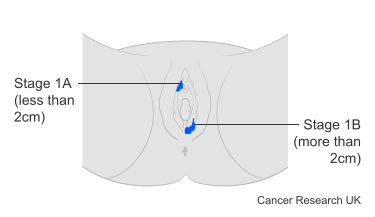
Stage 1 means that the cancer is only in the vulva. There is no sign of cancer in the .
Stage 1 is divided into stages 1A and 1B.
Stage 1A means that the cancer:
is 2 cm or less in size
has only grown 1 mm or less into the skin and tissues underneath
Stage 1B cancer means one of the following:
the cancer is more than 2 cm across
has grown more than 1 mm into the skin and tissues underneath
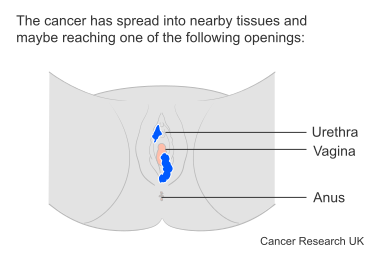
Stage 2 vulval cancer means the cancer has spread to nearby tissues such as:
the lower part of the vagina
the lower part of the tube that carries urine from the bladder to the outside of the body. This is the urethra
the lower part of the opening to the back passage. This is the anus.
There is no sign of cancer in the lymph nodes.
In stage 3, the cancer can be any size and it has spread into nearby tissues and lymph nodes. It is divided into stages 3A, 3B and 3C.
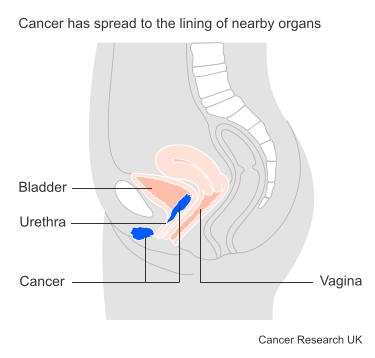
Stage 3A means that the cancer has spread to:
the upper part of the urethra
the upper part of the vagina
the lining of the bladder (bladder mucosal)
the lining of the back passage (rectal mucosal)
Or stage 3A means that the cancer has spread to lymph nodes and these are smaller than 5mm in size.
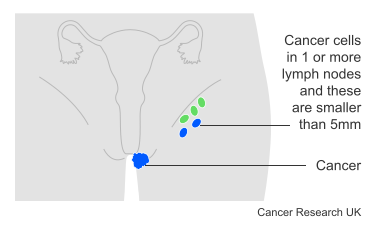
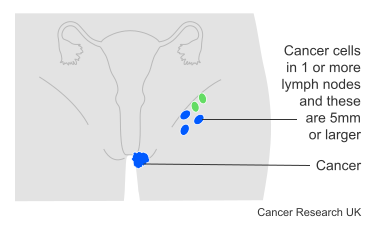
Stage 3B means that the cancer has spread to 1 or more lymph nodes and these are 5mm or larger in size.
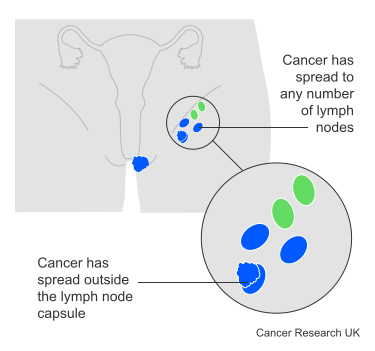
Stage 3C means the cancer has spread to the lymph nodes and it has spread outside the capsule that surrounds them.
Stage 4 vulval cancer is advanced cancer. It is also called metastatic vulval cancer. It is divided into stages 4A and 4B.
In stage 4A the cancer has spread to:
the pelvic bone
the nearby lymph nodes and the lymph node is either fixed, meaning it cannot move around, or it has formed an open sore called an ulcer
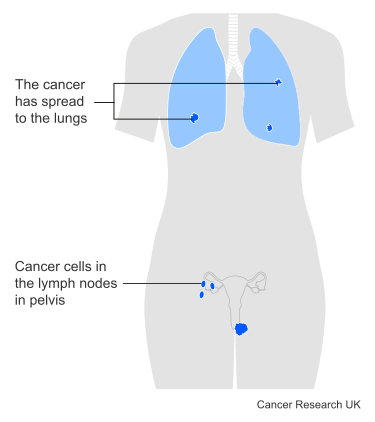
In stage 4B, the cancer has spread to other parts of your body further away from the vulva. For example, it has spread to the lungs.
The grade of a cancer is a way of measuring how abnormal cancer cells are compared to healthy cells. It gives an idea of how quickly a cancer may grow and whether it is likely to spread.
Low grade cancers are usually slower growing and less likely to spread. High grade cancers tend to be faster growing and more likely to spread.
There are 3 grades of vulval cancer – from grade 1 to grade 3:
The cells look very like normal cells. They are also called low grade or well differentiated. They tend to be slow growing and are less likely to spread than higher grade cancer cells.
The cells look more abnormal and are more likely to spread. This grade is also called moderately differentiated or moderate grade.
The cells look very abnormal and not like normal cells. They tend to grow quickly and are more likely to spread. They are called poorly differentiated or high grade.
Your doctor looks at the stage and grade of the cancer and suggests the best treatment for you. They also consider other things when recommending treatment:
the type of cell the cancer started in
your age and general health
how you feel about the treatments and their side effects
Treatments you might have include surgery, radiotherapy and chemotherapy.
Last reviewed: 02 Sept 2025
Next review due: 02 Sept 2028
Your treatment depends on a number of factors. Surgery is the most common treatment for vulval cancer. Chemotherapy with radiotherapy (chemoradiotherapy) is also a treatment.
There are a number of different types of vulval cancer. The most common type is squamous cell carcinoma.
Vulval melanoma is a rare type of cancer. It develops from the cells in the skin that produce pigment. These are called melanocytes. You usually have surgery as a treatment for vulval melanoma.
You have a number of tests to find out if you have vulval cancer. These include a vulval examination and a biopsy.
Survival for vulval cancer depends on several factors including the age at the time of diagnosis and the type of vulval cancer.
Vulval cancer is a rare cancer. It can start in any part of the female external sex organs, the vulva. The treatment you need depends on how big the cancer is and whether it has spread.

About Cancer generously supported by Dangoor Education since 2010. Learn more about Dangoor Education


Search our clinical trials database for all cancer trials and studies recruiting in the UK.

Connect with other people affected by cancer and share your experiences.

Questions about cancer? Call freephone 0808 800 40 40 from 9 to 5 - Monday to Friday. Alternatively, you can email us.
