Getting diagnosed
Mouth cancer can start in different parts of the mouth. This includes the lips and gums.
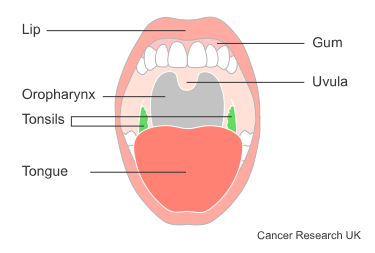
It can also start in the front part of the tongue. This is called tongue cancer. We have separate information about the tests you might have to check for tongue cancer.
Find out more about the tests you might have for tongue cancer
Oropharyngeal cancer starts in the oropharynx. The oropharynx is the part of the throat just behind the mouth. It also includes the tonsils. We have separate information about the tests you might have for tonsil cancer.
Find out about the tests for tonsil cancer
You have tests if you have symptoms that could be due to mouth or oropharyngeal cancer. These tests will find out what is causing them and whether it is cancer or not.
Most people with symptoms start by contacting their GP or dentist. The first appointment with your GP is often a telephone appointment. Your GP then might arrange for you to go in and see them.
Read about the symptoms of mouth and oropharyngeal cancer
Your GP or dentist can do some tests to help them decide if you need to see a specialist. This usually includes an examination of your mouth and neck. Your GP may also ask you to have some blood tests done.
Your doctor or GP looks inside your mouth and feels around your neck. They feel for any areas that might be swollen or not feel normal. If you have any pain, they will feel those areas as well.
Your GP may also listen to your chest and tummy (abdomen) to find out if they sound normal.
Blood tests can check your general health including:
how well your liver and kidneys are working
the number of blood cells in your blood such as , and . You may hear this being called a full blood count
if you have any signs of infection
Blood tests can't show whether you have mouth or oropharyngeal cancer. At the moment, there are no blood tests to diagnose mouth and oropharyngeal cancer.
Your GP or dentist might refer you to a specialist doctor at the hospital. It depends on the results of your tests. This is usually a head and neck doctor or ENT specialist. ENT stands for ear, nose and throat.
Your specialist doctor usually does more tests. These include:
a test to look at the inside of your nose, mouth and throat. This is a nasoendoscopy
taking a sample of tissue called a biopsy
checking your for cancer
testing oropharyngeal cancer for
CT scan
MRI scan
an x-ray of the mouth and jaw. This is an orthopantomogram (OPG)
PET-CT scan
a barium swallow
A nasoendoscopy is often the first test you have at the hospital. You have this in the outpatient clinic.
Your doctor passes a thin, flexible tube through your nose and into your throat. This is called a nasoendoscope. The tube has a camera and a light at the end. This can be uncomfortable but does not usually hurt. It only lasts a few minutes.
Read more about having a nasoendoscopy
To diagnose mouth and oropharyngeal cancer, your doctor needs to take a sample of tissue from the abnormal area. A specialist doctor called a looks at the tissue under a microscope to check for cancer cells.
There are different ways to take a biopsy of your mouth and oropharynx. These include:
an incisional biopsy
a panendoscopy
An incisional biopsy means cutting out a small piece of tissue from the abnormal area. You have this under . You are likely to have this if the abnormal area is easy to reach. This could be your:
lips
tongue
cheek
You usually have an incisional biopsy as an outpatient. The biopsy only takes a few minutes but you will be in the hospital for longer. This is so your nurse or doctor can check that you are well afterwards.
To have the biopsy, you usually lie on a couch. Your doctor then injects some local anaesthetic into the area to numb it. They then cut around the area using a scalpel. You may need to have a few stitches afterwards. These are often dissolvable and will disappear on their own.
You have a panendoscopy under general anaesthetic. This means that you are asleep and won’t feel anything.
You usually have a panendoscopy if the abnormal area is difficult to reach. This includes the:
back of your mouth
throat
Find out more about having a panendoscopy
Your specialist will test a biopsy of your cancer or a lymph node for HPV if you have oropharyngeal cancer.
You might have an ultrasound scan to check the lymph nodes in your neck. Ultrasound scans use high frequency sound waves to create a picture of a part of the body. The ultrasound scanner has a microphone that gives off sound waves. The sound waves bounce off the organs inside your body and are picked up by the microphone. The microphone links to a computer that turns the sound waves into a picture.
If your doctor sees any abnormal areas, you might have a fine needle aspiration (FNA) at the same time.
A fine needle aspiration is a way of taking a sample of cells from an abnormal lymph node or lump in your neck. Your doctor uses a fine needle and syringe to take the cells. A pathologist then looks at the cells under a microscope.
Your doctor numbs the area with a local anaesthetic before taking the sample of cells.
Read more about having a neck lymph node ultrasound and biopsy
A CT (or CAT) scan stands for computer (axial) tomography. It is a test that uses x-rays and a computer to create detailed pictures of the inside of your body. The computer puts them together to make a 3 dimensional (3D) image.
You usually have a CT scan of your:
head and neck
chest
abdomen
The CT scan can show where the cancer is and whether it has spread to other parts of your body.
Find out more about having a CT scan
MRI stands for magnetic resonance imaging. It uses magnetism and radio waves to take pictures of the inside of your body.
You might have an MRI scan of your head and neck if your doctor thinks the cancer has spread to the nearby lymph nodes. It can also help doctors to look at the oropharynx in detail.
Read more about having an MRI scan
An ultrasound scan is a procedure that uses high frequency sound waves to create a picture of a part of the inside of your body.
You might have an ultrasound as part of your tests or instead of an MRI or CT scan.
Read more about having an ultrasound scan
An OPG is a type of x-ray. An x-ray is a test that uses small amounts of radiation to take pictures of the inside of your body.
An OPG takes pictures of the area around the upper jawbone (maxilla) and lower jawbone (mandible). You might have an OPG to see if you need any dental work before treatment starts.
Find out more about having an x-ray
A PET-CT scan combines a CT scan and a PET scan. It gives detailed information about your cancer.
You usually have a PET-CT scan in the radiology department. It usually takes between 30 and 60 minutes. You might have a PET-CT scan if your doctor finds cancer cells in the lymph nodes in your neck, but they don’t know where the cancer started. The PET-CT scan can help to show a cancer that other scans have not been able to find.
Read more about having a PET-CT scan
A barium swallow is a test that looks at the food pipe (oesophagus) and stomach. This is not a very common test. You might have it if you are having difficulty swallowing food.
You have a barium swallow test in the radiology department. You stand next to the x-ray machine and drink the liquid barium. The then takes a number of x-rays while the barium passes down your throat and into your stomach.
The liquid barium passes through your . The liquid does not cause you any harm.
Find out more about having a barium x-ray
The tests you have help your doctor find out if you have mouth or oropharyngeal cancer and how far it has grown. This is the stage of the cancer.
Read about the stages of mouth and oropharyngeal cancer
This is important because doctors recommend your treatment according to the stage of the cancer.
Find out about the treatment options for mouth and oropharyngeal cancer
Coping with a diagnosis of mouth and oropharyngeal cancer can be difficult. There is help and support for you and your family.
Read about what you can do to cope with a diagnosis of mouth and oropharyngeal cancer
Last reviewed: 24 Jul 2024
Next review due: 24 Jul 2027
Mouth and oropharyngeal cancer develop when abnormal cells in the mouth and oropharynx divide and grow uncontrollably.
Symptoms of mouth and oropharyngeal cancer include a mouth ulcer that doesn't heal or a swelling or lump in the neck.
A nasoendoscopy is part of a normal ear, nose and throat examination. It is a procedure to look at the inside of your nose and throat.
A panendoscopy is a test to look inside your mouth, around your throat, and the back of your nose. You might have biopsies taken of any abnormal areas. You have this under general anaesthetic.
Your treatment depends on where in your mouth or oropharynx your cancer is, the type, how big it is, whether it has spread anywhere else in your body and your general health.
Mouth cancer can start in the lips, gums or soft sides of your mouth. The oropharynx is the part of the throat (pharynx) just behind the mouth. Cancer starting in the oropharynx is called oropharyngeal cancer.



